Description
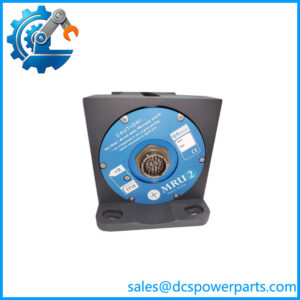
KONGSBERG MRU 5
Product Introduction
The KONGSBERG MRU 5 is a fifth-generation Motion Reference Unit designed for high-precision marine motion measurement. Rather than functioning as a general-purpose controller or I/O device, it measures vessel motion and supplies synchronized attitude and motion data to survey, positioning, stabilization, and motion-compensation systems. The unit combines three accelerometers with three Kongsberg Seatex MEMS MRG gyros to measure angular and linear motion. Its outputs include roll, pitch, yaw, angular-rate vectors, acceleration, and relative dynamic heave data.
For engineers integrating KONGSBERG MRU 5 into a vessel or offshore measurement system, the communication architecture is particularly important. The unit supports RS-232, RS-422, and Ethernet interfaces, with Ethernet UDP/IP communication at 10/100 Mbps and a maximum data output rate of 200 Hz. External speed and heading information can be supplied to improve motion calculations during turns and acceleration. The system also supports 1PPS timing input and configurable monitoring points for lever-arm compensation.
The KONGSBERG MRU 5 is commonly applied to multibeam echo sounder motion compensation, offshore crane applications, hydroacoustic positioning, and dynamic monitoring of offshore structures. Its PFreeHeave® processing provides delayed heave data for applications where long-period wave motion must be handled accurately, such as seabed mapping. The unit is supplied with Windows-based configuration and data-presentation software and is delivered with an individual calibration certificate.
Technical Specifications
| Parameter | Specification |
|---|---|
| Product Model | MRU 5 |
| Manufacturer | Kongsberg Discovery / Kongsberg Seatex |
| Product Type | Motion Reference Unit |
| Sensor Technology | MEMS gyros and accelerometers |
| Orientation Range | ±180° |
| Orientation Resolution | 0.0001° |
| Static Roll/Pitch Accuracy | 0.02° RMS |
| Dynamic Roll/Pitch Accuracy | 0.005° 1-sigma at ±5° amplitude |
| Gyro Angular Rate Range | ±75°/s |
| Acceleration Range | ±45 m/s² |
| Heave Output Range | ±50 m, adjustable |
| Ethernet | 10/100 Mbps UDP/IP |
| Ethernet Ports | 5 |
| Serial Interfaces | RS-232 / RS-422 |
| Maximum Data Rate | 200 Hz |
| Timing | <1 ms |
| Analog Channels | 4 × ±10 V, 14-bit via junction box |
| Supply Voltage | 10–36 VDC |
| Power Consumption | Maximum 8 W |
| Operating Temperature | -5 to +55°C |
| Storage Temperature | -25 to +70°C |
| Enclosure Rating | IP66 |
| Dimensions | Ø105 × 140 mm |
| Weight | 2.2 kg |
| Mounting | Marine installation; mounting orientation is not restricted |
| Compliance | IEC 60945 / EN 60945 EMC and vibration requirements |
Specifications above are based primarily on Kongsberg’s September 2025 MRU 5 datasheet.
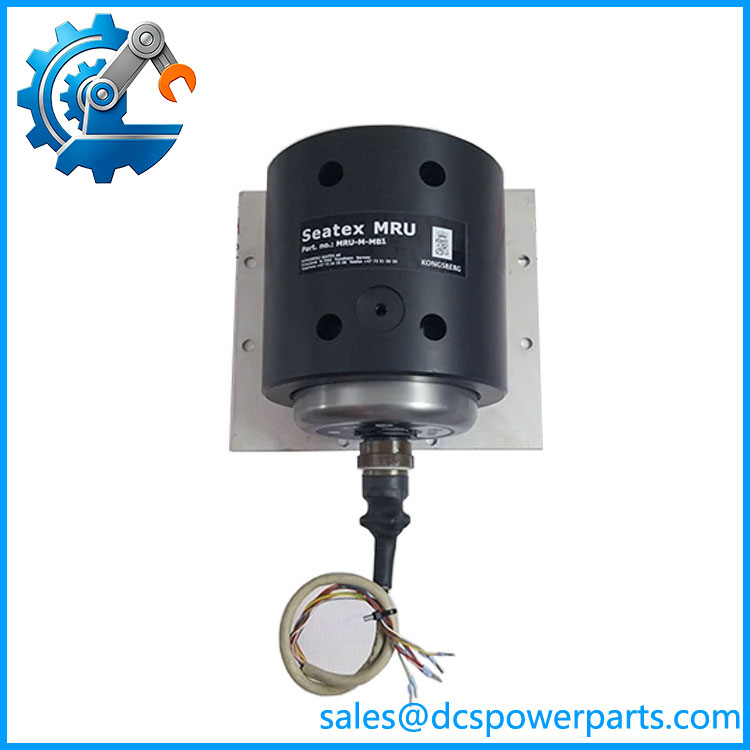
KONGSBERG MRU-5
Main Features and Engineering Considerations
High-Precision Motion Measurement
The MRU 5 is built around three MEMS gyros and three accelerometers. The current Kongsberg specification gives a static roll/pitch accuracy of 0.02° RMS and a dynamic roll/pitch accuracy of 0.005° 1-sigma for ±5° amplitude motion. These figures should not be interpreted as generic accuracy under every operating condition; the datasheet defines the test conditions for the published values.
Flexible Data Distribution
Five Ethernet output ports and configurable serial interfaces allow motion data to be distributed to multiple marine systems. Supported output formats include MRU Normal, NMEA 0183 proprietary, EM3000, Atlas Fansweep, TSS1, Seapath binary formats, PFreeHeave®, PRDID and KM binary. The interface protocol must be checked against the receiving equipment before commissioning.
Heave and Lever-Arm Compensation
A practical advantage of the MRU 5 is its ability to calculate motion relative to configurable locations. The Kongsberg software allows vector arms to be defined between the MRU installation position, vessel center of gravity and monitoring points. This matters when the sensor is physically separated from a sonar head, crane tip or other measurement point.
Procurement and Replacement Risk
Do not purchase an MRU 5 solely by matching the external model name. Confirm the complete unit identification, firmware/software compatibility, connector arrangement, junction-box configuration, calibration status and required output protocol. A used MRU can appear electrically functional while still requiring calibration or configuration work before it can be trusted in a survey system.
Kongsberg’s documentation also distinguishes MRU 5 from MRU 5+. They are not simply two names for the same performance level. The MRU 5+ has tighter published roll/pitch performance, so a replacement decision should be based on the actual system specification rather than assuming the newer/higher-performance model is automatically interchangeable.
Application Scenarios
- Multibeam echo sounder motion compensation
- Hydrographic and seabed mapping systems
- Offshore crane motion compensation
- Hydroacoustic positioning
- Dynamic positioning support systems
- Offshore structure motion monitoring
- Vessel attitude and motion measurement
- Marine survey instrumentation
- AUV/ROV-related motion measurement applications
Kongsberg specifically identifies multibeam echo sounders, offshore cranes, hydroacoustic positioning systems, and offshore-structure monitoring among the MRU 5 application areas.
Engineer’s Guide: Field Pitfalls
1. Verify the exact MRU generation.
MRU 5, MRU 5+, and older-generation MRUs have different performance specifications and should not be treated as interchangeable simply because their names are similar.
2. Check the communication protocol, not just the connector.
RS-422 availability does not guarantee that the receiving system will accept the required message format. Confirm baud rate, message structure, update rate, timing, and protocol configuration.
3. Check installation reference geometry.
Incorrect lever-arm or monitoring-point coordinates can introduce practical errors even when the MRU itself is operating correctly.
4. Confirm calibration status.
Kongsberg specifies individual calibration documentation for the unit. For used equipment, request the calibration certificate and establish whether recalibration is required before returning the sensor to operational service.
5. Do not confuse relative heave with absolute vessel position.
The MRU provides motion information. It is not, by itself, a complete GNSS positioning solution.
6. Inspect the connector and junction-box arrangement.
The MRU uses a specified Souriau 851-series connector, while several serial and analog functions are associated with the junction-box arrangement. Verify the actual supplied configuration before ordering replacement cables or accessories.
Frequently Asked Questions
What is the KONGSBERG MRU 5?
The KONGSBERG MRU 5 is a marine Motion Reference Unit used to measure vessel or platform motion, including attitude, angular rate, acceleration and heave-related information.
Is MRU 5 a PLC or DCS module?
No. It is an inertial motion sensor and measurement unit intended for marine navigation, survey and motion-compensation applications.
What communication interfaces does MRU 5 provide?
The unit supports RS-232, RS-422 and Ethernet communication. The current datasheet specifies 10/100 Mbps Ethernet UDP/IP and up to 200 Hz data output.
What power supply does MRU 5 require?
The specified input range is 10–36 VDC, with maximum power consumption of 8 W.
What is the operating temperature?
The specified operating range is -5 to +55°C, with a storage range of -25 to +70°C.
What is the difference between MRU 5 and MRU 5+?
They are different performance variants. The current Kongsberg documentation specifies 0.005° 1-sigma dynamic roll/pitch accuracy for MRU 5 under its stated test condition, while MRU 5+ is specified at 0.002° 1-sigma under its corresponding test condition.
What should be checked before purchasing a used MRU 5?
Check the complete model identification, serial number, calibration certificate, firmware/software compatibility, connector and junction-box configuration, communication protocol, installation accessories, and previous service history. These details can matter more than the basic MRU 5 model designation when replacing a field-installed unit.
Procurement Note
For a replacement KONGSBERG MRU 5, request a clear photograph of the identification label, the serial number, calibration documentation, connector condition, and any included junction box or interface accessories. For a used unit, functional power-up alone is not sufficient acceptance testing. Confirm that the attitude outputs, heave output, communication ports, timing input and configured message protocol match the receiving marine system before installation.