Description
Product Overview
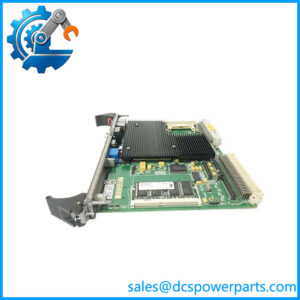
IC695CPE400-ABAB is the launch-release build of the PACSystems RX3i CPE400, and that is the single most important fact about this exact catalog number. GE’s own release history for the CPE400 lists the suffix sequence explicitly: -AAAA in December 2016, -ABAB in January 2017 with PACSystems firmware 9.00, then -ABAC, -ABAE and -ABAF through 2017 as release 9.20 and then 9.30 arrived. Wedge-style suffix letters do not mean hardware revisions here — they record the firmware and build that the unit shipped with, so IC695CPE400-ABAB identifies a controller as it left the factory in early 2017, running release 9.00 with FPGA 2.2.0 and CPLD 2.2.0.
What the hardware is has not changed: a rackless RX3i controller built around a 1.2 GHz quad-core microprocessor running a real-time hypervisor, which lets the deterministic PACSystems control runtime and the embedded edge application environment execute side by side without one compromising the other. It carries 64 MB of configurable data and program memory, reference tables of 32k bits for discrete %I and %Q, up to 32k words each for analog %AI and %AQ, bulk %W memory for data exchange, and on the launch firmware up to 512 program blocks with a 128 KB maximum block size. Programming is familiar RX3i territory — Ladder Diagram, Structured Text, Function Block Diagram or C — with a C Toolkit 8.00 requirement for 64-bit C blocks.
The controller’s identity as “rackless” is structural, not cosmetic. There is no RX3i backplane behind it and no local I/O rack to fill: I/O arrives over the embedded PROFINET controller on LAN2, or over Ethernet-based protocols, which makes the CPE400 a compact cell or skid controller rather than a cabinet CPU. The four Ethernet LANs are the reason this works — LAN1 as a dedicated unswitched 10/100/1000 port, LAN2 and LAN3 each as a pair of internally switched ports, plus a separate Field Agent port on the underside. On the embedded communications engine GE publishes concrete numbers rather than adjectives: up to 48 simultaneous SRTP server connections, 16 Modbus/TCP server connections, 32 clients of either kind, an OPC UA server supporting 5 sessions and 12 500 variables, up to 255 Class 1 EGD exchanges, and a simplex PROFINET I/O controller handling 32 devices at update rates from 1 to 512 ms.
Because this is the 9.00 release, the feature set legitimately differs from what current documentation describes, and buyers deserve the distinction. Hot Standby redundancy with PROFINET I/O arrived with firmware 9.30; the serial COM port became usable with 9.40; program blocks beyond 512 up to 768 required 9.70 and later PME revisions; Achilles Level 2 certification is associated with release 9.20 rather than 9.00. None of these are hardware limits — the unit is field-upgradeable — but a -ABAB controller sitting in a warehouse for years is a 9.00-release controller until somebody upgrades it, and that governs what it can do on day one.
Security is built in at the silicon level rather than bolted on: Trusted Platform Module, secure boot, and firmware updates that are authenticated before installation, with the controller continuing to run its existing version if it detects non-genuine firmware. The optional IC695ACC403 Energy Pack — the only pack compatible with the CPE400 — gives the controller seconds of hold-up to write user memory to non-volatile storage on power loss. Mounting is DIN rail as shipped, with a panel-mount adaptor plate in the ship-set, and the operating range runs from −40 °C to +70 °C, derated by altitude.
Technical Specifications
| Parameter | Value |
|---|---|
| Catalog number | IC695CPE400-ABAB |
| Product | PACSystems RX3i CPE400 rackless CPU, 64 MB |
| Suffix meaning | Factory firmware release 9.00 (Build E79S), January 2017; FPGA 2.2.0, CPLD 2.2.0 |
| Processor | 1.2 GHz quad-core, real-time hypervisor architecture |
| Control runtime OS | VxWorks-based PACSystems runtime |
| User memory | 64 MB configurable program and data |
| Reference tables (launch firmware) | 32k bits %I and %Q; up to 32k words each %AI and %AQ; bulk %W |
| Program blocks | Up to 512 blocks, 128 KB maximum block size (9.00); 768 blocks from R9.70 |
| Ethernet LANs | Four independent 10/100/1000: LAN1 dedicated unswitched; LAN2 two switched ports; LAN3 two switched ports; separate Field Agent port |
| Embedded PROFINET I/O | Simplex controller on LAN2, up to 32 devices, 1–512 ms update; ≤8 ms with ≤16 devices |
| Ethernet protocols | SRTP, Modbus TCP, EGD (255 Class 1 exchanges), OPC UA server (5 sessions, 12 500 variables), PROFINET, HART passthrough |
| Server / client limits | 48 simultaneous SRTP server connections; 16 Modbus/TCP server connections; 32 clients total |
| Power requirements | 18–30 V DC input, 20 W maximum |
| Memory backup | Energy Pack IC695ACC403 only (with cable IC695CBL003); 4 s backup window |
| Dimensions | 203.5 × 56.7 × 153.6 mm (H × W × D), family figure |
| Operating temperature | −40 °C to +70 °C (0–2 000 m); 65 °C at 2 000–3 000 m; 60 °C at 3 000–4 000 m; storage −40 to +85 °C |
| Mounting | DIN rail as shipped; panel-mount adaptor plate included |
| Display | OLED status display with DISP/SEL pushbuttons; per-LAN IP address visible |
| Security | Trusted Platform Module, secure boot, authenticated encrypted firmware updates |
| Compliance (family) | CE / EMC, ATEX Cat 3 [II 3 G] Ex ec, UL Class I Div 2 Groups A–D, Zone 2 Ex nA, FCC Class A, ICES-003, marine ABS / DNV-GL / BV / LR |
| Software requirement | PAC Machine Edition Logic Developer PLC 9.00 SIM 8 or later; C Toolkit 8.00 for 64-bit C blocks |
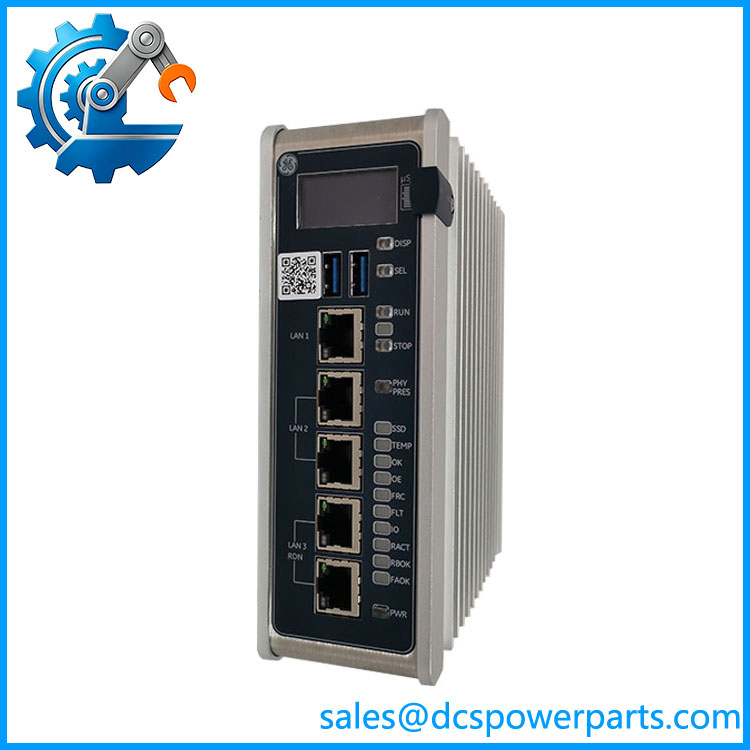
IC695CPE400-ABAB
Key Features and Advantages
Suffix literacy as a procurement skill: IC695CPE400-ABAB is not “a CPE400 with option ABAB”. It is a that shipped with release 9.00 in January 2017, and the release history published in GFK-3003 lets anyone place it precisely — after -AAAA, before -ABAC. Reading the suffix correctly tells you the firmware generation before you power the unit up, which is exactly what a spare-parts buyer needs to know.
A rackless architecture that removes a failure domain: no backplane, no rack power supply, no local I/O chassis. The controller mounts on DIN rail or a panel and reaches its I/O over PROFINET. In a skid or a remote pumping station that is a smaller cabinet, fewer terminals and one less set of things to fail.
Quad-core plus hypervisor, not quad-core as a slogan: the deterministic runtime and the edge application environment run concurrently under separation, so analytics, data collection or a cloud connector cannot steal cycles from the control sweep.
Real communications budgets instead of claimed capability: 48 SRTP server connections, 16 Modbus/TCP servers, 255 Class 1 EGD exchanges, 12 500 OPC UA variables, 32 PROFINET devices at 1–512 ms with 8 ms achievable under 16 devices. Those are numbers an integrator can design against, and they explain why the suits cells with a modest I/O count and a heavy data appetite.
Three usable LANs plus a service port: LAN1 unswitched for a plant backbone, LAN2 switched with the embedded PROFINET controller, LAN3 switched, and the Field Agent port isolated underneath. Segmentation is possible without adding an industrial switch, and MRP ring support means the I/O network itself need not be a single point of failure — the controller can act as either Media Redundancy Manager or Client.
Security that fails closed: TPM-anchored identity, secure boot, and firmware that is authenticated before it is accepted. A controller that refuses non-genuine firmware is a controller that cannot be quietly re-flashed in the field.
An honest upgrade path: redundancy from 9.30, serial port from 9.40, 768 blocks from 9.70, newer PROFINET subslot and HART device-information features later still. The same -ABAB hardware carries all of it after a firmware update, which is what makes a 2017 unit still worth keeping — provided the update is planned rather than assumed.
Diagnostics at the front panel: OLED menus, LAN IP addresses readable without a laptop, and LEDs covering MODE, output-scan state, overrides, fault, Field Agent status and redundant-controller readiness on later firmware. Commissioning time drops when the first question — “what address is this thing on?” — can be answered by looking at it.
Compatibility discipline worth noting: only IC695ACC403 belongs on this controller. GE publishes an explicit list of packs that physically connect but must not be used — the CPE305/310 pack, the CPE330 pack, and the RXi pack — because attaching them silently blocks future energy-pack firmware updates or risks memory not being preserved.
Applications
Water and wastewater pumping and treatment: remote stations and small plants where a rack is unnecessary, PROFINET scanners collect the local I/O, and the edge runtime forwards flow, level and energy data upward. The −40 °C to +70 °C range and 18–30 V DC input suit unheated shelters and solar-plus-battery supplies.
Metro and tunnel infrastructure: ventilation, drainage and lighting control in distributed cabinets along a tunnel, with MRP ring topology on the I/O network and LAN segmentation between control and supervisory traffic.
Industrial steam and packaged boiler plant: a compact controller for burner management auxiliaries, feedwater and steam-header monitoring, where the replaces a rack plus a separate gateway box.
Automotive and discrete manufacturing cells: assembly stations, robot cell coordination and tooling islands where the controller is mounted at the machine rather than in a central cabinet, and where OPC UA and EGD carry data to line-level systems.
Chemical and oil and gas skids: metering skids, odorisation and small process packages with 20–30 PROFINET devices, DNP3 or Modbus TCP links to a host SCADA, and a need to run locally even when the WAN is down.
OEM machine builders and fleet owners: the edge application environment is the differentiator for builders who want per-machine analytics and remote diagnostics without a second industrial PC in the enclosure.
Where it is the wrong choice: rack-based RX3i installations with a populated backplane, which want a IC695CPE330 or a rack CPU; processes needing hundreds of local I/O points in one chassis; and safety functions, which belong in a dedicated safety controller rather than in the standard runtime.
Related Products
IC695CPE330 — rack-based RX3i CPU of the same generation; the choice when a Universal Backplane and local I/O are required. IC695CPK400 — the catalogued with an Energy Pack included, sparing a separate IC695ACC403 order. IC695ACC403 — the only compatible Energy Pack; the CPE305/310 and CPE330 packs must not be used with this controller. IC695CBL003 — purpose-built cable connecting the Energy Pack to the 24 V DC In and Energy Pack Control & Status connectors. IC695PNS001 / IC695PNS101 — RX3i PROFINET scanners, the remote I/O path for a rackless controller; the PNS101 adds advanced diagnostics and sequence-of-events support. IC695PNC001 — rack-mounted PROFINET I/O controller for backplane systems, the counterpart product to the ‘s embedded controller. IC695CPL410 — sibling edge controller of the same hardware generation, catalogued with PACEdge plus WebHMI instead of PACEdge plus Connext. IC695CMM002 / IC695CMM004 — serial communication modules supported through the PROFINET scanners, for plants that still need RS-232/485 devices near the I/O. IC695CHS016 — 16-slot RX3i Universal Backplane, used by rack-based CPUs and not by the itself.
Installation and Maintenance
Before installation: read the suffix and plan around it. A IC695CPE400-ABAB arrives at release 9.00, so confirm in PAC Machine Edition that the project’s required features — redundancy, serial COM, block count above 512, later PROFINET subslot handling — are supported by the release actually installed, and schedule the firmware update to the intended target release before commissioning rather than after. Verify the SELV supply delivers 18–30 V DC with capacity for 20 W, or 72 W if an Energy Pack is fitted, and confirm the pack is the IC695ACC403 and not one of the physically compatible but prohibited alternatives. Allow the thermal clearances the installation requirements document specifies — 25 mm above, 50 mm below and around adjacent devices — and mount either on DIN rail or with the supplied panel adaptor plate.
Commissioning: connect the programming computer to LAN1 or LAN2 and configure through PME 9.00 SIM 8 or later. Set each LAN’s address deliberately, because the OLED display shows them but does not choose them for you; keep the Field Agent port on its own network and change its default credentials at first login. On the embedded PROFINET controller, size the device count against the update-rate rule — 8 ms and faster only with 16 or fewer devices, 16 ms and above beyond that — and set the PROFINET watchdog to a value the process can tolerate.
Maintenance: the routine work is firmware and configuration management, not hardware. Track the installed release against the project baseline; keep a copy of the Energy Pack’s condition in the maintenance record, since its capacitor life is finite and a pack that no longer holds the write-back window gives no warning until the day it is needed. Clean the front panel and confirm the OLED and LEDs remain legible in the cabinet lighting. On a fault, export the controller fault tables before replacing anything — the logs enough to distinguish a network problem from a module problem, and a swapped controller that loses that evidence costs more time than it saves. Keep one IC695CPE400-ABAB with its release documented as the cold spare, and update it to the plant’s baseline release before it goes on the shelf, so that the spare is not a downgrade waiting to happen.
Warranty and Quality
Every is supplied as a PACSystems RX3i rackless CPU, with its catalog suffix verified against GE/Emerson’s published release history in GFK-3003 — -ABAB being the January 2017 release 9.00 build — and with the firmware version and build number read out and reported before dispatch, because the suffix governs what the unit can do without an upgrade. Each unit is inspected for connector and housing condition, OLED and LED function, port pin integrity, evidence of prior rework or firmware tampering, and label legibility; where a bench arrangement is available it is powered at 24 V DC, booted, its LANs are confirmed, and its PROFINET and SRTP communication verified. A 12-month repair, replacement or refund commitment applies. Technical support covers what this catalog number actually raises: decoding the suffix sequence from -AAAA through -ADBA, deciding which release a project needs before commissioning, distinguishing the from rack-based CPE330 installations, pairing only with the controller, and sizing PROFINET device counts and update rates against the documented limits.