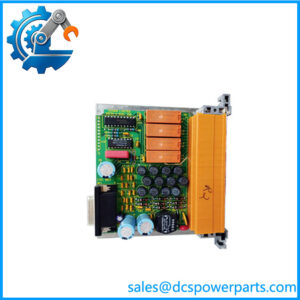
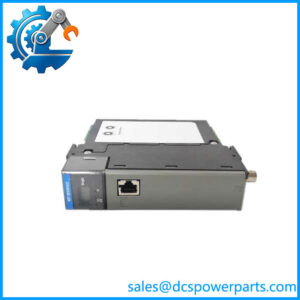
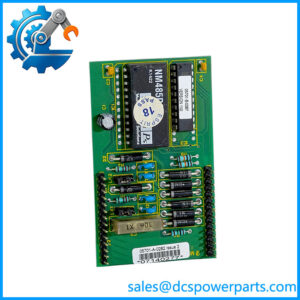
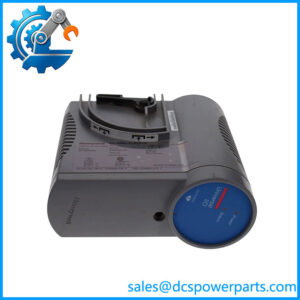
Description
Honeywell CC-PAIN01 High-Level Analog Input Module
Product Overview
The Honeywell CC-PAIN01 is a high-level analog input module for Honeywell Experion Series C I/O systems. Its primary job is straightforward but critical: convert field transmitter current into process values that the control system can use for monitoring, alarming, regulatory control, and sequence logic. Honeywell specifies 16 single-ended input channels, accepting 4–20 mA signals from 2-wire or self-powered transmitters. The module uses a 16-bit A/D converter and provides a documented 50 ms input scan rate.
A useful distinction for procurement is that CC-PAIN01 is the non-HART high-level analog input member of the Series C family. It should not be confused with CC-PAIH01/02 HART modules or CC-PAIX01/02 analog-input variants. Honeywell specifies the CC-PAIN01 input through a 200 Ω resistance, with a common-mode rejection ratio of 70 dB and normal-mode rejection of 20 dB at 60 Hz. Hardware accuracy is specified at ±0.075% of full scale around the reference temperature and ±0.15% of full scale over 0–60°C.
The module also provides transmitter field-power conditioning using individually protected current-limiting circuits. Honeywell describes this arrangement as supporting Class 1, Division 2 non-incendive interfacing, without requiring individual fusing for that protection function. The CC-PAIN01 can be installed with the CC-TAIN01 non-redundant IOTA or CC-TAIN11 redundant IOTA.
For a plant replacement, the IOTA is not a minor accessory. It forms part of the electrical interface between the field wiring and the Series C module. Confirming the installed IOTA, redundancy arrangement, transmitter wiring, and complete module order number before changing hardware avoids a surprisingly common commissioning problem.
Product Introduction
A 4–20 mA signal looks simple on a drawing, but the actual I/O interface determines loop loading, field-power behavior, noise rejection, diagnostics, and cabinet architecture. The Honeywell CC-PAIN01 provides a dedicated 16-channel Series C interface for conventional high-level current transmitters.
For a Honeywell Experion PKS legacy replacement, the key checks are channel type, IOTA model, redundancy, transmitter power requirements, and the exact 51410069 order-number variant where applicable. Do not substitute a HART or differential input module simply because the physical Series C form factor appears similar.
Key Technical Specifications
| Parameter | Specification |
|---|---|
| Product Model | CC- |
| Manufacturer | Honeywell |
| Product Family | Experion Series C I/O |
| Product Type | High-Level Analog Input Module |
| Input Channels | 16 single-ended |
| Input Signal | 4–20 mA |
| Transmitter Type | 2-wire or self-powered transmitters |
| Input Resistance | 200 Ω |
| A/D Converter | 16-bit |
| Input Scan Rate | 50 ms |
| Common-Mode Rejection | 70 dB, DC–60 Hz |
| Normal-Mode Rejection | 20 dB at 60 Hz |
| Normal-Mode Filter | Single-pole RC, -3 dB at 6.0 Hz |
| Maximum Normal-Mode Input | ±30 V |
| Channel-to-Channel Crosstalk | -60 dB, DC–60 Hz |
| Accuracy at Reference Temperature | ±0.075% of full scale |
| Accuracy, 0–60°C | ±0.15% of full scale |
| Non-Redundant IOTA | CC-TAIN01 |
| Redundant IOTA | CC-TAIN11 |
| Field Power Conditioning | Individually protected current limiting |
| Hazardous-Area Interface | Class 1, Division 2 non-incendive field interface |
| HART | No — use the appropriate Series C HART module when HART communication is required |
The technical values above are from Honeywell’s Experion Series C I/O specification.
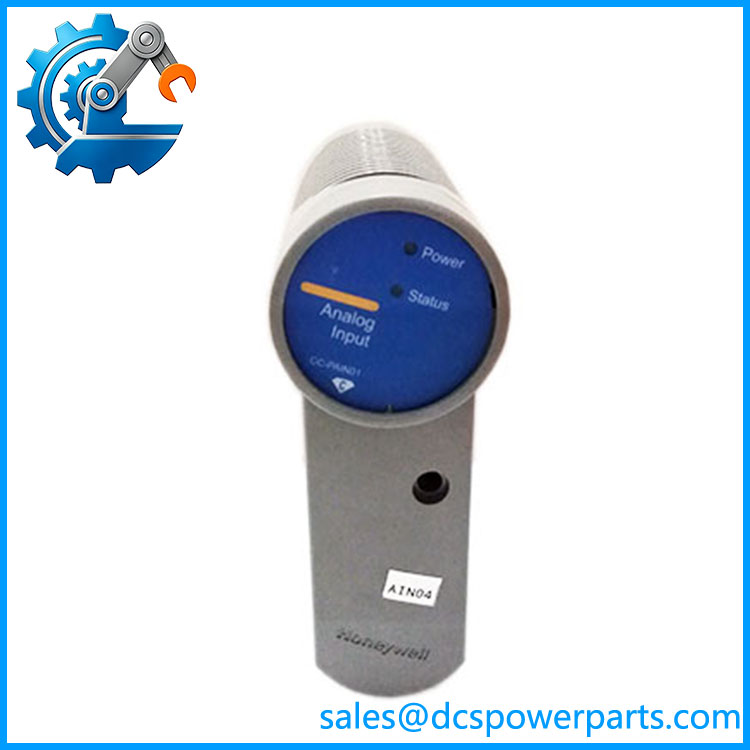
CC-PAIN01
Major Features / Practical Advantages
16-Channel 4–20 mA Acquisition
The CC- provides 16 single-ended analog channels, making it suitable for conventional process transmitters such as pressure, flow, level, temperature transmitters with current outputs, and other 4–20 mA instrumentation. Honeywell specifically identifies the input as current from 2-wire or self-powered transmitters.
This is conventional process I/O rather than universal-channel hardware. The signal type needs to be established before commissioning.
16-Bit Signal Conversion
A 16-bit A/D converter provides the digital resolution required for normal process measurement applications. The specified hardware accuracy is ±0.075% of full scale at the reference temperature and ±0.15% of full scale from 0 to 60°C.
Do not confuse converter resolution with total loop accuracy. Transmitter accuracy, wiring resistance, calibration, temperature effects, grounding, and the actual process instrument all contribute to the final measurement error.
50 ms Input Scanning
Honeywell specifies a 50 ms input scan rate. That is useful when evaluating loop response and alarm timing, but it should not be interpreted as a 20 Hz closed-loop controller execution rate. The I/O scan and the controller’s control-execution schedule are separate system functions.
Noise Rejection
The module provides 70 dB common-mode rejection from DC through 60 Hz and 20 dB normal-mode rejection at 60 Hz. A single-pole RC input filter provides a -3 dB response at 6.0 Hz. Channel-to-channel crosstalk is specified at -60 dB over DC–60 Hz.
For field troubleshooting, these numbers are relevant when investigating unstable readings near large motors, variable-frequency drives, contactors, or long analog cable runs. They do not eliminate the need for proper shielding and grounding.
Non-Incendive Transmitter Power Conditioning
One useful feature is the integrated transmitter field-power conditioning. Honeywell specifies individually protected current-limiting circuits for Class 1, Division 2 non-incendive interfacing. The documented arrangement removes the need for external fusing for that specific protection function.
That does not mean every hazardous-area installation is automatically approved. The complete loop, field device, wiring method, barriers/interfaces where applicable, cabinet, installation area, and project approvals must still satisfy the site’s hazardous-area requirements.
Redundancy Option
The Series C specification identifies CC-TAIN01 for non-redundant installations and CC-TAIN11 for redundant installations. Honeywell also describes Series C modules as capable of redundant implementation.
When replacing a module in a redundant cabinet, verify the actual IOTA and system topology rather than assuming that every CC- installation is redundant.
Series C Cabinet Integration
CC- belongs to Honeywell’s Series C I/O architecture, which supports both local and remote I/O implementation. The Series C platform uses dedicated IOTA/interface hardware to connect field signals to the I/O module.
This is why the correct replacement process should include the physical IOTA and terminal arrangement, not just the electronic module.
Related Products
- CC-PAIH01 — Series C high-level analog input with HART functionality.
- CC-PAIH02 — Series C HART analog input module with a different channel/interface configuration.
- CC-PAIH51 — HART analog input variant within the Series C family.
- CC-PAIX01 — Series C high-level analog input variant; verify signal/interface requirements before substitution.
- CC-PAIX02 — Differential high-level analog input module; not an automatic replacement for CC-.
- CC-PAIM01 — Low-level analog/temperature input module for different signal types.
- CC-PAON01 — Series C analog output module.
- CC-PAOH01 — Series C HART analog output module.
- CC-TAIN01 — Non-redundant IOTA associated with CC-.
- CC-TAIN11 — Redundant IOTA associated with CC-.
Honeywell’s Series C specification explicitly separates CC- from the HART, differential, temperature, and analog-output modules, so these should be selected according to signal and system requirements rather than physical similarity.
FAQ
What is Honeywell CC-?
It is a 16-channel high-level analog input module for Honeywell Experion Series C I/O systems. It accepts 4–20 mA signals from 2-wire or self-powered transmitters.
Is CC- a HART analog input module?
No. The documented CC- is the conventional high-level analog input module. Honeywell lists separate HART modules such as CC-PAIH01/02 and CC-PAIH51.
How many analog inputs does CC- have?
It has 16 single-ended analog input channels.
What signal does CC- accept?
The specified input is 4–20 mA through 200 Ω, supporting 2-wire or self-powered transmitters.
Can I hot-swap CC-?
Series C architecture supports maintenance-oriented module replacement features, but hot replacement should not be assumed for every installation without checking the installed cabinet, redundancy arrangement, system procedure, and applicable Honeywell documentation. The IOTA and field wiring also need to be considered before removal.
Does CC- support firmware v3.1?
The part number by itself does not establish a particular firmware revision. Treat the module hardware identification and the Experion/Series C software release as separate compatibility checks.
Is CC- compatible with CC-TAIN01 and CC-TAIN11?
Honeywell’s specification identifies CC-TAIN01 as the non-redundant IOTA and CC-TAIN11 as the redundant IOTA for the CC-. The correct choice depends on the installed Series C architecture.
Does CC- provide transmitter loop power?
Yes. Honeywell documents transmitter field-power conditioning with individually protected current-limiting circuits for the non-incendive interface.
What should I verify before buying a replacement CC-?
Verify the complete module part number, IOTA model, redundancy arrangement, field transmitter type, cabinet location, hardware revision, and existing Experion configuration. If the installed unit carries an extended order number such as a 51410069-series identification, match the complete number rather than relying only on “CC-.”
Procurement Note
The Honeywell CC- is a relatively straightforward module electrically, but replacement errors usually occur at the system-interface level. Confirm whether the existing installation uses CC- or CC-, whether redundancy is implemented, and whether the field loops are conventional 4–20 mA or require HART communication. Honeywell’s documentation explicitly distinguishes these Series C variants.
When sourcing New Surplus hardware, verify the full nameplate and order number, not just the CC- label. A visually similar Series C module can have a different signal function. Also verify the IOTA before commissioning; the module and its field interface form one practical installation.
For a plant-critical replacement, preserve the existing channel assignments, engineering ranges, alarm limits, scaling, and controller configuration before removing the original module. The replacement hardware should be validated against the actual Experion project rather than assumed compatible from the model number alone.