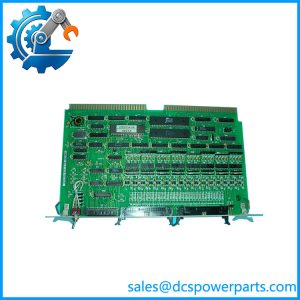
Description
Key Technical Specifications
| Parameter | Specification |
|---|---|
| Product Model | MPD310A |
| Manufacturer | Hitachi |
| Product Type | Channel Input Card |
| System Family | Hitachi legacy industrial control |
| Possible System Association | HIACS / legacy Hitachi DCS |
| Functional Role | Input signal acquisition |
| Installation | System-specific rack/backplane |
| Channel Count | Verify from original Hitachi documentation |
| Input Signal Type | Verify against installed system configuration |
| Rated Input | Verify before replacement |
| Operating Temperature | Verify from original documentation |
| Power Requirements | System-dependent |
| Communication | Backplane/system bus dependent |
| Firmware | Hardware/system revision dependent |
| Condition | New Surplus / Used / Tested Refurbished |
A particularly important point for procurement: the available references do not agree on the exact function of MPD310A. One Hitachi equipment repair database lists it as a power supply unit, while another industrial parts index explicitly lists MPD310A as a Channel Input Card.
A separate commercial product page calls it an “AC drive inverter” and supplies detailed drive specifications such as 380–480 VAC and 5.5 kW. Those specifications should not be accepted as verified MPD310A data, because they conflict with the channel-input identification.
Application Scenarios & Pain Points
An input card failure can be surprisingly difficult to isolate. A single bad channel may look like a transmitter problem, while a broader card or backplane fault can make several healthy field signals disappear together.
- Hitachi legacy DCS: MPD310A is indexed as a channel input card for Hitachi control-system equipment.
- Process signal acquisition: Where the installed architecture confirms the channel-input function, the module sits between field instrumentation and the control processor.
- Legacy plant maintenance: An exact spare can help maintain an existing Hitachi control installation without immediately replacing the entire controller architecture.
- Troubleshooting input failures: Compare the suspect channel with a known-good channel before condemning the module. A loop power problem or field termination issue can produce the same symptom.
Field note: If several channels fail simultaneously, check the module supply, rack connections, and common signal path first. If only one channel is abnormal, field wiring and the transmitter deserve equal attention.
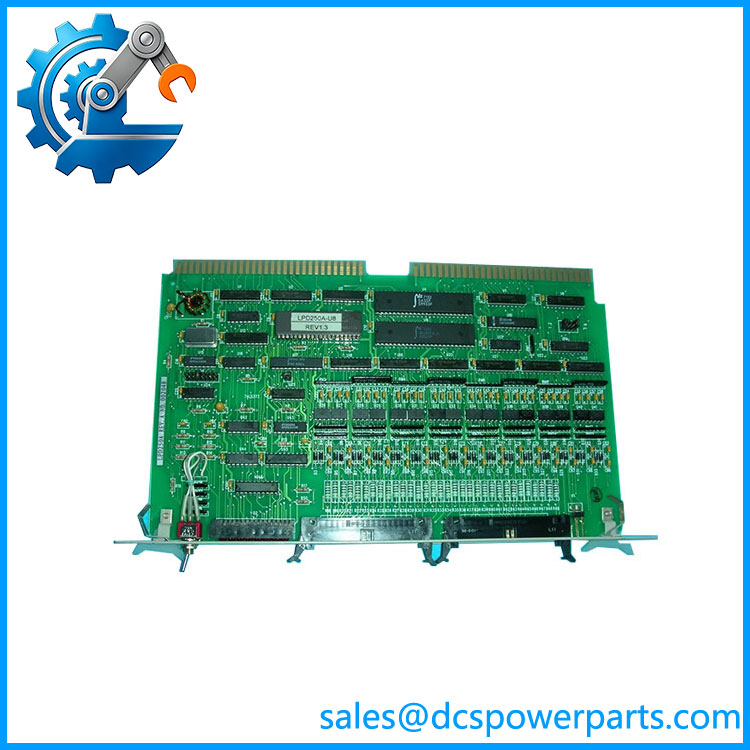
LPD250A
Related Products
- Hitachi MPD110A — Listed among Hitachi legacy control hardware as a logic control card or power-supply-related module. It should not be treated as a functional substitute for MPD310A.
- Hitachi MPD060A — Identified in the same Hitachi equipment family as a sequential control card. Its processing role differs from the input-card function.
- Hitachi MPD210A — Listed in Hitachi repair records as a power-supply unit. It may belong to the same broader legacy hardware family but performs a different function.
- Hitachi MPD410A — Also listed as a Hitachi power-supply unit. It should be considered complementary power hardware rather than an replacement.
- Hitachi MPD411A — Another legacy Hitachi power-supply reference. Confirm the rack architecture before considering its role in the same cabinet.
- Hitachi LPU100A — A related legacy Hitachi control module that has been identified in industrial references as a redundant-channel module. Its function is different from .
- Hitachi LPU100H — Listed as a communication module in the same legacy Hitachi product grouping. It supports system communication rather than field-channel input acquisition.
- Hitachi LPT020A — Listed as a pulse input module. It may be relevant where pulse/frequency signals are required, but it should not be substituted for a general channel-input module without checking signal type.
The Engineer’s Guide: Field Pitfalls to Avoid
⚠️ Do not trust a generic product description.
Current references conflict significantly: channel input card, power supply, and AC drive descriptions all appear in indexed material. Verify the actual Hitachi label and cabinet documentation before purchasing.
⚠️ Do not assume the input signal type.
Voltage, current, contact, thermocouple, RTD, and pulse inputs require different electronics. Never connect a field signal based only on the model number until the system manual confirms the channel specification.
⚠️ Check the backplane and common supply.
If multiple channels disappear simultaneously, the fault may be upstream of the individual channels. Inspect rack power, connector seating, backplane contacts, and common signal references.
Practical check: Photograph the front label and rear connector, record the rack position and adjacent module models, and compare the suspected with a known-good card before replacement. For a used spare, request a channel-level functional test rather than a simple power-on test.
Frequently Asked Questions (FAQ)
What is Hitachi ?
One industrial automation parts index identifies Hitachi as a Channel Input Card used within Hitachi legacy control equipment. Because other references classify the same model differently, the physical part label and installed system documentation should be used for final identification.
Is an AC drive inverter?
I would not treat it as an AC drive inverter based on the available evidence. A commercial listing describes it that way, but other sources identify as a channel input card or power-supply unit. The conflicting descriptions make the drive specifications unsuitable for engineering procurement without additional verification.
Is a Hitachi HIACS module?
It appears in Hitachi legacy control-system product groupings that also include LPU, LPT, LPP, and other Hitachi control modules. However, the exact HIACS generation should be confirmed from the cabinet documentation rather than inferred solely from the model number.
What should I verify before replacing ?
Check:
- Complete model marking
- Hardware/revision information
- Rack and slot position
- Input signal type
- Number of active channels
- Adjacent Hitachi modules
- System power and backplane condition
- Existing diagnostic indications
This is especially important because the public descriptions for are inconsistent.
Can I use as a direct replacement without configuration?
Do not assume that. Even if the replacement hardware is physically identical, channel configuration, signal conditioning, calibration, and system database settings may need to match the original installation.
How should I evaluate a used ?
Ask for photographs of the complete label and connectors, plus evidence of functional testing. For an input card, a meaningful test should verify the actual input channels—not merely that the module powers on.