Description
HIMA H4116 Safety Relay in Terminal Housing
Product Introduction
In a safety control cabinet, the difficult part is often not generating the trip command but transferring that command into another electrical circuit without introducing an uncontrolled voltage path. The HIMA H4116 addresses this interface requirement as a safety relay installed in a terminal housing. It provides a 24 VDC relay coil and a potential-free changeover contact for transferring signals between HIMA safety equipment and external circuits. HIMA documentation references the relay for safety-related applications up to SIL 2 under IEC 61508.
The terminal-housing arrangement moves the relay interface directly into the wiring area, which can simplify panel wiring and help separate external circuit voltages from the safety-system output. The H4116 uses low coil consumption—about 20 mA at 24 VDC—and is designed for DIN/C-rail mounting. For brownfield HIMA installations, verify the exact relay contact requirements, safety calculation, wiring arrangement, and terminal configuration rather than treating the H4116 as a generic PLC relay.
Key Technical Specifications
| Parameter | HIMA H4116 Specification |
|---|---|
| Product Model | H4116 |
| Manufacturer | HIMA |
| Product Type | Safety relay in terminal housing |
| Safety Classification | SIL 2, IEC 61508 |
| Input / Coil Voltage | 24 VDC |
| Input Voltage Tolerance | -15% to +20% |
| Current Consumption | Approx. 20 mA |
| Relay Contact | 1 potential-free changeover contact |
| Switching Voltage | 1 mV to 250 VAC/VDC |
| Switching Current | 1 mA to 4 A |
| AC Switching Capacity | ≤1000 VA, cos φ > 0.5 |
| DC Switching Capacity | ≤120 W at 30 VDC; ≤40 W at 250 VDC |
| Switching Time | Approx. 7 ms |
| Reset Time | Approx. 5 ms |
| Bounce Time | Approx. 1 ms |
| Operating Temperature | -25°C to +50°C |
| Protection Rating | IP20 |
| Mounting | 35 mm DIN rail or C rail |
| Power Dissipation | Approx. 1–2 W |
| Terminal Cross-Section | 0.25–2.5 mm² |
| Terminal Tightening Torque | 0.5–0.6 Nm |
The published specifications consistently identify the as a 24 VDC relay with one potential-free changeover contact. The switching limits and environmental data above are reported by HIMA-focused technical documentation and should be checked against the revision-specific documentation supplied with the unit.
Major Features and Advantages
Safety-Related Signal Transfer
The is intended for a very specific job: transferring a safety-related control signal through a relay contact while keeping the external circuit electrically separated from the relay coil circuit. This is useful when the safety controller output cannot—or should not—be connected directly to the downstream load or signaling circuit.
The relay is documented for safety-related circuits up to SIL 2 in accordance with IEC 61508. That designation belongs to the component’s certified application conditions; it should not be interpreted as meaning that any machine or safety instrumented function automatically becomes SIL 2 simply because an is installed. The complete safety loop still requires the appropriate architecture, diagnostics, proof testing, failure-rate data, and application calculations.
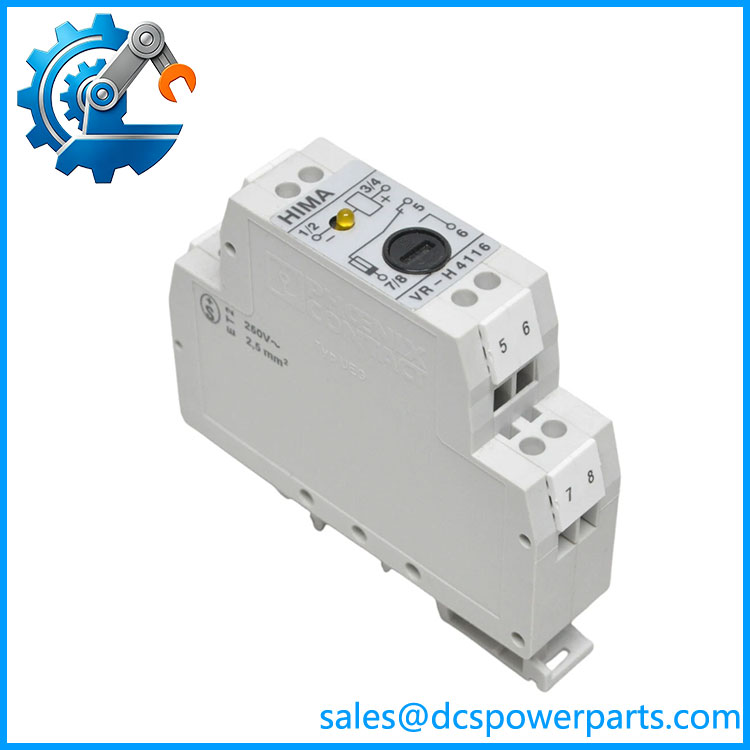
H4116
Low Coil Power
At 24 VDC, the published coil consumption is approximately 20 mA. This is important when the relay is being driven from a safety output module with a limited output load budget. HIMA documentation indicates that the low-current relay can be controlled directly from suitable fail-safe module outputs, provided the relevant output-loading requirements are satisfied.
Potential-Free Changeover Contact
The provides a single potential-free changeover contact. That makes it useful for transferring a safety-system state into another electrical circuit without directly tying the external circuit’s voltage to the control output. The published switching range extends from very low signal levels up to 250 VAC/VDC, with current and power limits that must be respected for the particular load.
Terminal-Housing Construction
Unlike a conventional plug-in relay sitting inside a general-purpose relay bank, the places the relay function in a terminal housing intended for field-side wiring. This arrangement can make cabinet wiring easier to inspect and maintain, particularly where the relay provides the boundary between safety-controller wiring and external equipment.
Practical Cabinet Installation
The is specified for 35 mm DIN rail or C-rail mounting and uses screw-terminal wiring suitable for 0.25–2.5 mm² conductors. For replacement work, these mechanical details matter: the correct electrical function does not guarantee a physically equivalent replacement if the existing mounting or terminal arrangement differs.
Application Scenarios & Field Considerations
The is particularly relevant where a HIMA safety controller needs to hand a discrete safety state to an external circuit.
- Emergency shutdown circuits: Relay contacts can transfer a safety-system command to downstream shutdown or interlock circuitry, subject to the approved safety architecture.
- External signaling: A potential-free contact can interface a safety status with an external indication or monitoring circuit.
- Safety controller interfaces: The low coil consumption makes the relay suitable for applications where the driving safety output has a defined current limitation.
- Brownfield HIMA systems: The terminal-housing format can be useful when maintaining an existing cabinet where relay interfaces are already part of the approved wiring design.
One useful distinction during troubleshooting is that the is not a communications module or programmable safety controller. It does not replace the safety logic solver. Its role is electrical signal transfer through a relay contact. Confusing it with a HIMA I/O module can lead to an incorrect wiring and procurement decision.
Related HIMA Products
Depending on the system generation and application, engineers may encounter these HIMA components alongside or instead of the :
- HIMA F3430 — four-fold relay module for safety-related applications.
- HIMA F3421 — relay amplifier module.
- HIMA F3334 — four-fold safety-related output module.
- HIMA F8621A — HIMA safety controller/CPU family component.
- HIMA F8627 — Ethernet communication module.
- HIMA F8651E — safety central module.
- HIMA F3 DIO series — distributed safety digital I/O components.
- HIMA H6200A — HIMA safety-system component appearing in the same certification documentation.
These components are not automatic substitutes for the . A relay interface, relay amplifier, digital output module, and central processor have different electrical and safety functions. Select a replacement by the approved system architecture and wiring documentation, not merely by nominal voltage.
Engineer’s Guide — Field Pitfalls to Avoid
1. Do not treat “24 VDC relay” as enough information.
The coil supply is only one part of the specification. The has a particular contact arrangement, switching capacity, mounting format, and safety application. Check all of them before substitution.
2. Check the load type.
The published AC and DC switching capacities are different. An inductive solenoid, contactor coil, lamp load, PLC input, and resistive load can place very different stresses on relay contacts. A load that appears to be within the voltage rating can still exceed the permitted switching power.
3. Do not automatically claim SIL 2 for the complete function.
The is documented for safety-related applications up to SIL 2, but the complete safety function is determined by the entire architecture and its validated parameters. Component-level certification is not a shortcut around a safety calculation.
4. Check the terminal wiring before energizing.
Because the relay is housed at the terminal interface, wiring errors can put external voltage onto the wrong circuit. Verify the terminal assignment against the applicable HIMA documentation and cabinet drawings.
5. Confirm the relay’s actual condition during procurement.
units may appear in legacy-system spare inventories, and current listings can describe different stock conditions. Do not assume “new,” “unused,” or “refurbished” from a generic product listing. Inspect the nameplate, housing, terminals, relay condition, and available test documentation.
6. Verify the exact safety-system application.
The appears in HIMA safety-system documentation and has also been identified in FM hazardous-location certification documentation. The certification conditions still apply to the final installation, including enclosure, mounting, segregation, and environmental requirements.
FAQ
Is HIMA a PLC I/O module?
No. The is identified as a safety relay in terminal housing. Its primary function is relay-based signal transfer, not programmable logic execution or conventional analog/digital I/O processing.
What voltage does the HIMA require?
The published specification is 24 VDC, with an input tolerance of approximately -15% to +20%. Current consumption is approximately 20 mA.
What type of relay contact does the have?
The uses one potential-free changeover contact. The published switching limits are 1 mA to 4 A and up to 250 VAC/VDC, with separate AC and DC switching-capacity limits.
Is the SIL 2 certified?
Available HIMA-related documentation identifies the as a safety-related relay for circuits up to SIL 2 according to IEC 61508. This does not mean the entire safety function automatically achieves SIL 2; the complete application must be assessed against the applicable safety architecture and requirements.
Can replace another HIMA relay?
Not solely based on voltage or physical appearance. Check contact configuration, switching capacity, safety certification, mounting, terminal arrangement, and the approved circuit design. A relay with a similar 24 VDC coil may still be electrically or safety-wise unsuitable.
What should be checked before purchasing a HIMA ?
At minimum, verify the exact marking, relay/contact configuration, physical terminal housing, condition, and available test or inspection documentation. For a safety-system spare, matching the original part number is much safer than selecting by a generic “24 V safety relay” description.
Is HIMA still available as a current production item?
Current web listings are inconsistent, and at least one major industrial parts reference identifies the as discontinued. Because lifecycle status can differ from remaining inventory status, treat it as a legacy/maintenance procurement item unless current HIMA documentation confirms production status for your required revision.