Description
Key Technical Specifications
| Parameter | Value |
|---|---|
| Manufacturer | HIMA |
| Model | F8627 |
| Order Number | 984862702 |
| Product Type | Ethernet Communication Module |
| System Family | H41q / H51q |
| PES Platform | ELOP II |
| Primary Function | Ethernet communication |
| Ethernet Standard | 100Base-T |
| Physical Interface | RJ45 |
| Safety Communication | safeethernet |
| OPC Support | OPC DA / OPC A&E |
| Operating Mode | Mono or redundant configurations, depending on system architecture |
| Maximum System Networking | Documentation states communication between up to 64 H51q PES systems |
| Installation | HIMA H41q/H51q rack |
| Power | System/backplane dependent; verify installed rack documentation |
| Lifecycle | Legacy / obsolete-family hardware |
The original F8627 operating documentation describes the module specifically as a communication module for Ethernet communication in H51q PES systems using ELOP II. It also documents Ethernet, high-speed serial, and serial interfaces, plus configuration switches for module addressing and communication settings.
Important correction: I found several current listings that incorrectly classify F8627 as a CPU, analog-input module, digital-input module, or modern Ethernet gateway. Those descriptions conflict with HIMA’s own documentation. The defensible identification for F8627 / 984862702 is an Ethernet communication module for the H41q/H51q family.
Product Introduction
HIMA F8627 984862702
The HIMA F8627 984862702 is an Ethernet communication module used with the H41q and H51q programmable electronic safety systems. It provides the network interface required for communication between the safety controller and external systems, including engineering and supervisory environments, while supporting HIMA’s safeethernet communication architecture.
It is not the controller’s central processor. That distinction matters during troubleshooting. A failed can interrupt Ethernet-based engineering, monitoring, or safety communication while the underlying H41q/H51q safety logic continues to execute.
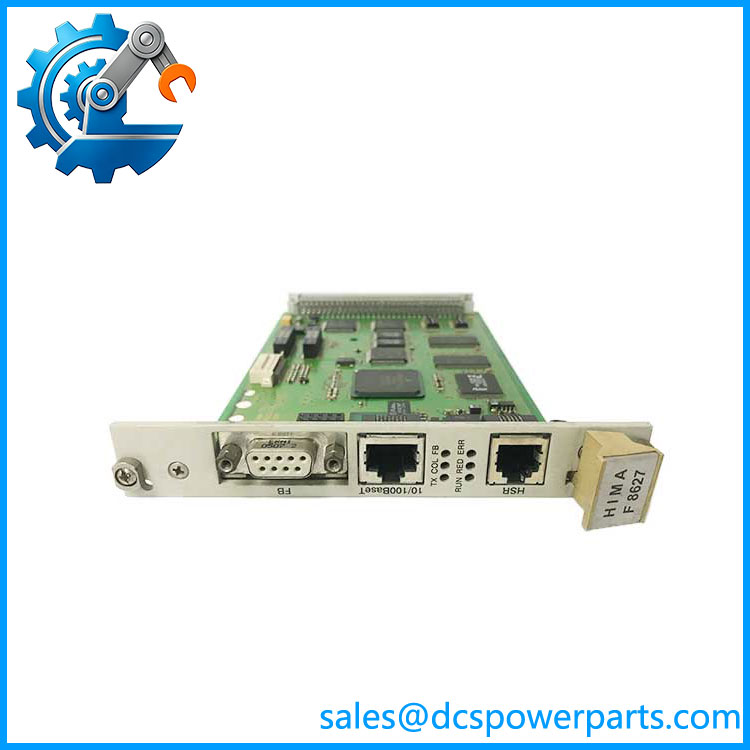
F8627
Application Scenarios & Field Pitfalls
Engineering Pain Point
A communication-module failure can be surprisingly misleading in a safety system. The H51q controller may continue running its application while the engineering workstation loses access, OPC data stops updating, or safeethernet communication becomes unavailable. Replacing the CPU in that situation solves nothing. Start at the network interface.
Typical Applications
- Oil & Gas — H51q/H41q safety-system communication with DCS, operator stations, and engineering systems.
- Petrochemical — Ethernet-based exchange of safety-system status, diagnostics, and process information.
- Power Generation — Communication between safety controllers and supervisory or engineering systems.
- Process Safety Systems — SafeEthernet communication between HIMA PES installations and associated safety-system nodes.
HIMA’s documentation lists specifically for OPC DA, OPC A&E, 100Base-T Ethernet, and safeethernet within its H41q/H51q safety-system architecture.
Technical Pitfalls to Avoid
- Do not confuse with the central CPU.
is the communication module. HIMA’s approval documentation separately identifies the F8650/F8652 family as central modules and as the Ethernet replacement for F8625. - Check the ELOP II version.
The original operating documentation specifies for H51q PES systems using ELOP II. Verify the controller’s software generation before replacing the module. - Check the Ethernet configuration switches.
uses switches for configuration functions including module number and communication settings. Record the original switch positions before removal. - Do not assume modern Gigabit Ethernet.
The HIMA documentation identifies the interface as 100Base-T. Claims of 1 Gbps operation found in some newer product listings should not be applied to this legacy . - Check the RJ45 connection and network path first.
Verify the cable, switch port, link status, and network configuration before declaring the defective. - Understand safeethernet separately from ordinary Ethernet.
The physical network may use standard Ethernet infrastructure, but HIMA’s safety communication has its own protocol and configuration requirements. A normal Ethernet ping does not prove that the safety communication layer is healthy. - Check mono versus redundant configuration.
The can participate in different system architectures. Do not alter the network topology during replacement without checking the original system drawings. - Record diagnostic indications before power cycling.
Network and module status information can disappear after a restart. Capture LEDs, display indications, and engineering-software diagnostics first. - Do not replace an with an F8625 simply because it is from the same family.
HIMA’s approval documentation explicitly describes as a new model introduced to replace F8625 with new Ethernet functionality. - Treat changes as safety-system changes.
If the participates in safety-related communication, replacement and configuration should follow the site’s approved safety lifecycle, verification, and validation procedures.
Related Products
- HIMA F8625 — Earlier communication-module generation. HIMA documentation states that was introduced to replace F8625 with new Ethernet functionality. It is therefore historically related, but not automatically a drop-in substitute.
- HIMA F8652E 984865264 — H41q central processing module. It executes the safety application; handles communication. These are complementary modules with very different system roles.
- HIMA F8650E — Central module for the H51q family. It provides safety-logic processing, whereas provides Ethernet communication. HIMA’s approval documentation identifies F8650E as a central-module variant.
- HIMA F8628 — Profibus-DP slave communication module. HIMA documentation lists F8628 separately from , making it the more appropriate choice where the external interface is Profibus-DP rather than Ethernet.
- HIMA F8621A — MODBUS/RS-485 communication module used in HIMA safety-system architectures. It provides serial communication rather than the 100Base-T Ethernet interface of .
- HIMA F3333 / F3334 — HIMA I/O modules used with H41q/H51q systems. They perform field signal processing rather than communications. HIMA’s approval documentation lists them separately from .
- HIMA F3236 — 16-channel digital-input module for 24 VDC contact signals. It belongs to the same broader H41q/H51q I/O ecosystem but has no equivalent communication function.
- HIMA F5220 — Related HIMA system module identified in the H41/H51 approval documentation. It is part of the same generation of safety hardware but does not replace ‘s Ethernet role.
- HIMA H41q PES — Safety-system platform supported by . The module provides Ethernet communication within this architecture.
- HIMA H51q PES — The primary documented application environment for . The original operating instructions specifically identify for H51q PES systems using ELOP II.