Description
Product Overview
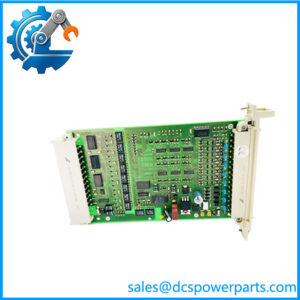
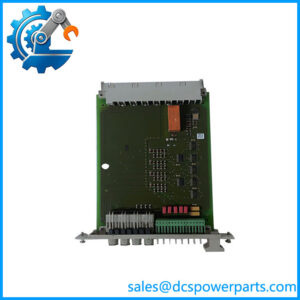
The HIMA F3 AIO 8/4 01 is a compact HIMatrix remote I/O device intended for safety-related automation systems. Its primary I/O configuration consists of eight analog inputs with a 0–10 V signal range and four analog outputs with a 0–20 mA range. HIMA documentation identifies the analog inputs as safety-related while the four analog outputs are not safety-related. The unit also contains an integrated two-port 100Base-T Ethernet switch for communication with the associated controller using HIMA SafeEthernet.
For HIMA F3 AIO 8/4 01, the important distinction is that this is a remote I/O device rather than an independent PLC CPU. The unit extends the I/O level of HIMatrix and HIMax controllers, while the application program remains in the associated controller. HIMA’s manual states that the F3 AIO 8/4 01 itself cannot execute a user program and communicates with the controller through SafeEthernet.
The HIMA F3 AIO 8/4 01 was designed for safety-related applications and has certification for applications up to SIL 3, Category 4, and Performance Level e, subject to the applicable system configuration and safety requirements. HIMA documentation also lists the unit for Ex Zone 2 installation under specified conditions. Its 24 VDC supply operates within a specified 20.4–28.8 VDC range in the hazardous-area certification documentation. For a replacement, hardware revision, operating-system version, engineering tool, and exact F3 AIO variant should all be checked before commissioning.
Product Introduction
A remote analog I/O node becomes critical when process measurements must reach a safety controller without bringing every field signal back to the main cabinet. HIMA F3 AIO 8/4 01 provides 8 analog inputs and 4 analog outputs, with the inputs safety-related and the outputs intended for non-safety-related functions.
For a HIMatrix safety I/O replacement, the two Ethernet ports and SafeEthernet architecture are just as important as the channel count. The device operates from 24 VDC and supports 10/100Base-T communication through its integrated switch.
Key Technical Specifications
| Parameter | Value |
|---|---|
| Manufacturer | HIMA |
| Product Family | HIMatrix |
| Model | F3 AIO 8/4 01 |
| HIMA Part Number | 98 2200409 |
| Product Type | Safety-Related Analog Remote I/O |
| Analog Inputs | 8 |
| Analog Input Range | 0–10 V |
| Input Safety Classification | Safety-related |
| Analog Outputs | 4 |
| Analog Output Range | 0–20 mA |
| Output Safety Classification | Non-safety-related |
| Ethernet Ports | 2 × RJ-45 |
| Ethernet Standard | 10/100Base-T |
| Communication | HIMA SafeEthernet |
| Operating Voltage | 24 VDC |
| Certified Supply Range | 20.4–28.8 VDC |
| Typical Operating Temperature | 0 to +60°C |
| Special Function | Supply for NAMUR proximity switches and 24 V |
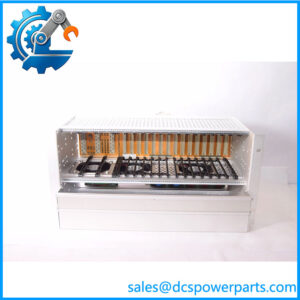
| Mounting | Compact metal enclosure |
| Hazardous Area | Suitable for specified Ex Zone 2 applications |
| Safety Capability | Up to SIL 3 / Cat. 4 / PL e, subject to system conditions |
| User Program Execution | No — remote I/O only |
HIMA’s current technical facts identify the F3 AIO 8/4 01 as an 8-input/4-output analog remote I/O with two Ethernet switch ports, while the product certificate specifies the 0–10 V inputs and 0–20 mA outputs.
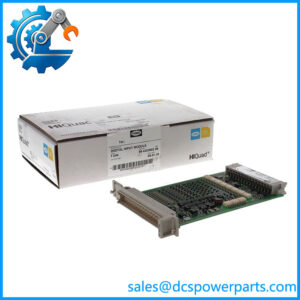
The manual identifies the standard F3 AIO 8/4 01 as part number 98 2200409 and distinguishes related 011 and 012 variants. Do not treat these suffix variants as interchangeable without checking the environmental and application requirements.
Related Products
- F3 AIO 8/4 011 — Related F3 AIO variant intended for a different operating-temperature configuration. It should be selected according to the actual environmental requirement rather than used solely because the I/O count matches.
- F3 AIO 8/4 012 — Subsea / −20°C variant identified in the HIMA manual. Its environmental design differs from the standard unit.
- F3 DIO 8/8 01 — HIMatrix remote I/O with 8 digital inputs and 8 digital outputs. It is suited to discrete signals rather than the analog measurements handled by the F3 AIO.
- F3 DIO 16/8 01 — Provides 16 digital inputs and 8 digital outputs. Useful when a project requires substantially more discrete I/O.
- F3 DIO 20/8 02 — 20 digital inputs and 8 digital outputs, with two Ethernet ports. It addresses a higher-density digital I/O requirement.
- F1 DI 16 01 — 16-channel digital input remote I/O. It complements the F3 AIO when additional discrete field-status signals are required.
- F2 DO 16 01 — 16-channel digital-output remote I/O. It provides discrete actuator outputs rather than analog outputs.
- F35 03 — Compact HIMatrix controller with digital and analog I/O plus Ethernet interfaces. Unlike the F3 AIO, it functions as a controller rather than simply extending remote I/O.
- F60 CPU 03 — Central processor for the modular HIMatrix F60 architecture. It provides controller functionality that the F3 AIO 8/4 01 does not.
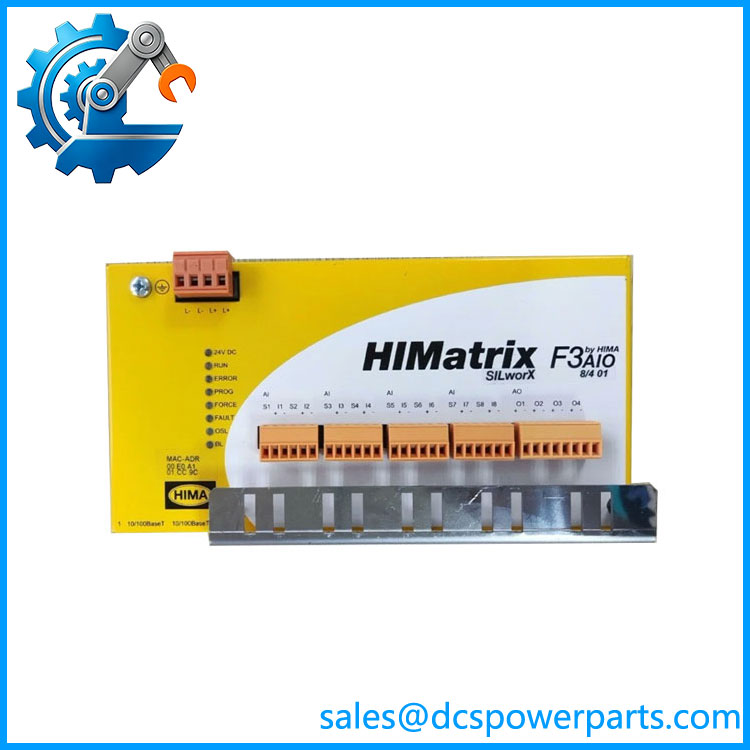
F3AIO8401
Frequently Asked Questions
What is HIMA F3 AIO 8/4 01 used for?
The F3 AIO 8/4 01 is a HIMatrix analog remote I/O device used to extend the I/O level of HIMatrix and HIMax controllers.
Its standard configuration provides:
- 8 safety-related analog inputs
- 4 non-safety-related analog outputs
- 2 Ethernet ports
- SafeEthernet communication with the associated controller
The device itself does not execute the user application.
Are all four analog outputs safety-related?
No.
This is an important specification detail. HIMA’s certification documentation identifies the F3 AIO 8/4 01 as having 8 safety-related analog inputs and 4 analog outputs that are not safety-related.
Therefore, if the application requires a safety-rated analog output function, the F3 AIO 8/4 01 should not automatically be selected simply because the module itself carries safety certifications.
Can F3 AIO 8/4 01 run my PLC or safety logic?
No.
It is a remote I/O device. The user program runs in the associated HIMatrix or HIMax controller, while the F3 AIO communicates the field values through SafeEthernet. HIMA explicitly states that the remote I/O itself cannot run a user program.
This distinction matters during a HIMatrix system upgrade: replacing the F3 AIO does not mean transferring the entire application into the I/O unit.
Can I hot-swap the HIMA F3 AIO 8/4 01?
I would not treat it as a generic hot-swappable I/O module.
The manual provides specific installation, replacement, startup, and safety procedures for the device. Before replacement, verify the controller state, system redundancy, SafeEthernet configuration, field wiring, and plant maintenance procedure.
After installation, confirm communication and validate every affected analog channel.
What is the difference between F3 AIO 8/4 01 and F3 AIO 8/4 011?
They belong to the same basic F3 AIO family but represent different environmental variants.
The HIMA manual lists separate product-data sections for the standard F3 AIO 8/4 01, the 011 −20°C variant, and the 012 subsea / −20°C variant.
For procurement, match the complete part number and environmental rating rather than ordering by F3 AIO 8/4 alone.
Does F3 AIO 8/4 01 support firmware v3.1?
Firmware compatibility must be checked against the exact hardware revision and engineering environment.
The product label itself contains a firmware revision index and hardware revision index, according to the HIMA manual. The manual also distinguishes systems configured with SILworX from earlier ELOP II Factory environments. Projects created in one environment cannot simply be edited in the other.
For a replacement, record the existing:
- Hardware revision
- Firmware revision
- SILworX/ELOP II environment
- Controller type
- SafeEthernet configuration
- I/O configuration
How should I verify a New Surplus F3 AIO 8/4 01?
For a safety-related remote I/O device, “powers on” is not enough.
I would request:
- Exact model and part-number photograph.
- Hardware revision and firmware revision.
- Serial number and manufacturing information.
- 24 VDC power-up test.
- Ethernet port and SafeEthernet communication test.
- Verification of all 8 analog input channels.
- Verification of all 4 analog output channels.
- Input/output terminal inspection.
- Diagnostic LED verification.
- Functional test report.
One point deserves special attention: HIMA’s documentation identifies a 10-year metrological accuracy period for the analog outputs, followed by recalibration. For a safety-system replacement, the age and calibration history of a surplus unit should therefore be documented rather than assumed acceptable simply because the hardware is unused.