Description
Product Introduction (Non-Templated)
Power plant engineers facing unexpected excitation regulator faults inside high-voltage turbine cabinets face severe grid reliability risks and strict restoration deadlines. When a legacy digital signal processor board throws unrecoverable watchdog errors or fails to maintain gate firing synchronization, securing an exact hardware drop-in is mandatory to prevent prolonged unit outages.
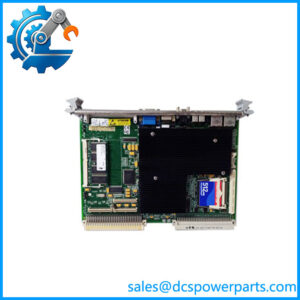
The IS200DSPXH1DBC provides precision high-speed data processing and bridge regulation within GE’s EX2100 and Innovation Series architectures. Deploying this direct replacement card restores closed-loop exciter control and system stability without forcing complex cabinet wiring redesigns.
Key Technical Specifications
- Board Type: Digital Signal Processor Control Board (DSPX)
- System Compatibility: GE EX2100 Excitation and Innovation Series Drive Systems
- Processor Core: High-performance Digital Signal Processor operating at 60 MHz
- Memory Architecture: On-board FLASH, RAM, and NVRAM configuration storage
- Environmental Protection: Conformal-coated PCB shielding against moisture and airborne contaminants
- Operating Temperature Range: -30°C to 65°C (-22°F to 149°F)
- Interrupt System: Four external interrupt channels for real-time priority handling (stack overflow, loop load pulses)
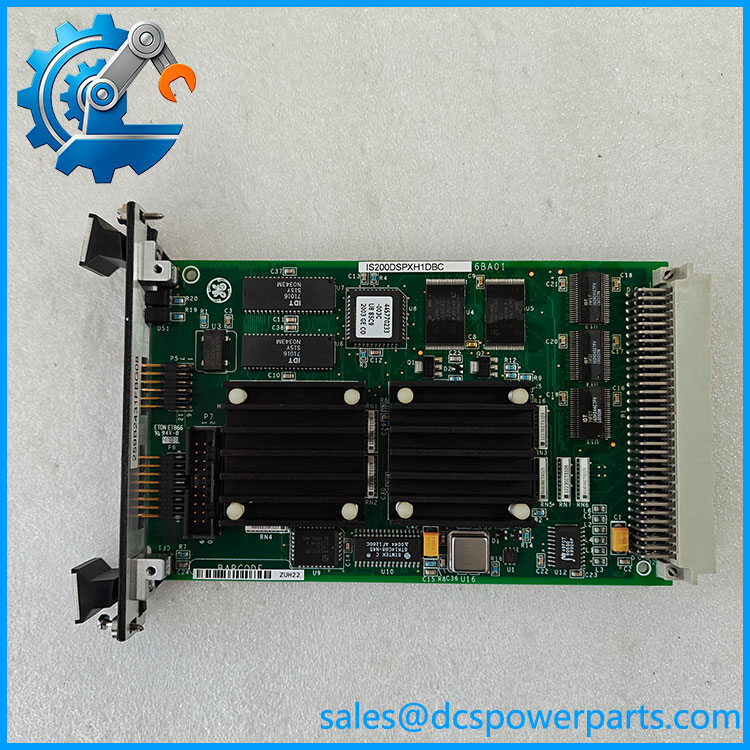
IS200DSPXH1DBC
Application Scenarios & Pain Points
Excitation system trips on large utility generators drop reactive power support instantly, creating severe voltage instability and exposing operators to heavy financial penalties.
- Power Generation: Managing generator field current regulation and thyristor bridge firing loops on heavy steam and gas turbine skids.
- Heavy Industrial Drives: Regulating high-current DC motor drives where execution lag causes speed control jitter.
- Utility Substations: Controlling excitation feedback loops exposed to aggressive electromagnetic interference and harsh thermal swings.
A combined-cycle power facility in the Midwest faced recurrent excitation bridge faults during peak summer ambient temperature shifts. Swapping out the erratic processor board for a verified surplus IS200DSPXH1DBC cleared the internal fault registers and restored stable excitation control immediately.
Related Products
- DS200DCFBG1BLC: Mark V excitation control and power distribution board; handles similar high-voltage gating duties on legacy systems.
- IS200EPVCH1A: Excitation control processor board; coordinates high-level generator regulation logic alongside DSPX interface cards.
- IS220PPRFH1B: PROFIBUS master gateway module; handles industrial network bus communications outside of exciter cabinets.
- IC086SLM082: Genius bus controller module; manages serial node networks within older GE automation architectures.
- RXE2N0F7G132A: GE RXi-XP industrial PC; manages high-level SCADA visualization separate from low-level exciter hardware cores.
The Engineer’s Guide: Field Pitfalls to Avoid
- Failing to Match Revision Suffixes: Dropping a replacement board with an unverified or mismatched suffix code (-DBC variants) into an active rack can trigger configuration locks in the software suite. How to avoid: Cross-reference the exact catalog string and hardware revision suffix on your original unit against the replacement label before landing connections.
- Electrostatic Discharge (ESD) Vulnerability: Handling static-sensitive circuit traces without an active grounded wrist strap can instantly fry onboard microchips. How to avoid: Discharge your static potential against the metal enclosure backplane before touching any component pins (watch your torque on those terminal screws—overtightening strips the block threads easily).
- Ignoring Parameter and Firmware Loading: Replacing the board without verifying the application code image can result in execution mismatches. How to avoid: Utilize the dedicated tool port loading procedures outlined in manual GEI-100488 to ensure proper parameter configuration prior to commissioning.
Frequently Asked Questions (FAQ)
- Can the IS200DSPXH1DBC be hot-swapped in a live excitation cabinet? No, standard industrial safety protocols require cutting all excitation and control power to the rack before pulling or seating processor cards to prevent electrical arcing.
- What causes internal component degradation on older DSPX boards? Over extended operational lifespans, electrolytic capacitor drying, thermal stress cycling, and dust accumulation are the primary drivers of hardware failure.
- Are factory-sealed surplus units tested prior to shipment? Yes, verified surplus components undergo comprehensive bench simulation testing to validate clock speed, memory integrity, and gating response times.
- Does this board require software configuration updates upon installation? Because it functions as a central processor unit, you must verify that the application code and parameters match your facility’s specific excitation profile using the system software tools.
- What is the purpose of the conformal coating on the PCB? It provides a protective barrier against moisture, sulfur, and conductive dust common in heavy industrial and power generation environments.