Description
Product Introduction
When a plant needs to check cooling-water flow, investigate a suspected restriction, or verify a process line without shutting it down, installing a permanent flow meter may not be practical. The GE Panametrics TransPort PT878 addresses this task with clamp-on ultrasonic measurement, allowing technicians to collect flow data from the outside of a suitable pipe.
The GE PT878 portable ultrasonic flow meter supports flow velocity, volumetric flow, and totalized-flow measurements, with logging and optional energy-measurement accessories. For procurement, the meter alone is not the complete system: confirm transducer compatibility with the pipe diameter, material, wall thickness, and operating temperature.
Key Technical Specifications
| Parameter | Specification |
|---|---|
| Manufacturer | GE Panametrics / GE Measurement & Control |
| Model | PT878 |
| Product family | TransPort |
| Measurement principle | Transit-time ultrasonic |
| Measurement channel | Single channel |
| Measured medium | Acoustically conductive liquids; suitability depends on fluid and installation conditions |
| Flow velocity range | Approximately ±0.03 to ±12.2 m/s in the documented operating range |
| Typical clamp-on accuracy | Approximately ±1–2% of reading for pipe IDs over 150 mm; ±2–5% for smaller pipe IDs under specified conditions |
| Repeatability | Approximately ±0.1–0.3% of reading |
| Measurement values | Flow velocity, volumetric flow, totalized flow |
| Display | Backlit 240 × 200 pixel graphic LCD |
| Data logging | More than 100,000 data points in documented configurations |
| Analog output | One current output, configurable for 0/4–20 mA |
| Digital output | Selectable pulse totalizer or frequency output |
| Analog inputs | Two 4–20 mA inputs for temperature transmitters |
| Communication | USB and/or infrared interface depending on supplied configuration |
| Power | Rechargeable battery; charger input documented at 100–250 VAC, 50/60 Hz |
| Enclosure | Submersible, IP67 in the documented PT878 specification |
| Operating temperature | −20°C to +55°C for the instrument in the cited manual |
| Transducer range | Depends on transducer model; standard and high-temperature options differ |
Specifications above are drawn from PT878 documentation; accuracy is conditional, not a guaranteed result for every pipe and fluid. Pipe size limits also vary by transducer kit, so verify the exact accessories supplied with the instrument.
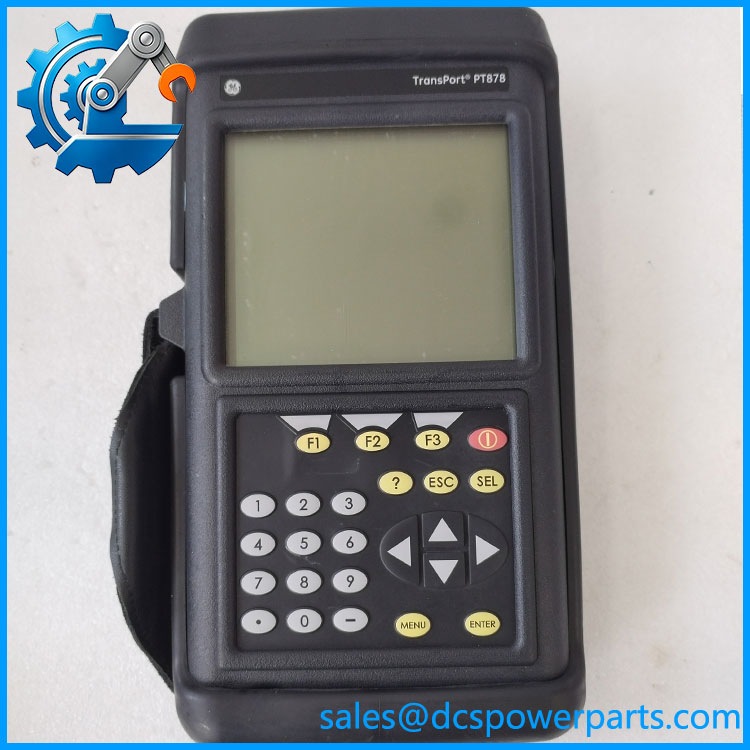
PT878
Application Scenarios & Pain Points
A flow reading that looks wrong can originate from poor sensor coupling, incorrect pipe data, an unsuitable measurement location, or actual process changes. The PT878 is useful for temporary measurements and troubleshooting, provided the pipe and fluid are suitable for transit-time measurement.
- Cooling-water systems: Check flow in plant cooling loops and investigate suspected restrictions without breaking into the pipe.
- Water and wastewater treatment: Perform spot checks on compatible liquid lines and compare readings across operating conditions.
- Chemical and hydrocarbon processing: Conduct temporary flow surveys on suitable liquid lines after verifying fluid compatibility and acoustic conditions.
- HVAC and energy audits: Combine flow measurement with compatible temperature transmitters and the appropriate energy kit to evaluate thermal performance.
Field note: A portable meter is only as useful as its setup. Enter the correct pipe outside diameter, wall thickness, material, liner details where applicable, and fluid properties. Poor straight-run conditions or inadequate acoustic coupling can compromise readings even when the instrument itself is functioning normally.
Related Products
The following instruments and accessories are relevant to portable ultrasonic flow measurement. They differ in purpose and should not be treated as direct substitutes without checking the application.
- GE Panametrics — Portable transit-time meter for temporary, non-invasive liquid-flow measurements.
- GE Panametrics PT900 — A newer portable ultrasonic flow-meter platform to evaluate for field measurement requirements; verify transducer and software compatibility separately.
- GE Panametrics PanaFlow — A broader flow-measurement product family with different installation and application options.
- transducer kit C-RS-402 — A transducer option documented for applications from −40°C to +150°C and pipes approximately 2–24 inches in size.
- transducer kit CF-LP-2EM-40HM-6 — A documented high-temperature option for approximately −40°C to +230°C applications on smaller pipes; confirm the complete kit specification.
- energy kit — Adds matched Pt1000 surface-mount RTDs and associated interfaces for compatible energy-measurement applications.
- thickness-gauge accessory — Supports optional pipe-wall thickness measurement; confirm that the supplied instrument and accessory configuration support this function.
- USB/infrared interface accessories — Used for data transfer or PC connectivity, depending on the instrument version and accessory supplied.
The ordering guide distinguishes transducer kits by temperature range and pipe-size suitability. Match the accessory part number to the measurement job rather than selecting by the model name alone.
Engineer’s Guide: Three Procurement and Setup Pitfalls
1. Do not buy the meter without checking the transducer kit. Warning: A console without the correct transducers, cables, and mounting fixtures may be unusable for the intended pipe. Confirm pipe diameter, material, wall thickness, liner, and process temperature before ordering.
2. Treat accuracy figures as application-dependent. Check the required straight-pipe run, flow profile, fluid condition, and sensor spacing. Entrained gas, solids, poor coupling, or a badly chosen measurement point can degrade the reading. Compare field results against a trusted reference if the measurement will support a critical process decision.
3. Verify accessories and data interfaces before commissioning. Confirm battery condition, charger compatibility, transducer cable condition, output connectors, data-transfer accessories, and any required software. If energy measurement is needed, verify that the temperature sensors and energy kit are included.
Frequently Asked Questions
Q1: What is the GE Panametrics used for?
It is a portable ultrasonic flow meter for measuring the flow of compatible liquids from outside the pipe. Typical uses include checking cooling water, process liquids, wastewater, and other acoustically suitable fluids without installing an inline meter.
Q2: Does the require cutting the pipe?
No. In its clamp-on configuration, the transducers attach to the outside of the pipe. The pipe must still provide a suitable acoustic path, and correct sensor placement and coupling are essential.
Q3: What pipe sizes can the measure?
The overall system documentation describes a broad range, but the usable range depends on the transducer kit. Some kits target small pipes, while others are intended for larger lines. Confirm the actual transducer model and pipe outside diameter before purchase.
Q4: Is the accurate enough for process verification?
It can be suitable for field checks, but accuracy depends on pipe diameter, sensor arrangement, flow profile, and operating conditions. Published typical figures are around ±1–2% for larger pipe IDs and ±2–5% for smaller pipe IDs in the documented conditions. Do not assume those figures apply to every installation.
Q5: Can the measure energy flow as well as liquid flow?
Yes, when configured with the appropriate temperature-measurement accessories. Energy calculations require compatible temperature inputs and suitable temperature sensors; verify the energy kit and RTD arrangement before ordering.
Q6: What should I check when buying a used or refurbished ?
Request photos of the actual meter and nameplate, a battery and charging check, a functional measurement test, and confirmation of the included transducers, cables, mounting fixtures, and software/interface accessories. Ask for the test conditions and warranty terms in writing. A power-on test alone does not establish measurement accuracy.
Q7: What information should I provide when requesting a replacement or quotation?
Provide the model, serial number, required pipe diameter and material, wall thickness, fluid, operating temperature, and whether you need energy measurement or data logging. Also specify the transducer kit and accessories required, the unit’s condition preference, and the delivery deadline. This helps prevent receiving a meter that is technically correct but incomplete for the field task.