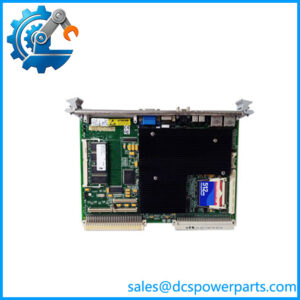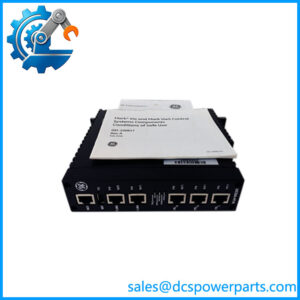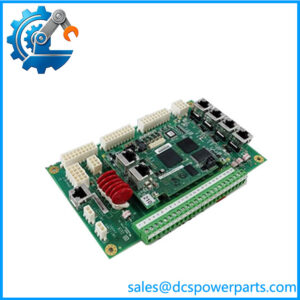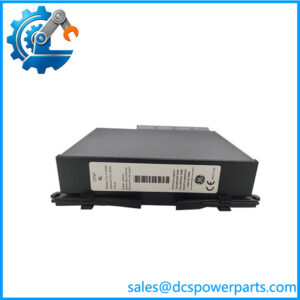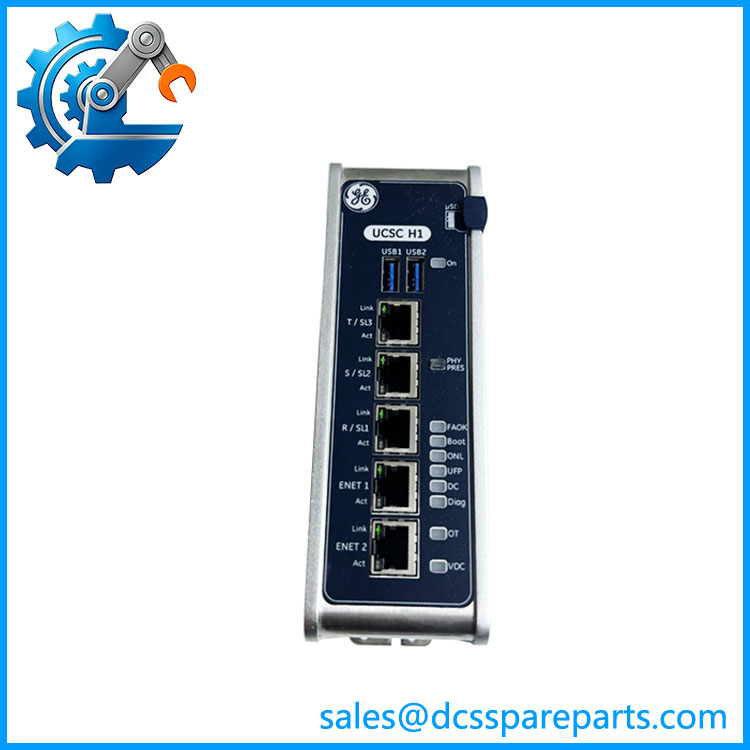
Description
Key Technical Specifications
| Parameter | Specification |
|---|---|
| Manufacturer | GE |
| Model | IS420UCSCH2A-C-V0.1-A |
| Base Model | IS420UCSCH2A |
| Product Type | UCSC Controller Module |
| Control Platform | Mark VIe / Mark VIeS |
| Processor | 1600 MHz Dual-Core AMD G Series |
| Supply Voltage | 18–32 VDC |
| Communication | Ethernet-based control/I/O communications |
| I/O Network | IONet |
| System Architecture | Simplex, Dual, or TMR configurations depending on application |
| Application | Turbine and plant control |
| Typical Systems | Gas turbine, steam turbine, combined-cycle control |
| Battery | No battery |
| Cooling | Forced-air cooling configuration |
| Status Indication | Local diagnostic/status LEDs |
| Hardware Revision | C-V0.1-A |
GE’s current certification documentation identifies IS420UCSCH2A as a UCSx controller using a 1600 MHz dual-core AMD G Series processor. The same certification family includes other UCS controllers with different processor architectures, so the UCSCH2A should not be treated as interchangeable with every IS420UCS variant.
The published controller information also identifies 18–32 VDC as the supply range and describes Ethernet communications, status LEDs, and simplex/dual/TMR system arrangements.
Application Scenarios & Pain Points
A UCSC controller sits much closer to the control logic than an ordinary I/O card. If it fails, the result can extend across I/O communications, turbine sequencing, protective functions, and operator visibility. That is why replacement should be treated as a controlled engineering task rather than a simple board swap.
- Gas turbine control: Used as part of Mark VIe control architectures where the UCSC executes application-specific control functions.
- Steam turbine systems: Suitable for Mark VIe turbine control installations using the corresponding UCSC architecture.
- Combined-cycle plants: The controller can form part of the turbine and balance-of-plant control architecture, with I/O communications distributed through the control network.
- Redundant controller systems: GE documentation describes simplex, dual, and TMR configurations, allowing controller redundancy to be designed according to the application.
Field note: If the controller is being replaced during an outage, record the Ethernet connections before removing it. Labeling each network cable takes minutes; reconstructing an undocumented control-network topology after startup can take considerably longer.
Brief Field Case
A turbine controller can appear electrically healthy while failing to establish the expected I/O network or application state. In that situation, the replacement should be checked against the engineering database, firmware requirements, controller role, and network configuration—not just its part number.
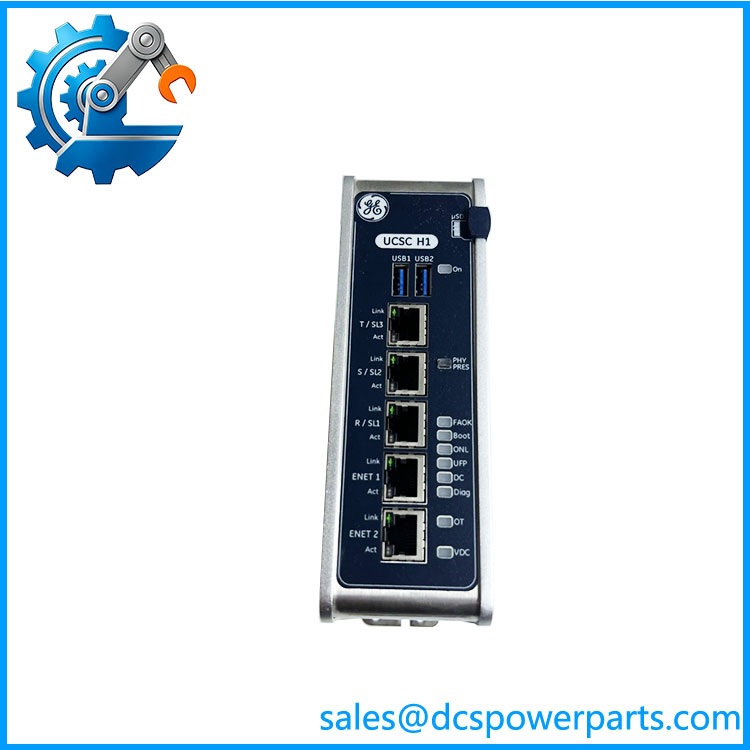
IS420UCSCH2A-C-V0.1-A
Related Products
- GE IS420UCSCH2A — Base UCSC controller designation corresponding to the 1600 MHz dual-core AMD G Series platform. The complete suffix should still be matched for replacement work.
- GE IS420UCSBH1A — Earlier UCS controller using a 600 MHz Intel EP80579 processor. Different processor generation and application requirements mean it is not a direct substitute.
- GE IS420UCSBH3A — 1200 MHz Intel EP80579-based UCS controller. Useful as a related UCS platform but requires application-level compatibility verification.
- GE IS420UCSBH4A — 1066 MHz Intel EP80579 controller variant. Different processing platform and should not be substituted solely on physical form.
- GE IS420UCSBS1A — 600 MHz Intel EP80579-based UCS controller used in Mark VIe/Mark VIeS applications. It belongs to a different hardware configuration.
- GE IS420UCSEH2A — Newer UCS controller using a 2800 MHz quad-core 11th-generation Intel Core i7 processor. Substantially different processing hardware; not a drop-in replacement.
- GE IS420UCSEH2B — 1200 MHz dual-core 11th-generation Intel Core i7 UCS controller. Related platform, but firmware and application compatibility must be established first.
- GE IS420UCSEH2C — Another 1200 MHz dual-core 11th-generation Intel Core i7 UCS variant. It should be considered an alternative platform only after engineering review.
- GE IS420UCSCH1A — Related UCS controller family member referenced in Mark VIe documentation. Processor and hardware configuration differ from UCSCH2A.
- GE IS420UCSCH1B / IS420UCSCH1C — Related UCSCH controller variants appearing in current GE certification records. They are useful for family-level comparison but should not be assumed compatible with the H2A configuration.
The Engineer’s Guide: Field Pitfalls to Avoid
WARNING 1 — Do not ignore the complete C-V0.1-A designation.
The base model IS420UCSCH2A identifies the controller family, but the complete ordering designation includes the hardware/configuration suffix.
How to avoid it: Record the entire label exactly as installed: IS420UCSCH2A-C-V0.1-A. Do not purchase against “UCSCH2A” alone when the application is shutdown-critical.
WARNING 2 — Processor architecture matters.
GE certification material distinguishes the UCS controller families by processor. uses a 1600 MHz dual-core AMD G Series processor, while several visually similar UCS controllers use Intel processors with different clock rates and generations.
How to avoid it: Match the exact controller model and hardware revision rather than selecting a faster-looking UCS module as a replacement.
WARNING 3 — Verify firmware and application compatibility before startup.
A controller can pass a basic power-on test while still being unsuitable for the installed Mark VIe application.
How to avoid it: Before installation, verify:
- Controller hardware revision
- Firmware revision
- ToolboxST project compatibility
- Controller role: simplex, dual, or TMR
- IONet configuration
- Ethernet addressing
- Application download requirements
- Startup sequence and permissives
Also use proper ESD handling. The board may be perfectly functional until a careless handling event says otherwise.
Frequently Asked Questions (FAQ)
What is GE -C-V0.1-A?
It is a GE UCSC controller module for Mark VIe/Mark VIeS control architectures. GE certification information identifies the base as a controller using a 1600 MHz dual-core AMD G Series processor.
It is a controller, not a conventional Mark VIe I/O pack.
What processor does use?
The GE certification documentation specifies a 1600 MHz dual-core AMD G Series processor for .
Some secondary listings incorrectly describe this model as quad-core. For procurement, I would rely on the GE certification data rather than those conflicting descriptions.
Is used with Mark VIe?
Yes. The appears in GE Mark VIe/Mark VIeS controller certification documentation and is included among the UCSx controller processors used in turbine/compressor control configurations.
What is the supply voltage for ?
Available technical information specifies an 18–32 VDC supply range for the UCSC controller family.
Before installation, verify the cabinet’s actual DC supply and grounding arrangement rather than relying only on nominal 24 VDC labeling.
Can replace IS420UCSBH3A?
Not as a routine drop-in replacement. Although both are UCS controllers for Mark VIe-family systems, their processors are different: UCSCH2A uses a 1600 MHz dual-core AMD G Series processor, while UCSBH3A uses a 1200 MHz Intel EP80579.
The application, firmware, ToolboxST configuration, and controller role must all be checked before considering such a substitution.
Does the controller use a battery?
The available controller specifications indicate no battery.
That removes one common maintenance item, but it does not eliminate the need to preserve the controller’s configuration and application information.
What should I request when buying a refurbished -C-V0.1-A?
For a turbine-control spare, ask for the actual unit identification and a meaningful functional test. At minimum:
- Complete label.
- Hardware revision.
- Firmware revision.
- Processor identification.
- Power-up test.
- Ethernet/IONet communication test.
- LED and diagnostic test.
- Configuration/application compatibility statement.
- Actual photographs of connectors and board condition.
- Written warranty.
A “powers on” statement is not enough for a UCSC controller. The useful acceptance test is whether the hardware communicates correctly and can support the intended Mark VIe application.