Description
GE IS420UCSBH4A
Product Overview
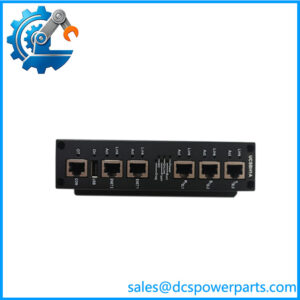
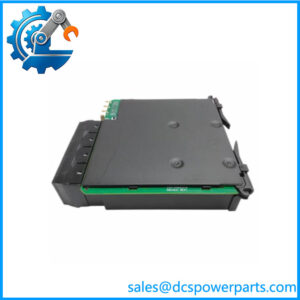
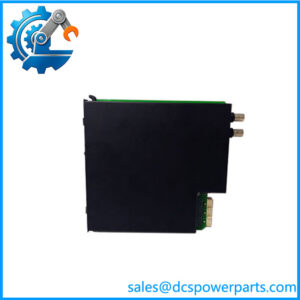
The GE IS420UCSBH4A is a Mark VIe UCSB controller that executes application control logic and manages communications between the control application and distributed Mark VIe I/O. Unlike a conventional PLC CPU mounted in a centralized backplane, the UCSB is a standalone controller installed directly on the control-system panel. Field I/O is distributed through GE’s IONet architecture, allowing the controller to communicate with separate IS220 I/O packs over Ethernet. GE identifies the H4A specifically with an Intel EP80579 processor operating at 1066 MHz.
The GE IS420UCSBH4A belongs to the UCSB controller family used across Mark VIe turbine-control applications and related platforms such as EX2100e and LS2100e. Its H4A designation is important because UCSB processors are not all identical: GE documents the H1A at 600 MHz, H3A at 1200 MHz, and H4A at 1066 MHz. The controller architecture provides three IONet interfaces for I/O communications, while separate Ethernet interfaces handle control-system and engineering communications.
For a Mark VIe controller replacement, the processor number is only one part of the compatibility check. The installed ControlST/ToolboxST release, controller firmware, application configuration, IONet topology, redundancy arrangement, and connected I/O packs all need to be considered. A UCSB controller is not equivalent to a generic industrial computer simply because both use Ethernet and an Intel processor.
Product Introduction
A Mark VIe controller has to do more than execute logic. It must maintain deterministic communication with distributed I/O while coordinating the turbine application and system-level communications. The IS420UCSBH4A addresses that role with a 1066 MHz EP80579 processor and dedicated IONet interfaces.
For a Mark VIe legacy replacement or control-system upgrade, the H4A suffix deserves attention. It identifies a specific UCSB processor generation rather than merely a cosmetic hardware revision.
Key Technical Specifications
| Parameter | Specification |
|---|---|
| Manufacturer | GE |
| Model | IS420UCSBH4A |
| Product Family | Mark VIe |
| Product Type | UCSB Controller Module |
| Controller Architecture | UCSB standalone controller |
| Processor | Intel EP80579 |
| Processor Speed | 1066 MHz |
| Memory | 256 MB DDR2 SDRAM with ECC |
| Local Flash Storage | NAND Flash; exact usable capacity depends on documented configuration |
| Operating System | QNX Neutrino |
| Programming Environment | GE ControlST / ToolboxST |
| I/O Network | 3 × IONet Ethernet interfaces |
| IONet Connector | RJ-45, 10/100BASE-TX |
| Primary Ethernet | ENET1, 10/100BASE-TX RJ-45 |
| Secondary Ethernet | ENET2, 10/100BASE-TX RJ-45; applicability depends on Mark VIe/Mark VIeS configuration |
| Power Input | 18–32 VDC |
| Cooling | Passive / fanless for H4A |
| Mounting | Direct panel mounting |
| Communication | IONet, TCP/IP and applicable Mark VIe control-network protocols |
| Redundancy | Simplex, dual, or TMR system configurations |
| Firmware | ControlST/Mark VIe dependent |
| Application Platforms | Mark VIe, EX2100e, LS2100e and related GE control applications |
GE’s DNV type-approval certificate identifies the IS420UCSBH4A as a UCSB controller using the 1066 MHz Intel EP80579. GE’s Mark VIe product description documents the broader UCSB architecture, including 18–32 VDC supply, IONet interfaces, and controller/network functions.
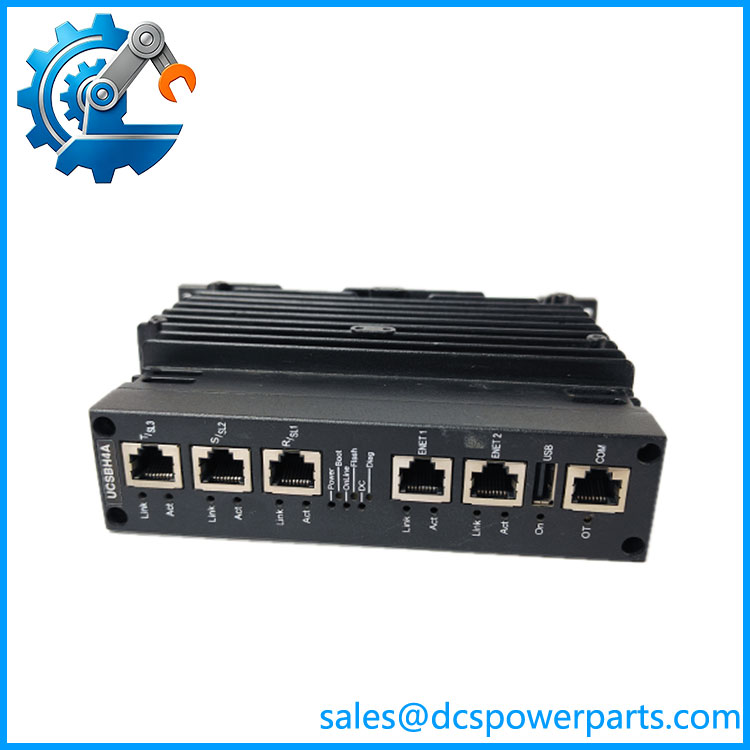
IS420UCSBH4A
Major Features / Practical Advantages
1066 MHz UCSB processing platform
The defining hardware characteristic of the is its 1066 MHz Intel EP80579 processor. GE’s type-approval documentation clearly separates this version from other UCSB processor generations. The H1A uses 600 MHz EP80579 hardware, while H3A is 1200 MHz.
This distinction matters when maintaining an existing installation. Processor generation, firmware, and application compatibility should be checked together rather than treating every UCSB controller as interchangeable.
Standalone Mark VIe controller architecture
The UCSB does not depend on a conventional centralized PLC backplane for field I/O. The controller is mounted directly to the panel and communicates with distributed I/O packs through IONet. GE describes the Mark VIe controller architecture as a compact controller with separate I/O-network and control-network interfaces.
That distributed architecture changes troubleshooting as well. When a controller reports an I/O communication problem, the investigation needs to include the IONet switch, network cable, I/O pack, controller port, and configuration—not just the controller itself.
Three IONet interfaces
The UCSB architecture provides three IONet Ethernet interfaces. GE describes these as 100 MB Ethernet interfaces used for communication with Mark VIe I/O networks. In redundant systems, separate IONet paths support the controller redundancy architecture.
Do not confuse IONet with a plant LAN. It is a dedicated Mark VIe I/O communication network and should be engineered according to GE’s Mark VIe network architecture.
Multiple system configurations
GE documents Mark VIe controller configurations using simplex, dual, and triple-controller arrangements. The UCSB controller architecture therefore supports applications ranging from a single controller to redundant and TMR installations.
The important procurement point is that redundancy is a system configuration, not simply a property of one spare controller. The replacement must match the existing controller arrangement and software configuration.
QNX Neutrino real-time operating system
Available UCSB technical documentation identifies QNX Neutrino as the operating system. The controller executes the configured Mark VIe application rather than functioning as a general-purpose Windows or Linux industrial PC.
This is another reason not to substitute the controller based solely on CPU speed or physical dimensions.
Fanless H4A construction
The H4A version uses passive cooling rather than the redundant-fan arrangement documented for the H3A. GE-related technical references identify the H4A as a fanless UCSB version.
That removes a mechanical fan as a maintenance item, but it does not eliminate thermal concerns. The mounting arrangement must leave the controller’s heat-dissipation surfaces and airflow path unobstructed.
Applications beyond conventional turbine control
The UCSB platform is used in Mark VIe control applications and related GE platforms. GE’s type-approval material lists the controller family in turbine/compressor applications and identifies the H4A processor configuration.
The exact application—gas turbine, steam turbine, excitation, or drive control—should therefore be verified from the installed system documentation rather than inferred from the part number alone.
Related Products
- IS420UCSBH1A — earlier 600 MHz UCSB controller version using the Intel processor family.
- IS420UCSBH3A — 1200 MHz UCSB controller version; different processor-speed generation and cooling arrangement.
- IS420UCSBS1A — 600 MHz UCSB controller variant documented in the same Mark VIe controller family.
- IS220UCSAH1A — earlier UCS controller using a 667 MHz PowerQUICC II Pro processor; not the same UCSB hardware generation.
- IS420UCSEH2A — newer UCSC controller platform using a quad-core Intel Core i7 processor; different controller architecture.
- IS420UCSCH2A — UCSC controller using a dual-core AMD G-Series processor; not a direct UCSB substitute.
- IS220PDIAH1B — Mark VIe discrete-input I/O pack communicating with the controller through IONet.
- IS220PAICH2B — Mark VIe analog I/O pack with 10 analog inputs and 2 analog outputs, including 200 mA capability on the first output.
- IS420ESWBH2A — Mark VIe Ethernet switch family used to build the dedicated control/I/O network architecture.
FAQ
What is GE ?
The is a GE Mark VIe UCSB controller module. It executes the turbine-control application and communicates with distributed I/O packs through IONet.
What processor does use?
It uses an Intel processor at 1066 MHz. GE’s DNV certification documentation explicitly identifies the H4A processor configuration.
How much memory does the H4A have?
The UCSB technical documentation identifies 256 MB DDR2 SDRAM with ECC. NAND flash is also provided for local storage.
What is the difference between and IS420UCSBH1A?
Both are UCSB controllers using the Intel processor family, but the documented processor speeds differ: H1A = 600 MHz; H4A = 1066 MHz.
Do not assume that processor speed is the only difference relevant to a replacement. Firmware, ControlST compatibility, application configuration, and redundancy requirements must also be checked.
Does communicate with IS220 I/O packs?
Yes. The UCSB architecture uses IONet Ethernet to communicate with distributed Mark VIe I/O modules. GE documents three IONet interfaces on the controller.
Can I connect normal Ethernet equipment to IONet?
IONet should not be treated as an ordinary office or plant Ethernet segment. It is the dedicated Mark VIe I/O network used for controller-to-I/O communications. Network design should follow the GE Mark VIe architecture and approved configuration.
Does support TMR?
The Mark VIe UCSB controller architecture supports simplex, dual, and triple-controller configurations. Whether a particular H4A is installed as part of a TMR system depends on the application architecture and configuration.
Can I hot-swap ?
Do not assume that controller replacement is equivalent to hot-swapping a standard PLC I/O module. The UCSB contains the application controller itself. In a redundant Mark VIe system, controller replacement may be performed under specific approved maintenance procedures, but the exact procedure depends on the redundancy arrangement and application.
Does contain a battery?
The UCSB architecture is documented as a battery-free controller design.
What programming software is used?
The controller is configured and programmed through GE’s ControlST / ToolboxST engineering environment. The exact supported software release should be matched to the installed Mark VIe application.
What should I verify when purchasing New Surplus ?
Verify the complete nameplate, hardware revision, serial number, processor designation, physical connectors, flash/storage condition, and evidence of functional testing. Then confirm the required ControlST release, firmware compatibility, controller redundancy arrangement, and IONet configuration.
A listing that simply states “Mark VIe UCSB controller” is not enough. The H4A processor generation is specifically identified by GE and should be matched to the installed system.
Procurement Note
The is a controller-level spare, so procurement mistakes here are more consequential than with a conventional I/O card.
Before releasing an order, verify:
- Exact catalog number: .
- H4A hardware revision.
- Intel , 1066 MHz processor.
- 256 MB ECC DDR2 memory configuration.
- QNX Neutrino operating environment.
- Mark VIe application and ControlST release.
- Installed firmware revision.
- Simplex, dual, or TMR controller arrangement.
- Three IONet network connections.
- ENET control-network configuration.
- Connected IS220 I/O-pack population.
- Actual functional test status.
- Nameplate and serial-number information.
- Physical condition of Ethernet ports, power connector, and heatsink.
One field distinction is worth emphasizing: is not simply a faster replacement for every UCSB controller. GE documents separate H1A, H3A, and H4A processor configurations, so the installed application’s hardware and software baseline should be checked before treating one version as a substitute for another.
For a legacy Mark VIe installation, the correct replacement assessment is controller hardware + firmware + ControlST release + redundancy architecture + IONet topology, rather than processor speed alone.