Description
GE IS400TCASH1AGD Core Analog PCAA Terminal Board
Product Introduction
The GE IS400TCASH1AGD is a Core Analog (PCAA) module terminal board used in the GE Mark VIe turbine control architecture. Its role is to provide the field-side termination and signal-routing interface for the associated PCAA analog I/O pack. It is therefore not a standalone processor or conventional analog input module. The terminal board forms part of the Mark VIe distributed I/O assembly, connecting field instrumentation to the PCAA electronics responsible for processing the incoming and outgoing signals. Current records specifically identify the board as a PCAA terminal board and associate it with the IS230PCAAH1B Core Analog I/O pack.
The GE IS400TCASH1AGD supports a broad group of turbine-control signal functions through the PCAA architecture. Documented applications include thermocouple inputs, 4–20 mA process signals, seismic inputs, LVDT excitation and feedback, pulse-rate inputs, and servo-coil outputs. In simplex systems, the terminal-board arrangement can serve a single PCAA; in redundant Mark VIe configurations, multiple PCAA modules can be associated with the terminal-board architecture. The TCAT and JGPA boards may also form part of the complete installation depending on the system configuration.
For procurement, the exact suffix matters. The supplied IS400TCASHIAGD should normally be searched and ordered as IS400TCASH1AGD, using the numeral 1 after “H.” Current records consistently use IS400TCASH1AGD. Before installation, the board marking, associated PCAA hardware, redundancy arrangement, terminal wiring, and electronic identification should be checked against the existing Mark VIe configuration.
Technical Specifications
| Parameter | Specification |
|---|---|
| Product Model | IS400TCASH1AGD |
| Manufacturer | General Electric (GE) |
| Product Type | Core Analog (PCAA) Module Terminal Board |
| Control System | Mark VIe |
| Associated I/O Pack | IS230PCAAH1B |
| Primary Function | Analog field termination and signal routing |
| Thermocouple Signals | Supported through PCAA architecture |
| 4–20 mA Signals | Supported |
| Seismic Inputs | Supported |
| LVDT | Excitation and feedback |
| Pulse-Rate Inputs | Supported |
| Servo-Coil Outputs | Supported |
| Redundancy | Simplex / TMR architecture |
| Related Terminal Board | TCAT, depending on configuration |
| Related Ground/Power Board | JGPA |
| Ethernet | Handled by associated PCAA I/O pack |
| Standalone Communication Protocol | None |
| External Power | Verify complete Mark VIe assembly |
| Mounting | Mark VIe control cabinet terminal-board assembly |
| Operating Temperature | Verify against applicable GE Mark VIe documentation |
| Protection Rating | Not established for the bare terminal board |
| Dimensions | Secondary listings report approximately 160 × 160 × 120 mm package/assembly dimensions; verify physical board dimensions before installation |
| Weight | Secondary listings report approximately 0.8 kg; verify actual assembly weight |
The signal-function information is supported by current product records describing the /PCAA architecture. Some secondary listings publish much more specific electrical, environmental, isolation, and hazardous-area figures; those figures are not sufficiently corroborated here and should not be treated as definitive specifications for the bare terminal board.
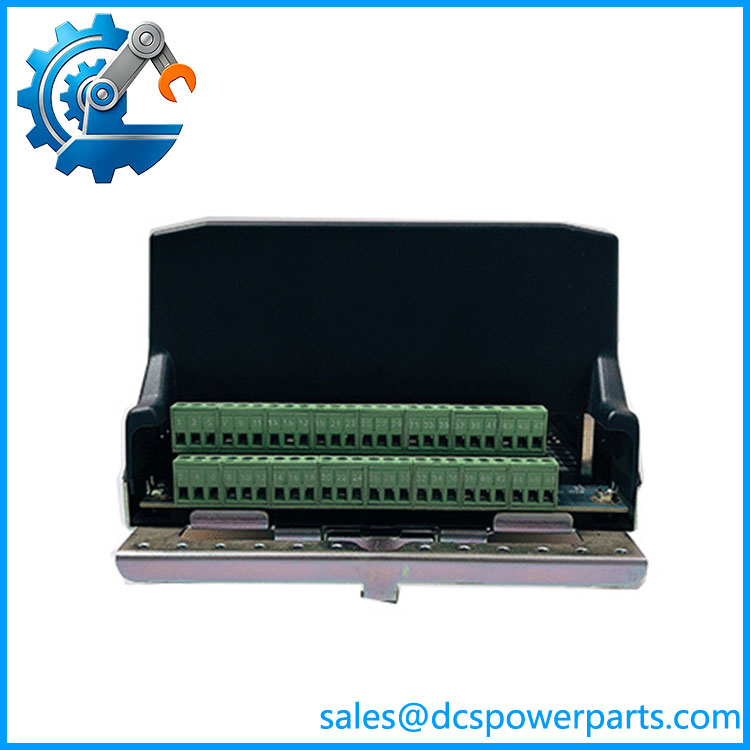
IS400TCATHIACB
Main Features and Engineering Considerations
PCAA Field Interface
The primary purpose of is field termination and signal routing for the Mark VIe PCAA architecture. It should not be confused with the IS230PCAAH1B I/O pack itself. The PCAA pack contains the active electronics, while the terminal board provides the physical interface between field wiring and the I/O pack.
Broad Analog Signal Coverage
The associated PCAA architecture handles several signal categories required in turbine control. These include thermocouples, 4–20 mA signals, seismic measurements, LVDT excitation/feedback, pulse-rate inputs, and servo-coil outputs. This makes the terminal-board wiring arrangement substantially more important than the board’s simple appearance might suggest.
Simplex and Redundant Configurations
The PCAA architecture can be used in simplex and TMR arrangements. In a TMR installation, the signal-routing arrangement extends across multiple PCAA modules and associated network connections. A replacement terminal board therefore needs to be checked against the actual R/S/T controller arrangement rather than treated as an isolated board.
TCAT and JGPA Relationships
The complete Mark VIe analog I/O installation may include TCAT and JGPA hardware alongside the PCAA assembly. Current installation information describes PCAA-to-TCAT connections through dedicated cables and JGPA connections for shield grounding and field power. These relationships should be documented before removing an installed terminal board.
Electronic Identification
Available installation information indicates that the PCAA and associated terminal hardware have electronic identification relationships. A mismatch between the acquisition/processor hardware and terminal-board configuration can produce diagnostics or prevent correct operation. This makes revision and configuration checking important during replacement.
Signal Integrity
Because the board interfaces directly with low-level analog and turbine instrumentation signals, field wiring condition matters. Thermocouple polarity, shielding, LVDT wiring, current-loop polarity, servo connections, and shield-ground arrangements should be documented before disconnecting the original assembly.
Application Scenarios
- GE Mark VIe gas turbine control systems
- Steam turbine control applications
- Combined-cycle power-generation systems
- Turbine analog instrumentation
- Process-current signal interfacing
- Thermocouple temperature measurement
- LVDT position measurement
- Seismic and vibration-related inputs
- Servo actuator control
- Mark VIe PCAA maintenance and replacement
Engineer’s Guide: Field Pitfalls
Use the correct part-number spelling. The supplied IS400TCASHIAGD should normally be checked against . The numeral 1 is part of the documented identifier.
Do not confuse the terminal board with the PCAA I/O pack. is the interface/terminal board; IS230PCAAH1B is the associated Core Analog I/O pack identified in current records.
Check the TCAT relationship. TCAT can be part of the same analog I/O architecture, particularly in redundant configurations. Do not assume that another TCAS/TCAT board is interchangeable simply because the names are similar.
Check simplex versus TMR wiring. A terminal-board replacement in a TMR installation requires attention to all associated PCAA modules and their R/S/T network and cable relationships.
Photograph every connector before removal. Record P1/P2 and other cable positions, terminal numbers, shield connections, and field wiring. This is especially important where multiple redundant PCAA channels are installed.
Do not assign unsupported electrical ratings. Secondary sources publish conflicting values for isolation, temperature, IP rating, and other parameters. These should be confirmed against the applicable GE Mark VIe hardware documentation before being used as acceptance criteria.
Inspect the complete signal path. If the board is being replaced because of an analog-channel problem, inspect the PCAA I/O pack, TCAT/JGPA hardware, field wiring, shield grounding, and sensor circuits before assuming the terminal board itself is defective.
Frequently Asked Questions
What is GE ?
It is a Core Analog (PCAA) module terminal board for the GE Mark VIe control system.
Is a PCAA I/O pack?
No. It is the terminal board associated with the PCAA I/O architecture. The current records associate it with the IS230PCAAH1B Core Analog I/O pack.
What signals can the associated PCAA architecture handle?
The documented signal functions include thermocouple, 4–20 mA, seismic, LVDT excitation/feedback, pulse-rate, and servo-coil signals.
Is used in TMR systems?
Yes. Current installation information describes the PCAA/terminal-board architecture for both simplex and TMR configurations.
Does have its own Ethernet communication?
The terminal board itself should not be treated as an independent Ethernet communication module. Ethernet connectivity is associated with the PCAA I/O pack and the Mark VIe IONet architecture.
What is the difference between and IS400TCASH1A?
They are closely related identifiers, but the complete suffix should be matched to the installed system. Current records specifically identify as the required PCAA terminal-board configuration.
Procurement Note
Specify in the purchase description and verify that the physical board marking uses the numeral 1, not the letter I. Request photographs of the board label, terminal blocks, connectors, and revision markings before acceptance.
For a replacement unit, verify the associated IS230PCAAH1B PCAA I/O pack, simplex/TMR configuration, TCAT/JGPA hardware, cable arrangement, and electronic identification. A board that is physically similar but from a different Mark VIe analog-I/O configuration should not be treated as an automatic substitute.