Description
Product Overview
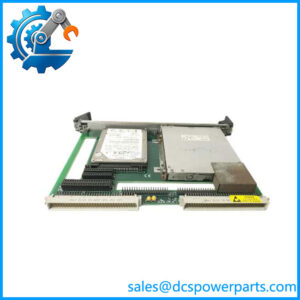
IS220YAICS1A is the analog I/O pack of the Mark VIeS functional safety control, and its code says so twice: Y marks the safety line and S1 marks the safety variant of the design, exactly as YSIL, YDIAS and YDOAS do across the family. It is the safety counterpart of the standard analog pack — same role in the architecture, different obligation. Where the standard pack has to be accurate, this one has to be accurate and provable, and the difference shows up in how the output stage is built rather than in the channel count.
The channel complement is twelve per terminal board: ten analog inputs and two analog outputs, with the inputs split into two range groups. Channels 1 through 8 accept 1–5 V DC, ±5 V DC, ±10 V DC or 0–20 mA, which covers the ordinary mix of transmitter loops and bipolar voltage signals. Channels 9 and 10 accept 0–20 mA or a ±1 mA span — a deliberately narrow pair for a small-signal current device or a channel where the resolution of a ±1 mA window is worth more than the flexibility of a wide range. Conversion is 16-bit on the input side, which is what makes a ±1 mA span usable in the first place: a narrow range is only an advantage if the converter can resolve within it.
The output stage is where this pack differs from a conventional analog output. Two 0–20 mA outputs with 18 V compliance are commanded by a 14-bit digital-to-analogue converter, which sets a current reference for a regulator loop that senses the current in two places: in the pack and on the terminal board. In a TMR arrangement the three packs’ regulators share the commanded current load. Two current measurements per output, taken at both ends of the path, mean the delivered current can be compared against the commanded current and against what the board sees — the loop is not merely driven, it is checked. That is the discipline a safety output needs, because an output that quietly delivers 60 % of its command is more dangerous than one that fails outright.
Scan rate is a configuration decision with a cost. The controller supports 10, 40, 80 and 160 ms I/O scan rates, and choosing 10 ms on every channel consumes processor capacity that a safety controller may need elsewhere. The practical approach is to set the scan rate from the process time constant — a fuel gas pressure trip does not need 10 ms, and a valve position feedback loop may — rather than from a habit of setting everything fast.
Redundancy is structural. The module runs simplex or TMR, with TMR needing three packs on a board that provides three positions; the pack is the replaceable element and the terminal board holds the field terminations, so a failed pack is swapped without touching a single field wire. In a safety system that matters more than in a control system, because every disturbance to field wiring is a disturbance to a proof-tested installation.
The approved terminal boards carry the safety designator as well: IS200STAIS1A and IS200STAIS2A, the compact boards, and IS200TBAIS1C, the barrier-type full-size board, with RoHS equivalents in the IS400 series. GE’s EU Declaration of Conformity enters IS220YAICS1A as “Mark VIeS Control Analog I/O Module” with those accessories and marks the combination Ex ic nA [ic] IIC T4 Gc, declared against EN IEC 60079-0:2018, EN 60079-7:2015+A1:2018, EN 60079-11:2012 and EN 60079-15:2010. The current IECEx certificate covers the later B revision of the same product line at Ex ic ec [ic] IIC T4 Gc over −40 to +70 °C, which is the pattern to keep in mind: the IS220-prefix safety analog pack and the IS420-prefix one are the same function in two generations, and a hazardous-location cabinet needs the certificate issue that names the revision actually installed.
One point of professional honesty belongs in the specification rather than in the marketing. The Mark VIeS platform is the safety control built to IEC 61508, and the pack is its analog I/O element, but a SIL claim does not attach to a catalog number. It attaches to the configured safety instrumented function — sensor, terminal board, pack, logic solver, final element and proof-test interval, assessed together. A pack bought as a spare inherits the SIL of the loop it is installed in, and only if the loop’s assessment says so.
Technical Specifications
| Parameter | Value |
|---|---|
| Model | IS220YAICS1A — IS220 prefix, YAIC safety analog I/O, S1 safety variant, revision A |
| Manufacturer | GE Drives & Controls, Inc., 1501 Roanoke Blvd., Salem, VA 24153, USA |
| Product type | Mark VIeS safety analog I/O pack (pack only) |
| Functional description | Mark VIeS Control Analog I/O Module, per GE EU Declaration of Conformity 116T4889 |
| Channels | 12 per terminal board — 10 analog inputs, 2 analog outputs |
| Analog input ranges | Channels 1–8: 1–5 V DC, ±5 V DC, ±10 V DC or 0–20 mA; channels 9–10: 0–20 mA or ±1 mA |
| Input conversion | 16-bit ADC |
| Analog outputs | 2 × 0–20 mA, 18 V compliance; 14-bit DAC commanding a current reference |
| Output current sensing | Sensed in the pack and on the terminal board; in TMR the three packs’ regulators share the commanded current load |
| I/O scan rates | 10 ms, 40 ms, 80 ms, 160 ms |
| Redundancy | Simplex, or TMR with three packs and one terminal board |
| Approved terminal boards | IS200STAIS1A, IS200STAIS2A, IS200TBAIS1C; RoHS equivalents IS400STAIS1A, IS400STAIS2A, IS400TBAIS1C |
| Hazardous location — ATEX DoC | Ex ic nA [ic] IIC T4 Gc; EN IEC 60079-0:2018, EN 60079-7:2015+A1:2018, EN 60079-11:2012, EN 60079-15:2010 |
| Hazardous location — IECEx (B revision) | Ex ic ec [ic] IIC T4 Gc, −40 to +70 °C |
| Platform conformity | Mark VIeS safety control, designed for IEC 61508 applications |
| Power consumption | 5.3 W reported for the IS420YAICS1B form of the same module |
| Newer generation | IS420YAICS1B — same 12-channel function, later pack prefix |
| Configuration tooling | ControlST / ToolboxST, with the Mark VIeS lock and unlock function for configuration and safety function programming |
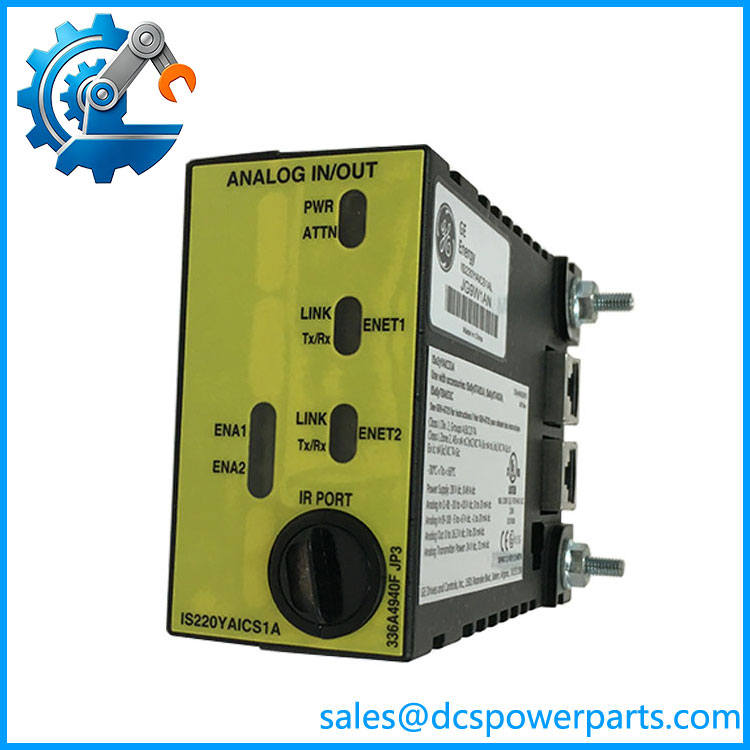
IS220YAICS1A
Key Features and Advantages
Two current measurements per output: the regulator loop senses current in the pack and on the terminal board, so a delivered current can be checked against the command and against the board’s own reading rather than assumed.
TMR that shares the load: three packs’ regulators share commanded current in a TMR arrangement, which is how a redundant analog output stays a single physical current rather than three competing sources.
16-bit input conversion: resolution that makes the deliberate ±1 mA pair on channels 9–10 useful, instead of a narrow range wasted on a coarse converter.
Two range groups by design: wide voltage and current spans on the first eight channels, a small-signal current window on the last two, so the cabinet’s awkward measurement gets an appropriate channel instead of being scaled into a wide one.
Configurable scan rate: 10/40/80/160 ms lets the safety function’s timing be matched to the process instead of defaulting every channel to the fastest rate.
Pack-and-board separation: field terminations stay on the terminal board, so a pack replacement does not disturb a proof-tested installation’s wiring.
Safety-designated accessories: the STAIS and TBAIS boards carry the safety designator, which keeps the approved combination identifiable in a cabinet that also contains standard analog boards.
Declared conformity at the combination level: the pack is declared with its specific accessory boards, so the hazardous-location statement covers the assembly rather than an isolated component.
Applications
Safety pressure trips: low-low fuel gas pressure, high-high differential pressure and lube oil pressure trips where the analog measurement itself is part of the safety function rather than an alarm only.
Safety temperature and process measurements: analog channels feeding the safety logic where a thermocouple or RTD pack is not the appropriate front end and a transmitter loop is the installed instrument.
Safety valve position feedback: analog position signals from final elements, read on a channel group that suits the transmitter’s output.
Combustion and burner management analog inputs: can pressure and flame-related analog signals entering the safety controller alongside discrete inputs.
Fired equipment and package safety systems: skids and packages where a standalone safety control to IEC 61508 is installed next to the turbine control.
TMR safety architectures: three packs on one board, with shared output current and a redundant analog path for each safety function.
Safety and control in the same cabinet: Mark VIeS alongside Mark VIe, where the analog signal types look identical but the packs and terminal boards belong to different design lines and must not be mixed.
Legacy Mark VIeS installations: IS220-prefix packs kept in service where the forward route is IS420YAICS1B on the same approved boards.
Related Products
IS200STAIS1A — approved safety analog terminal board, compact form, the field termination for this pack. IS200STAIS2A — the second approved safety analog board, differing in its field-terminal arrangement. IS200TBAIS1C — full-size barrier-type safety analog board, the TMR-capable position in the family. IS420YAICS1B — the later-generation safety analog pack with the same 12-channel function; the current catalog form. IS220YDIAS1A — Mark VIeS safety discrete input pack, used with the safety contact-input boards. IS220YDOAS1A — Mark VIeS safety discrete output pack, driving the safety relay terminal boards. IS220YTCCS1A — Mark VIeS safety thermocouple input pack, the temperature front end of the same safety line. IS220YHRAS1A — Mark VIeS safety HART-enabled I/O pack, for smart transmitters on the safety side. IS220PAICH1B — the standard, non-safety analog I/O pack; functionally similar and electrically different, and not interchangeable in a safety loop. IS220YSILS1A — Mark VIeS core safety protection module, the safety computation element of the same platform.
Installation and Maintenance
Before installation: confirm the installed terminal board is one of the safety-designated types — IS200STAIS1A, IS200STAIS2A or IS200TBAIS1C — and confirm the revision in hand is the revision the safety function was assessed with. Check the pack’s part prefix against the cabinet generation: an IS220-prefix YAIC and an IS420-prefix unit are the same function but not the same part, and a safety installation should not discover that at a proof test. Where the cabinet is in a classified area, verify the certificate issue that names this revision before energising.
Installation: the pack mounts on the terminal board’s connector positions and carries no field terminations of its own, so installation disturbs no wiring — treat that as the safety advantage it is and do not supplement it with field-side changes. In a TMR arrangement fit three packs to the board’s three positions and confirm each is recognised before the logic is unlocked. All configuration changes go through ControlST / ToolboxST with the Mark VIeS lock and unlock discipline, and the safety function’s scan rate is set from the process requirement rather than from a default. After installation, verify each analog channel at its working range with a traceable source, and verify the outputs into their loads at more than one point so the current-sensing path is exercised rather than merely powered.
Maintenance: proof testing is the maintenance activity that matters on this pack, and it should exercise the whole loop — sensor, board, pack, logic and final element — because the pack’s diagnostics cannot prove a transmitter. Record the pack revision, the terminal board part number and the certificate issue in the safety function’s documentation; a spare that is right in function and wrong in revision is a finding at the next audit. Keep the spare as a pack-plus-board pair, since a pack alone does not constitute a replaceable assembly, and never substitute a standard analog pack into a safety position on the grounds that the connector fits: the PAIC and YAIC lines are deliberately different, and the difference is the reason the safety function was certified.
Warranty and Quality
Every IS220YAICS1A unit is supplied as the Mark VIeS safety analog I/O pack, IS220 prefix with the YAIC functional code and the S1 safety variant at revision A, and is described from GE-issued and GE system-manual material for this module: twelve channels per terminal board comprising ten analog inputs and two analog outputs, inputs 1–8 at 1–5 V DC, ±5 V DC, ±10 V DC or 0–20 mA and inputs 9–10 at 0–20 mA or ±1 mA, 16-bit input conversion, two 0–20 mA outputs at 18 V compliance commanded by a 14-bit DAC through a current regulator loop that senses current in the pack and on the terminal board, TMR operation with three packs whose regulators share the commanded output current, I/O scan rates of 10, 40, 80 and 160 ms, approved use with IS200STAIS1A, IS200STAIS2A and IS200TBAIS1C (and the IS400 RoHS equivalents), marking Ex ic nA [ic] IIC T4 Gc under GE EU Declaration of Conformity 116T4889 against EN IEC 60079-0:2018, EN 60079-7:2015+A1:2018, EN 60079-11:2012 and EN 60079-15:2010, with the later B revision of the line covered by IECEx at Ex ic ec [ic] IIC T4 Gc over −40 to +70 °C, and a reported 5.3 W consumption for the IS420YAICS1B form. Units are inspected for connector and pin condition, board-identification contact cleanliness, housing and label integrity, revision marking, and for evidence of heat damage or prior repair. Three statements are made with their limits attached: the SIL claim belongs to the configured safety instrumented function and not to this catalog number; the IS220 and IS420 forms are the same function in different generations, so the revision must be matched to the site’s assessment; and where a figure is not published — isolation rating, accuracy class in engineering units, channel update behaviour — it is not invented here. A 12-month repair, replacement or refund commitment applies. Technical support covers what this module actually raises: distinguishing the safety YAIC from the standard PAIC before a spare is dispatched, confirming which safety terminal board and revision the installation was assessed with, setting scan rates to the process rather than to a default, and documenting the pack-and-board pair so a proof test and an audit find the same configuration the safety case assumed.