Description
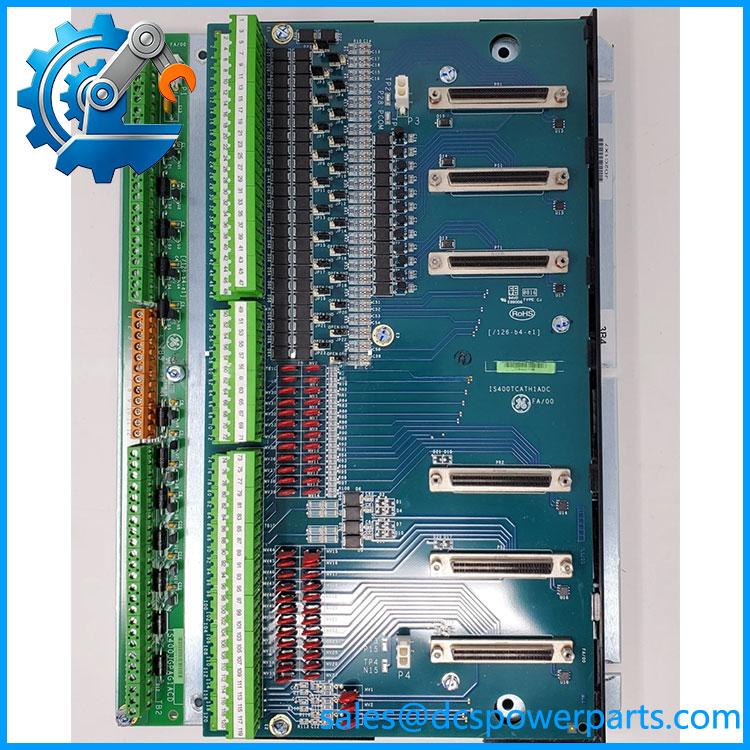
GE IS230TCATH1A — Mark VIe TCAT Core Analog Terminal Board
Product Introduction
Gas-turbine control systems have to bring a large number of field measurements into the control architecture without turning every sensor connection into a separate I/O assembly. GE IS230TCATH1A addresses that requirement as the TCAT Core Analog Terminal Board used with the Mark VIe PCAA core analog architecture. It provides the field-side termination and signal routing needed for analog process measurements, seismic monitoring, LVDT feedback, and pulse-rate signals.
The GE IS230TCATH1A is not a standalone processor. Its practical role is to connect field wiring to one or more PCAA modules through dedicated interfaces and paired 68-pin connections. GE documentation and associated drawings show the TCAT architecture being used in simplex, dual, and TMR arrangements, depending on the turbine control design. That distinction matters during replacement: the terminal board, PCAA hardware, cable pairs, and JGPA field-power arrangement should be checked as one system rather than treating the TCAT as an isolated PCB.
Key Technical Specifications
| Parameter | Specification |
|---|---|
| Product Model | IS230TCATH1A |
| Manufacturer | General Electric (GE) |
| Product Family | Mark VIe |
| Assembly Type | TCAT Core Analog Terminal Board |
| System Role | Core analog field termination / signal distribution |
| 4–20 mA Inputs | 24 |
| Seismic Inputs | 12 |
| LVDT Inputs | 12 windings |
| Pulse-Rate Inputs | 2 magnetic pulse-rate inputs |
| Analog Outputs | 3 hardware-voted 4–20 mA signals |
| Field Terminals | 120 pluggable Euro-style box terminals |
| PCAA Connection | Two 68-pin connections per associated interface path |
| Field Power | 24 VDC field-power terminals provided through the JGPA arrangement |
| Inter-module Supply | 28 VDC and 15 VDC are documented in the TCAT/PCAA architecture |
| Operating Temperature | -30°C to +65°C reported for the applicable Mark VIe distributed I/O environment |
| Installation | Mounted on a metal rear base with insulated plastic carrier |
| Diagnostics | Diagnostics are handled through the associated PCAA architecture |
The channel counts above correspond to available GE-associated wiring documentation and technical descriptions. The exact signal assignment is application-specific; turbine drawings should be treated as the final authority for field-channel usage.
Application Scenarios & Field Considerations
The IS230TCATH1A is primarily encountered in Mark VIe gas-turbine control systems where a common core analog terminal architecture is required.
- 4–20 mA process instrumentation: The TCAT provides termination for transmitter signals used for pressures, temperatures, process conditions, and other turbine measurements. The documented architecture provides 24 analog current inputs.
- Turbine vibration and seismic monitoring: Twelve seismic input positions are associated with the TCAT signal set. This makes correct shielding, grounding, and channel assignment particularly important.
- LVDT-based position feedback: Twelve LVDT windings are accommodated within the core analog signal architecture. This is relevant to turbine valve and actuator feedback circuits.
- Speed or pulse measurement: Two magnetic pulse-rate inputs are documented. These circuits should not be treated as ordinary 4–20 mA inputs; sensor type and expected signal level must match the control-system drawing.
- Redundant control architectures: GE drawings show TCAT implementations associated with simplex and TMR configurations. The physical terminal board may therefore sit inside a much larger redundancy scheme involving multiple PCAA paths.
A common field mistake is to purchase the correct-looking TCAT part number but overlook the PCAA-to-TCAT cable identification and system configuration. The TCAT cable connections incorporate electronic identification, and the cables are used in pairs so the PCAA can verify that the expected TCAT connections are present.
IS230TCATH1A
Related Products
- GE PCAA Core Analog I/O Pack — Active distributed I/O hardware associated with the TCAT terminal architecture. Verify the exact PCAA model and hardware revision.
- GE IS200TCATH1A — Earlier Mark VI analog-module terminal-board designation; do not assume it is a drop-in replacement for IS230TCATH1A.
- GE IS400TCATH1A / IS400TCATH1ADC — Later/alternate TCAT assembly designations appearing in Mark VIe-related documentation and inventories. Exact compatibility requires engineering verification.
- GE JGPA — Adjacent field-power/shield termination assembly associated with the TCAT arrangement.
- GE PCAA-to-TCAT 68-pin cables — Required interface hardware between the active PCAA module and TCAT assembly.
- GE Mark VIe I/O architecture — The wider distributed I/O system in which PCAA and TCAT assemblies operate.
These items should be treated as architecture-related components, not automatic substitutes. A matching connector or similar enclosure does not establish functional interchangeability.
Engineer’s Guide — Field Pitfalls to Avoid
1. Do not confuse TCAT with the active PCAA module
The TCAT is primarily the field termination and signal-distribution side of the core analog architecture. The processing and I/O functions are associated with the PCAA. Replacing a TCAT will not correct a fault originating in the active PCAA hardware.
2. Check the complete terminal-board configuration
appears in turbine-specific wiring drawings with individual channel assignments. A board can be physically correct while the proposed replacement is unsuitable for a particular cabinet configuration. Compare the cabinet drawing, connector designations, terminal assignments, and revision before installation.
3. Inspect both 68-pin cable paths
The TCAT/PCAA interface uses paired 68-pin connections, and electronic identification is part of the architecture. Do not treat these cables as ordinary passive ribbon cables simply because the connectors fit. Cable identity and routing should be verified during replacement.
4. Pay attention to JGPA field power
The adjacent JGPA arrangement provides additional 24 VDC field-power terminals and shield-related termination. If a transmitter or loop is dead after a terminal-board replacement, check the field-power path rather than immediately assuming the PCAA has failed.
5. Do not assume all TCAT boards have the same application wiring
The same general TCAT architecture can accommodate analog transmitters, vibration/seismic signals, LVDT windings, and pulse-rate signals. The actual turbine drawing determines which terminals perform which function.
6. Verify hardware revision before substitution
, IS200TCATH1A, and IS400TCATH1A-related designations should not be mixed merely because their descriptions contain “TCAT.” For an operational turbine controller, verify the exact GE part number, board revision, connector arrangement, associated PCAA hardware, and cabinet drawing.
FAQ
What is the GE ?
The is a GE Mark VIe TCAT Core Analog Terminal Board assembly. It provides field termination and signal routing for the PCAA core analog architecture rather than functioning as an independent processor.
How many analog inputs does support?
The documented TCAT architecture provides 24 channels for 4–20 mA signals, in addition to 12 seismic inputs, 12 LVDT windings, and two magnetic pulse-rate inputs.
Is a PLC I/O module?
Not in the conventional sense. It is a terminal/interface assembly within the GE Mark VIe core analog architecture. The PCAA provides the active distributed-I/O functionality, while the TCAT handles field termination and signal distribution.
Can be replaced by IS200TCATH1A?
Do not assume so. Both are associated with TCAT terminology, but they belong to different GE hardware designations. Replacement should be based on the turbine’s actual hardware configuration, drawings, connector arrangement, and approved GE documentation.
What should be checked when buying a replacement?
At minimum, verify the complete part number, revision, physical connector configuration, TCAT/PCAA cable arrangement, associated JGPA hardware, and the turbine cabinet drawing. For used or refurbished equipment, verify actual inventory condition rather than relying on a generic “tested” description.
Does the TCAT board contain its own controller or processor?
The TCAT itself should not be treated as the system’s processing unit. The Mark VIe core analog architecture uses PCAA I/O packs for the active electronics, with the TCAT providing the field-side interface.
What is the operating temperature?
A -30°C to +65°C range is reported for the applicable Mark VIe distributed-I/O environment. For a replacement installation, use the exact GE hardware documentation and cabinet environmental specification as the design basis rather than relying solely on a reseller listing.