Description
GE IS220YPROS1A
Product Introduction
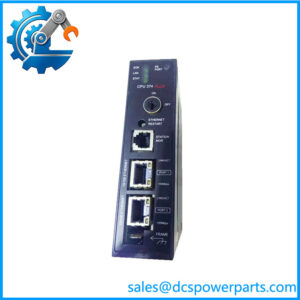
The GE IS220YPROS1A is a Mark VIeS YPRO Backup Turbine Protection I/O Pack designed for turbine protection applications where protection functions must remain independent of the primary turbine control path. Unlike a conventional Mark VIe analog or discrete I/O pack, the YPRO is dedicated to protection functions associated with turbine speed, emergency trip inputs, trip relay operation, and related protective logic. GE documentation identifies the unit as the Mark VIe Control YPRO Backup Turbine Protection module and specifies its use with dedicated YPRO protection terminal boards.
The protection pack forms part of the Mark VIeS safety architecture and can process critical protection signals locally. Published safety-assessment material describes YPRO as a backup or emergency protection I/O pack accepting three speed signals, an E-stop input, seven contact inputs, and driving three trip relay outputs. Speed processing and trip-relay operation are performed locally within the YPRO path rather than depending entirely on controller participation. The same documentation identifies firmware-based and hardware overspeed protection, monitoring of the trip output circuitry, and a non-interfering synchronizing check.
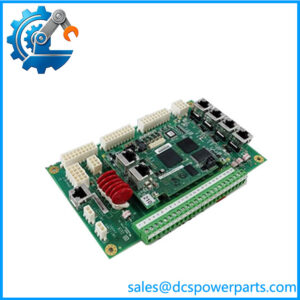
The GE IS220YPROS1A uses a 28 VDC supply, with GE certification documentation specifying 28 VDC and 0.37 A DC for the YPRO/associated protection assembly. The I/O pack communicates through Ethernet IONet connections, while field signals are presented through compatible protection terminal boards. GE identifies IS200SPROS1A, IS200TPROS1C, IS200TPROS2C, and IS200TREAS1A among the applicable terminal-board configurations. Replacement work should therefore treat the I/O pack and terminal board as a matched protection subsystem, not as interchangeable general-purpose I/O hardware.
Technical Specifications
| Specification | Details |
|---|---|
| Product Model | IS220YPROS1A |
| Manufacturer | General Electric |
| Product Family | Mark VIe / Mark VIeS |
| Product Type | YPRO Backup Turbine Protection I/O Pack |
| Application | Turbine protection / emergency backup protection |
| Power Supply | 28 VDC |
| Rated Supply Current | 0.37 A DC |
| Communication | Ethernet IONet |
| Protection Function | Backup / emergency turbine protection |
| Speed Inputs | 3 speed signal inputs |
| E-Stop Input | 1 |
| Contact Inputs | 7 |
| Trip Relay Outputs | 3 |
| Overspeed Protection | Hardware and firmware-based protection |
| Synchronizing Check | Non-interfering backup synchronization check |
| Typical Architecture | TMR protection arrangement |
| Compatible Terminal Boards | IS200SPROS1A, IS200TPROS1C, IS200TPROS2C, IS200TREAS1A and related certified configurations |
| Operating Temperature | 0 to +65 °C for the cited YPRO ATEX configuration |
| Protection Certification | Ex nA / Ex ec IIC T4 Gc variants according to applicable certification |
| Firmware Examples | V03.02.07C, V03.02.22C, V03.02.23C documented in Mark VIeS safety assessment |
GE’s certification documentation specifies the 28 VDC / 0.37 A electrical rating and lists the YPRO module with the associated TPRO/SPRO/TREA protection terminal boards. The historical Mark VIeS safety assessment provides the detailed signal count and functional description.
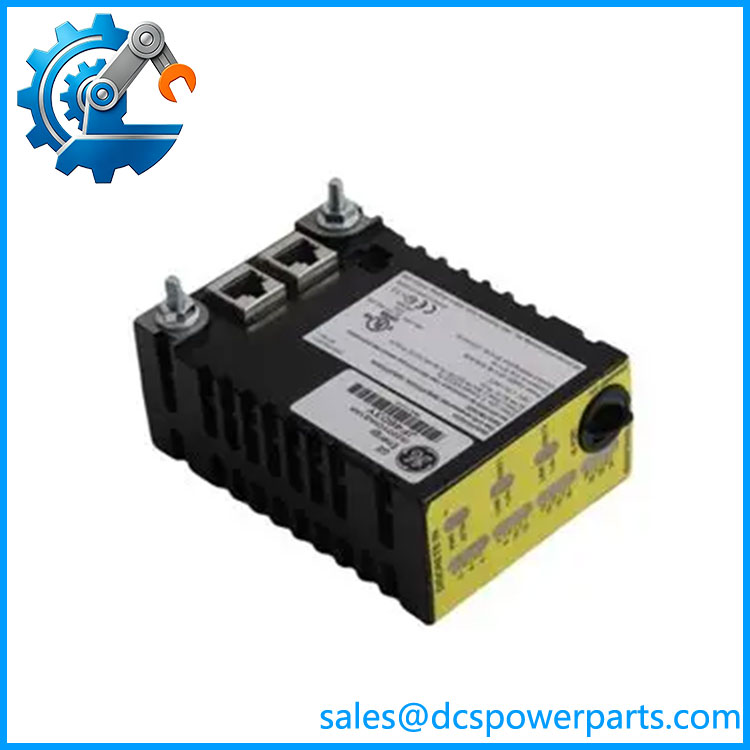
IS220YPROS1A
Main Features and Engineering Considerations
Independent turbine protection path
The most important characteristic of the IS220YPROS1A is that it is a protection I/O pack, not simply another Mark VIe field-I/O module. YPRO provides an independent backup protection path intended to remain functional when the primary turbine control system has a fault. The local processing of speed and trip functions is central to its role.
Speed and overspeed protection
YPRO accepts three speed signals and provides both hardware and firmware-based overspeed protection. This makes the module particularly relevant to turbine protection architectures where speed sensing and trip initiation must not depend solely on normal control software.
Trip relay control
The published safety assessment identifies three trip relay outputs. These outputs operate through the associated protection terminal-board architecture. The terminal board therefore has to be considered part of the protection circuit when replacing an existing installation.
Terminal-board compatibility
GE certification explicitly identifies the YPRO pack with IS200SPROS1A, IS200TPROS1C, IS200TPROS2C, and IS200TREAS1A terminal-board configurations. The TPRO variants are associated with TMR protection arrangements, while TREA provides the aero-derivative emergency-trip interface.
IONet communication
The pack uses Ethernet connections for IONet communication with the Mark VIeS control architecture. This communication path should not be confused with the safety function itself: critical local protection functions are processed within the YPRO architecture, while IONet provides the system-level communications interface.
Firmware and revision control
Firmware revision matters significantly for Mark VIeS protection equipment. Historical IEC 61508 assessment documentation lists several qualified YPRO firmware revisions, including V03.02.07C, V03.02.22C, and V03.02.23C. A replacement unit should therefore be checked against the site’s approved hardware and firmware baseline rather than accepted solely because the catalog number is identical.
Certification is configuration-specific
The IS220YPROS1A appears in GE’s ATEX and IECEx documentation, but certification applies to specified combinations of the I/O pack and associated terminal boards. Do not assume that an isolated replacement pack automatically reproduces the certification of the complete installed protection assembly.
Application Scenarios
- Gas turbine overspeed protection
- Backup turbine trip systems
- Mark VIeS safety instrumented systems
- TMR turbine protection architectures
- Emergency turbine shutdown systems
- Generator synchronization checking
- Aero-derivative turbine protection arrangements
- Existing Mark VIeS protection-system maintenance
- Replacement of aging YPRO protection I/O packs
Engineer’s Guide: Field Pitfalls
1. Do not treat YPRO as a standard I/O pack.
The has a specialized protection role. Substituting a standard Mark VIe discrete or analog I/O pack is not a functional replacement.
2. Verify the terminal board.
The exact terminal-board type matters. Check whether the installation uses SPRO, TPROS1C, TPROS2C, or TREA hardware before ordering the replacement.
3. Check the speed-signal wiring.
YPRO’s three speed inputs are central to the overspeed protection function. Verify sensor type, signal range, shielding, wiring polarity, and termination before commissioning.
4. Confirm the trip philosophy.
The Mark VIeS system can be configured for different demand and trip modes. The safety assessment shows that SIL capability depends on the architecture and trip mode. Do not infer the site’s SIL capability from the part number alone.
5. Verify firmware.
A physically identical replacement with an incompatible firmware baseline can create commissioning problems in a safety-related system.
6. Check certification as a complete assembly.
The applicable hazardous-area certification depends on the specified module and terminal-board combination. Verify the actual installed configuration before field replacement.
Frequently Asked Questions
It is the GE Mark VIeS YPRO Backup Turbine Protection I/O Pack.
Is it a normal PLC/DCS I/O module?
No. It is a specialized turbine protection I/O pack intended for backup/emergency protection functions.
What signals does YPRO handle?
The published safety assessment describes three speed signals, one E-stop input, seven contact inputs, and three trip relay outputs.
What voltage does it require?
GE certification specifies a 28 VDC power supply with a listed current of 0.37 A DC for the YPRO configuration.
Which terminal boards are associated with ?
GE identifies IS200SPROS1A, IS200TPROS1C, IS200TPROS2C, and IS200TREAS1A among the compatible/certified terminal-board configurations.
Does it perform overspeed protection locally?
Yes. The Mark VIeS safety assessment describes both hardware and firmware-based overspeed protection and states that speed processing and trip-relay operation do not require controller participation.
Is the still relevant for legacy systems?
Yes. GE’s Mark VIe I/O lifecycle documentation specifically listed among I/O packs that had not transitioned and remained orderable in their original form at the time of that notice.
Procurement Note
For a replacement, specify the complete catalog number and verify the installed terminal board, firmware revision, protection architecture, speed-sensor arrangement, trip philosophy, and hazardous-area certification. For a safety-related turbine system, “same part number” is necessary but should not be treated as the only acceptance criterion. Hardware revision, firmware baseline, terminal-board configuration, and site-specific validation all deserve review before the unit is placed into service.