Description
GE IS220PHRAH1A HART Analog I/O Pack
Product Overview
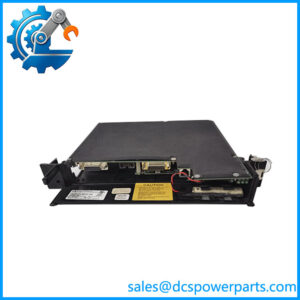
The GE IS220PHRAH1A is a HART-enabled analog I/O pack from the Mark VIe turbine control platform. Its job is to bridge field-level analog instrumentation and the Mark VIe I/O Ethernet network through a compatible analog terminal board. The PHRA hardware provides 10 analog input channels and 2 analog output channels, allowing one I/O pack to handle a mixture of transmitter signals and analog control commands. GE documentation identifies the IS220PHRAH1A as a Mark VIe HART-enabled I/O module and specifies its use with IS200SHRAH1A or IS200SHRAH2A terminal boards.
For the input section, channels 1 through 8 can be configured for either ±5 V signals or 4–20 mA current-loop operation. The remaining two inputs provide additional configurable analog measurement capability; published PHRA documentation identifies them for 4–20 mA and lower-range input configurations. The output section provides two 4–20 mA channels, with a 14-bit digital-to-analog converter and up to 18 V compliance documented for the PHRA family.
HART capability is the feature that separates the GE IS220PHRAH1A from a conventional analog I/O pack. When the associated field channels operate in the appropriate 4–20 mA mode, the PHRA can pass HART communications between compatible field instruments and an Asset Management System. The hardware uses two HART modems, dividing the 12 analog channels between them. That architecture is useful for transmitter identification, diagnostics, configuration and maintenance data without adding a separate HART interface for every field device.
Product Introduction
Turbine control cabinets often contain a mixture of 4–20 mA transmitters, voltage signals, valve commands and HART-enabled instruments. The IS220PHRAH1A combines these analog functions in one Mark VIe distributed I/O pack while maintaining the network interface expected by the control system.
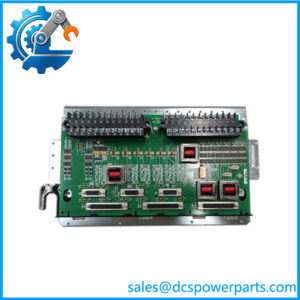
For a legacy Mark VIe replacement, the terminal board is just as important as the pack. The documented compatible boards are IS200SHRAH1A and IS200SHRAH2A; substituting the I/O pack without checking the terminal-board assembly can turn a seemingly simple spare replacement into a wiring problem.
Key Technical Specifications
| Parameter | Specification |
|---|---|
| Manufacturer | GE |
| Model | IS220PHRAH1A |
| Product Series | Mark VIe |
| Functional Acronym | PHRA |
| Product Type | HART-enabled analog I/O pack |
| Configuration | Simplex |
| Analog Inputs | 10 |
| Analog Outputs | 2 |
| AI Channels 1–8 | ±5 VDC or 4–20 mA DC |
| AI Channels 9–10 | Configurable low-level analog/current inputs; exact range depends on configuration |
| Input Resolution | 16-bit ADC |
| Analog Outputs | 2 × 4–20 mA |
| Output Resolution | 14-bit DAC |
| Output Compliance | Up to 18 V |
| HART | Supported on compatible analog channels |
| HART Modems | 2 |
| I/O Network | I/O Ethernet |
| Ethernet Ports | 2 × RJ45 |
| Terminal Board Compatibility | IS200SHRAH1A / IS200SHRAH2A |
| Nominal Pack Supply | 28 VDC |
| Maximum Documented Supply Current | 0.5 A |
| Transmitter Supply | 24 VDC nominal, 21 mA maximum in the cited HazLoc specification |
| Operating Temperature | -30°C to +65°C |
| Installation | Direct mounting to compatible Mark VIe terminal board |
GE’s hazardous-location documentation specifies a 27.4–28.6 VDC supply range for the PHRA family, with 28.0 VDC nominal and 0.5 A maximum current. It also specifies ±5 V maximum input range for channels 1–8, 0–20 mA current input capability, and 0–20 mA analog outputs.
Published PHRA technical documentation also identifies 5 ms normal scan operation, 60 dB common-mode rejection at 60 Hz, ±5 V common-mode voltage range, and an 800 Ω load capability for 4–20 mA outputs.
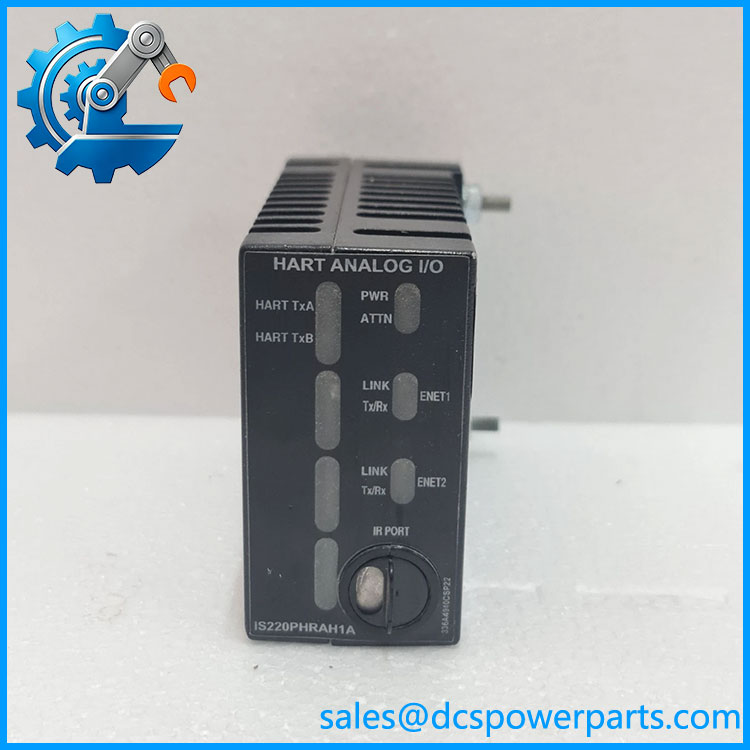
IS220PHRAH1A
Major Features / Practical Advantages
10 analog inputs plus 2 analog outputs
The PHRA pack provides a useful combination of measurement and control channels for Mark VIe turbine applications. Ten analog inputs can acquire transmitter or voltage signals while two 4–20 mA outputs provide commands to compatible field devices.
The first eight input channels are particularly flexible because the hardware can accommodate either ±5 V or 4–20 mA operation. For procurement, however, the correct terminal-board configuration must be retained. The current-loop burden resistors are located on the terminal board rather than being an independent external accessory in the basic PHRA signal path.
HART-enabled field instrumentation
HART is not simply a marketing label on this module. The PHRA has dedicated HART modem hardware and can relay HART messages between compatible field devices and the Mark VIe Asset Management System.
There are 12 HART channels associated with the 10 analog inputs and 2 analog outputs. The two internal modems divide those channels into two groups. If several instruments connected to the same modem are actively communicating, HART update time increases; the published PHRA documentation gives approximately one second for a single active device and approximately eight seconds when all six channels assigned to one modem are active.
That distinction matters during commissioning. The analog process value remains part of the normal control path; HART communication is a separate digital maintenance/configuration layer riding on the current loop.
16-bit analog acquisition
The analog input section uses a 16-bit ADC. Before conversion, the input signal passes through a second-order low-pass filter. Published PHRA documentation identifies filter poles at approximately 12.5 Hz and 48.3 Hz.
For turbine-control instrumentation, this filtering is relevant because the module is intended to process relatively slow process measurements rather than high-frequency waveform data. It should not be treated as a general-purpose high-speed data-acquisition card.
Two 4–20 mA analog outputs
The output section contains two 4–20 mA channels using 14-bit DACs. The PHRA documentation identifies up to 18 V compliance and internal output-current monitoring. That feedback arrangement allows the module to monitor commanded and actual loop-current behavior.
Typical application logic can therefore use the outputs for analog control commands while the Mark VIe system monitors the I/O pack’s diagnostic status.
Dual I/O Ethernet connectivity
The pack communicates with the Mark VIe control system through its I/O Ethernet interfaces. The physical interface uses two RJ45 connectors, while field signals enter and leave through the associated terminal board.
A single pack can operate over either Ethernet connection, while dual connections can be used according to the Mark VIe system architecture. This is not the same thing as making the individual analog channels redundant—the itself is documented as a simplex I/O pack.
Direct terminal-board installation
The PHRA does not replace the field terminal board. It plugs directly into the compatible SHRA terminal-board assembly through the pack’s field connector and is mechanically secured to the terminal-board mounting hardware.
GE’s hazardous-location documentation specifically approves with IS200SHRAH1A or IS200SHRAH2A.
That makes terminal-board identification a mandatory replacement check.
Hazardous-location documentation
The GE Mark VIe HazLoc documentation specifically includes the in approved hardware combinations. This does not mean every installation is automatically suitable for every hazardous area; the complete control assembly, terminal board, installation method and site certification requirements still have to match the applicable approval.
Related Products
- IS220PHRAH1B — Later PHRA HART analog I/O pack revision; verify system hardware and revision requirements before substituting for the H1A.
- IS200SHRAH1A — Compatible HART analog terminal board for PHRA I/O packs; provides the field wiring interface.
- IS200SHRAH2A — Alternate compatible HART analog terminal board; terminal-board selection should follow the existing Mark VIe cabinet design.
- IS221PHRAH1B — Coated HART-enabled I/O pack for Mark VIe/VIeS applications; associated with IS201SHRAH1A/SHRAH2A terminal boards in the HazLoc documentation.
- IS220PAICH1B — Mark VIe analog I/O pack family member for analog acquisition/output applications without the same PHRA HART architecture.
- IS220PRTDH1B — Mark VIe resistance-temperature-device input pack for RTD measurement rather than general analog I/O.
- IS220PTCCH1B — Mark VIe thermocouple input pack for temperature measurement applications.
- IS220PSCAH1B — Mark VIe serial communication I/O pack, used for serial-device integration rather than analog field signals.
FAQ
What is the GE used for?
It is a Mark VIe HART-enabled analog I/O pack used to connect analog field instrumentation and control signals to a Mark VIe turbine-control system. It provides 10 analog inputs and 2 analog outputs through a compatible SHRA terminal board.
Can I use the with any Mark VIe terminal board?
No. The documented compatible HART analog terminal boards are IS200SHRAH1A and IS200SHRAH2A. The terminal-board part number should be checked before purchasing the pack.
Can I hot-swap this module?
Do not treat it as an unrestricted hot-swap component. PHRA installation documentation describes plugging the pack into the terminal board and applying power through the side connector, with inherent soft-start controlling current inrush. That is different from saying every removal/replacement operation is permitted while the turbine-control system is energized. Follow the site’s Mark VIe maintenance procedure and the applicable GE documentation.
Does the support HART communication?
Yes. HART support is one of the defining functions of the PHRA pack. In compatible 4–20 mA operation, it can relay HART messages between connected field instruments and an Asset Management System.
Does it support firmware v3.1?
A generic firmware v3.1 cannot be assigned to the from the documentation reviewed. Mark VIe I/O packs operate as part of a configured control-system hardware/software environment, so the installed ToolboxST/control-system revision should be checked against the specific hardware revision rather than assuming compatibility from the part number alone.
Are all 10 analog inputs identical?
No. Channels 1–8 have the documented ±5 V / 4–20 mA configuration capability. Channels 9–10 have a different input range/configuration. GE documentation specifies the latter group separately, so a procurement or replacement check should compare the existing channel configuration rather than assuming ten identical inputs.
Is redundant?
The I/O pack itself is documented as simplex. It has two I/O Ethernet ports, but dual network connections should not be interpreted as two independent redundant PHRA processing units.
Is a New Surplus equivalent to a tested used unit?
Not automatically. For this type of legacy turbine-control hardware, condition and test evidence are separate procurement factors. A New Surplus unit may have no operating history, while a tested used or reconditioned unit may have documented functional checks but a different component-life history. Request the nameplate photograph, hardware revision, terminal-board compatibility and test documentation before approving a replacement.
Procurement Note
For a replacement, verify four things before issuing the purchase order: exact part number, hardware revision, terminal-board model, and existing Mark VIe configuration.
The most important compatibility check is the terminal board. GE’s documentation identifies as the associated terminal boards for .
Do not substitute a visually similar Mark VIe analog pack simply because it has the same number of channels. The PHRA’s HART architecture, input ranges, analog-output section and terminal-board interface are application-specific. Also, do not interpret the presence of two Ethernet connectors as proof of a redundant I/O pack; the PHRAH1A is a simplex module.
For critical turbine service, the procurement package should document:
→ hardware revision → SHRA terminal-board part number → channel configuration → HART requirement → Mark VIe software compatibility → physical condition → functional test evidence.
That sequence is considerably safer than purchasing against the generic description “GE Mark VIe analog module.”