Description
Product Overview
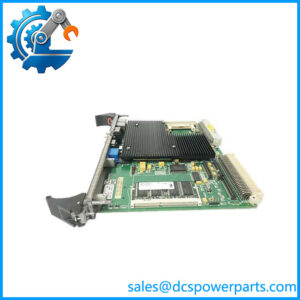
The GE IS215UCVHM06A IS415UCVHH1A is a UCVH-series VME controller assembly used in GE turbine control architectures. The UCVH is a single-board computer installed in a 6U VME control module, where it executes turbine application code and communicates with turbine I/O boards through the VME bus. GE-related technical references identify the UCVH controller as a Mark VI/Mark VIe control-system component rather than a conventional PLC CPU.
The GE IS215UCVHM06A is commonly described as the Mark VI hardware identification, while IS415UCVHH1A represents the UCVH controller board used in the Mark VIe generation. Available technical information identifies an Intel Ultra Low Voltage Celeron processor operating at approximately 1.067 GHz, with 128 MB flash memory and 1 GB SDRAM. The controller runs QNX, a real-time multitasking operating system intended for deterministic industrial control applications.
The IS415UCVHH1A provides the processing and communication layer for the turbine control system. It connects to I/O hardware through the VME bus and provides Ethernet connectivity to the Unit Data Highway (UDH), while serial interfaces support configuration and DCS communication. The second Ethernet interface can be configured for a separate logical network and may be used for Modbus or private Ethernet Global Data communication, depending on the system configuration.
Technical Specifications
| Parameter | Specification |
|---|---|
| Manufacturer | General Electric (GE) |
| Primary Model | IS215UCVHM06A |
| Associated Model | IS415UCVHH1A |
| Functional Abbreviation | UCVH |
| Product Type | VME Processor / Controller Board |
| System | GE Mark VI / Mark VIe |
| Application | Turbine control |
| Architecture | VME |
| Board Format | 6U VME |
| Processor | Intel Ultra Low Voltage Celeron |
| Processor Speed | 1067 MHz / 1.067 GHz |
| Flash Memory | 128 MB reported |
| System RAM | 1 GB SDRAM reported |
| Operating System | QNX |
| Ethernet | 2 × 10BaseT/100BaseTX RJ-45 |
| COM1 | RS-232C configuration interface |
| COM2 | RS-232C DCS interface |
| VME Interface | Yes |
| UDH Connectivity | Ethernet |
| DCS Connectivity | RS-232C / system-dependent |
| Redundancy | Simplex, dual, or triple redundancy |
| Faceplate | Status LEDs and communication interfaces |
| Cooling | Rack/controller cooling arrangement |
| Firmware | Application/system dependent |
| Installation | VME control module |
| PCB Coating | Conformal coating reported |
| Condition | New Surplus / Tested Replacement |
The processor, memory, Ethernet, and serial-interface specifications above are supported by multiple secondary references describing the UCVH controller.
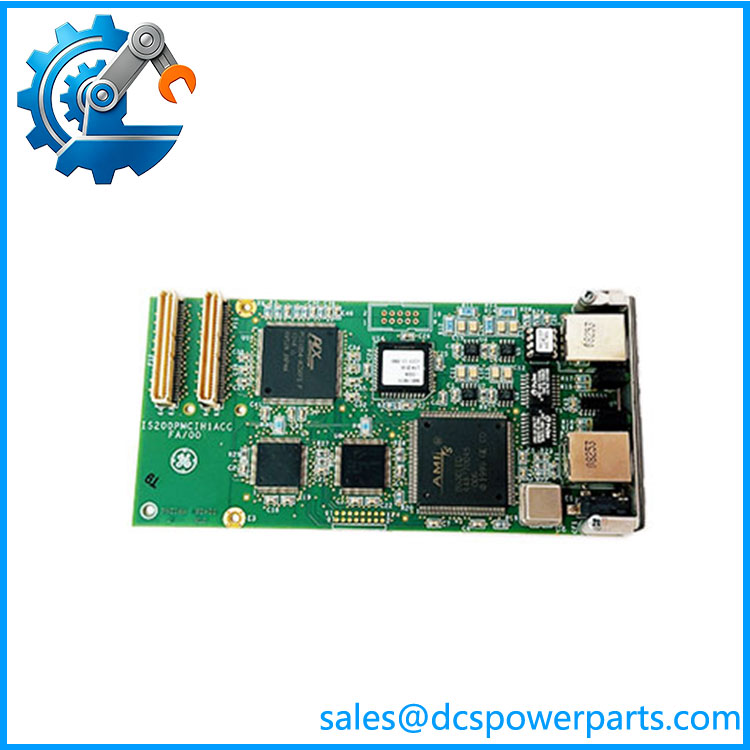
IS215UCVHM06A
Main Features and Advantages
VME-Based Turbine Controller
The GE IS215UCVHM06A is not a field I/O card. It is a computing and control board positioned at the controller level of the GE turbine-control architecture. It executes the turbine application and exchanges data with VME-connected I/O boards.
UCVH Processing Platform
The UCVH platform uses an Intel Ultra Low Voltage Celeron processor and dedicated memory resources. The published 1.067 GHz processor and 1 GB SDRAM specifications provide substantially more processing capability than the older generations of GE turbine controllers.
Dual Ethernet Architecture
Two Ethernet ports provide separate communication paths. The first is associated with the UDH for HMI, engineering, configuration, and peer communication. The second can operate on a separate IP subnet and can support applications such as Modbus or private EGD, depending on configuration.
This matters during replacement because the Ethernet port assignment is not simply a matter of plugging network cables into either connector. The controller validates its Toolbox configuration against the installed hardware during rack startup.
QNX Real-Time Environment
The UCVH controller runs QNX, providing the real-time operating environment for turbine application software. This is one reason the board should be treated as a configured turbine-control computer rather than a generic industrial PC.
Redundant Control Architectures
The IS415UCVHH1A supports simplex, dual, and triple-redundant control configurations. The actual redundancy arrangement is determined by the turbine control system design, controller configuration, I/O architecture, and application software.
Legacy Replacement Considerations
For a replacement controller, matching the board number alone is not sufficient. Check:
- IS215UCVHM06A identification
- IS415UCVHH1A controller revision
- Hardware revision
- Firmware
- ControlST/Toolbox configuration
- IP configuration
- UDH network assignment
- VME rack position
- Controller redundancy configuration
- I/O architecture
- CMOS battery condition
- Compact Flash condition
- Faceplate connectors
Related GE Products
- IS415UCVHH1A — UCVH VME controller used in the Mark VIe architecture. This is the closest associated controller identification to IS215UCVHM06A.
- IS215UCVGM06A — Related GE VME controller variant; do not assume interchangeability solely from the UCV functional designation.
- IS215UCVEM06A — Another UCV-family controller variant with a different hardware configuration.
- IS420UCSCH2A-C — GE Mark VIe controller hardware from a different UCS architecture; not a direct replacement for the UCVH.
- IS200PMCIH1ACC — GE Mark VI PCI/VME-related interface hardware; it performs a different system function.
- IS215VPROH2B — GE Mark VI turbine protection hardware, used for a different control/protection function.
Frequently Asked Questions
What is ?
It is a GE Mark VI VME processor control card. It belongs to the UCVH controller family and serves as the computing/control element of a VME-based turbine control system.
What is ?
is the UCVH VME controller board associated with the Mark VIe turbine-control architecture. It operates turbine application code and communicates with turbine I/O over the VME bus.
Are and the same part?
They are closely associated UCVH controller identifications, and commercial listings commonly pair them as:
However, I would still verify the complete board label, revision, firmware, and system generation before treating one as a direct replacement for the other.
What processor does the UCVH use?
Available UCVH documentation identifies an Intel Ultra Low Voltage Celeron processor at 1067 MHz (1.067 GHz).
How much memory does it have?
Published UCVH specifications report 128 MB flash memory and 1 GB SDRAM.
What operating system does it use?
The controller uses QNX, a real-time multitasking operating system designed for industrial applications.
Does it communicate with the DCS?
Yes. The UCVH provides an RS-232C COM2 interface for DCS communication, with the exact protocol and configuration determined by the installed system. The Ethernet interfaces also support system-level communications.
Can the UCVH be hot-swapped?
Do not assume hot-swap capability. This controller executes turbine application code and participates directly in the control architecture. Removing or replacing it can affect turbine control, redundancy, I/O communications, and controller synchronization.
Follow the approved GE turbine-control maintenance procedure and establish the required control-state and isolation conditions before replacement.
What should I check when purchasing a replacement?
For a plant-critical spare, verify:
- Hardware revision
- Firmware/application version
- ControlST/Toolbox configuration
- Compact Flash condition
- CMOS battery
- Ethernet configuration
- VME rack compatibility
- Simplex/dual/triple redundancy arrangement
- Diagnostic LED behavior
- Controlled power-up and controller communication
Procurement judgment: The is a UCVH VME controller for GE Mark VI/Mark VIe turbine-control systems, not a conventional PLC I/O board. The strongest technical references identify the UCVH as a 6U VME single-board computer running QNX, with an Intel Celeron-class processor, 128 MB flash, 1 GB SDRAM, dual Ethernet, and RS-232C interfaces. For a replacement, firmware/configuration and controller architecture are just as important as the physical part number.