Description
Product Overview
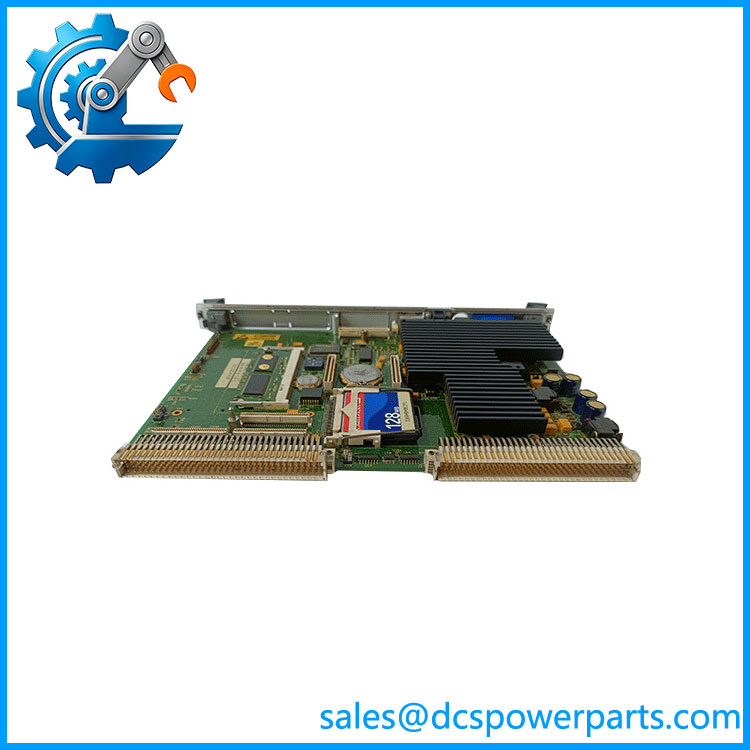
The GE IS215UCVEH2AF is a single-slot VME controller board associated with the GE Mark VI turbine control platform. It provides the processing and communication resources required by the VME-based controller architecture, executing control software while exchanging data with I/O and other control-system components through the VME backplane. Available technical references identify the UCVEH2 configuration with a 300 MHz Intel Celeron processor, 32 MB DRAM, 128 KB L2 cache, battery-backed SRAM, and CompactFlash storage.
In the Mark VI architecture, GE IS215UCVEH2AF is not simply an interchangeable VME interface card. It is part of the controller processing layer, with Ethernet and serial communications supporting interaction with the engineering/toolbox environment and external devices. Documentation and technical references describe 10Base-T/100Base-TX Ethernet, EGD communication, Modbus capability, and dedicated serial ports. The exact configuration matters: some catalog sources associate the same UCVEH2 hardware with VMIVME-7614-133, while suffixes and assembly revisions can identify different hardware or software configurations.
For a GE IS215UCVEH2AF replacement, firmware and storage configuration deserve the same attention as the physical board. The controller may contain application-specific boot files, configuration data, and NVRAM contents, so a board that passes a basic power-up test is not automatically a field-ready replacement. Before procurement, compare the original board’s revision, CompactFlash capacity, firmware/software environment, Ethernet configuration, serial-port use, and VME rack position. That verification is particularly important when maintaining an operating turbine-control installation where an incorrect controller configuration can create commissioning delays.
Product Introduction
A failed Mark VI controller can stop more than a single I/O point; it can remove the processing node responsible for executing the turbine control application. GE IS215UCVEH2AF provides the VME-based computing platform around which the applicable controller software and communications are organized.
With a 300 MHz Intel Celeron processor, 32 MB DRAM, and 10/100Base-TX Ethernet, the UCVEH2 platform was designed for embedded control processing rather than general-purpose desktop computing. It is therefore a candidate for Mark VI legacy replacement where the existing rack, software environment, and controller configuration must be retained.
Key Technical Specifications
| Parameter | Value |
|---|---|
| Manufacturer | General Electric (GE) |
| Model | IS215UCVEH2AF |
| Product Series | Mark VI |
| Board Type | UCVE VME Controller |
| Form Factor | Single-slot VME board |
| Processor | Intel Celeron |
| Processor Speed | 300 MHz |
| DRAM | 32 MB |
| L2 Cache | 128 KB |
| CompactFlash | 16 MB or 128 MB configuration reported |
| NVRAM | 8 KB battery-backed SRAM |
| Ethernet | 10Base-T / 100Base-TX |
| Ethernet Connector | RJ-45 |
| Ethernet Protocols | TCP/IP, EGD; Modbus Ethernet supported |
| Serial Ports | COM1 diagnostic; COM2 serial Modbus |
| COM1 Setting | 9600 baud, 8 data bits, no parity, 1 stop bit |
| COM2 Speed | 9600 or 19200 baud |
| Backplane | VME |
| Typical Power | +5 VDC, 6 A typical / 8 A maximum; ±12 V auxiliary rails |
| Operating Temperature | Sources report approximately −30°C to +65°C; verify against the installed hardware revision |
| Mounting | VME rack, single slot |
| Application | GE Mark VI turbine control |
| Condition | New Surplus, subject to inspection and functional testing |
The 300 MHz processor, 32 MB DRAM, 128 KB cache, 8 KB battery-backed SRAM, Ethernet, serial communications, and power figures are documented in available UCVEH2 technical references.
Important specification note: Secondary sources disagree on several details, including operating temperature, Ethernet-port count, dimensions, and whether certain interfaces apply to all UCVE variants. The exact IS215UCVEH2AF board revision should therefore take precedence over generic UCVE family data.
Related Products
- IS215UCVEH2A — Closely related UCVEH2 controller designation. It represents the underlying UCVEH2 hardware family, while the AF suffix identifies the specific board configuration/revision.
- IS215UCVEM01A — Another UCVE VME controller configuration. References associate it with the same general 300 MHz Celeron/32 MB architecture, but additional communication capabilities can differ.
- VMIVME-7614-133 — Associated VME controller identification found with the platform. It is useful when cross-referencing legacy hardware documentation, but the complete assembly number must be matched before substitution.
- IS215VCMIH2C — Mark VI VME communication/interface board. It complements the controller architecture by handling system communications rather than serving as the primary UCVE processor.
- IS215VPROH1B — Mark VI VME protection/control-related board. Its function differs from the UCVE processor and it should not be considered a direct replacement.
- IS200VAICH1D — Mark VI VME analog input board. It handles field analog acquisition and therefore complements, rather than replaces, the UCVE controller.
- IS200VVIBH1C — Mark VI VME vibration input board used for vibration-related monitoring. It operates at the I/O layer rather than the controller-processing layer.
- IS200VTURH2B — Mark VI turbine control interface board associated with turbine-specific control functions. It works with the controller architecture but does not replace the UCVE CPU.
- IS200TBCIH2C — Mark VI terminal/interface hardware used for I/O signal interfacing. Its role is field connection rather than VME application processing.
IS215UCVEH2AF
Frequently Asked Questions
What is GE used for?
The is a VME controller board for the GE Mark VI turbine control system. It provides the CPU and memory resources needed to execute controller software and communicates with other system components through the VME architecture.
It is fundamentally different from a Mark VI analog-input or relay-output board.
What processor and memory does have?
The configuration is documented with:
- 300 MHz Intel Celeron processor
- 32 MB DRAM
- 128 KB L2 cache
- 8 KB battery-backed SRAM
- 16 MB or 128 MB CompactFlash configurations
The installed CompactFlash capacity should be checked on the actual replacement board because this is configuration-dependent.
Can I replace with IS215UCVEM01A?
Not automatically.
The two boards belong to the UCVE VME controller family and can share core architecture, but the UCVEM variants can include additional communication interfaces.
Before a substitution, compare:
- Board revision.
- CPU configuration.
- Memory and CompactFlash.
- Ethernet interfaces.
- Serial interfaces.
- VME addressing.
- Firmware and boot image.
- Mark VI software compatibility.
A similar connector layout is not enough to establish interchangeability.
Can I hot-swap the ?
Do not assume that it can be hot-swapped.
This is a controller CPU board in a turbine-control architecture. Removing it while the system is energized can interrupt controller execution and communications.
Unless the specific Mark VI installation and approved maintenance procedure explicitly support online controller replacement, isolate the relevant rack and follow the site’s documented replacement procedure.
Does use Ethernet?
Yes. The technical reference identifies a 10Base-T/100Base-TX RJ-45 Ethernet interface. TCP/IP is used for controller/toolbox communication, while EGD is identified for communication with compatible control/HMI environments. Ethernet Modbus is also documented.
Some secondary sources describe dual Ethernet configurations for related UCVE variants. Do not assume that capability exists on every without checking the actual board.
Will I lose my Mark VI control logic when replacing the controller?
Not simply because the physical controller board is replaced. The critical issue is whether the replacement contains or receives the correct software, configuration, and nonvolatile data expected by the Mark VI installation.
Before removing the original controller, preserve or document:
- Controller configuration
- Firmware/software revision
- CompactFlash contents
- Ethernet/IP configuration
- Serial Modbus settings
- NVRAM-dependent parameters
- VME configuration
- Application/logic files
A replacement controller that powers up successfully can still be unusable if its boot environment or application configuration does not match the existing system.
How should I verify a New Surplus ?
For a turbine-control CPU, I would require more than a visual inspection.
Recommended incoming inspection:
- Confirm exact marking.
- Record PCB revision and serial information.
- Verify CPU and memory configuration.
- Inspect CompactFlash hardware.
- Check battery-backed SRAM condition.
- Inspect VME edge connectors.
- Perform controlled power-up testing.
- Verify Ethernet link and communications.
- Test serial communication where applicable.
- Confirm VME recognition.
- Record firmware/boot information.
- Provide a functional test report.
To be completely transparent, public sources contain conflicting descriptions of this board’s interfaces and environmental ratings. The strongest recurring technical data identifies the as a 300 MHz Celeron, 32 MB DRAM VME controller, while related UCVE variants can have different interface configurations. For a plant-critical spare, the actual board revision and test results should take priority over a generic catalog specification.