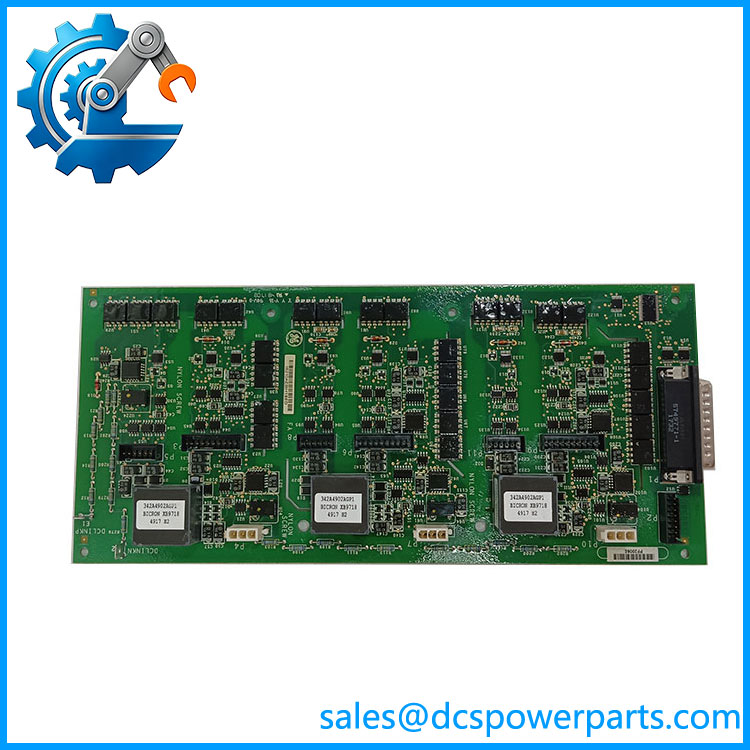
Description
Product Overview
IS210AEBIH1BED belongs to the board set that GE built for wind turbines on the Mark VIe platform, and the acronym is the whole story: AEBI is the Alternative Energy Bridge Interface. “Alternative energy” is GE’s own term for the renewables configuration of the Mark VIe controller, and “bridge interface” describes the board’s position — it sits between the turbine’s energy bridge, which is the power-conversion side of the machine, and the control system that governs it, carrying signals and coordinating data across that boundary.
The set it belongs to is worth listing, because a plant that holds one board usually holds several and the acronyms only make sense together. In the wind configuration there are input/output boards — AEAA conformal-coated I/O, AEAB the thread I/O board, AEAC the master I/O board, AEAD the input/output grid fork board — and then the bridge interfaces, AEBI and AEDB the DB bridge interface. There is the AE power supply family, AEPS in several revisions, and MACCH, the multiple application converter control board. There are the top-box assemblies, WEMA and WETB, WETC and WETA, and the pitch-axis boards, WEPA and AEPA in their wind-series assemblies. Read as a set, these are the components of a converter-driven wind turbine control cabinet: grid interface, converter control, bridge interface, pitch control, power supply and top-box signal routing.
The suffix fields in IS210AEBIH1BED follow the GE pattern of this generation. H1 is the hardware revision level. B is the functional revision recorded for the board. ED is the build code at the tail. Sibling boards show how the pattern moves: IS210AEBIH1BAC and IS210AEBIH1BEA are the same H1/B board at other build codes, IS210AEBIH2B steps the hardware to H2, and IS210AEBIH3B to H3, each with its own build tails such as ED or BBC. The function does not change across those levels; the board’s revision does. That matters because a wind cabinet is often maintained from a spares pool rather than from an order book, and a revision that the installed software does not expect is a commissioning problem waiting to happen.
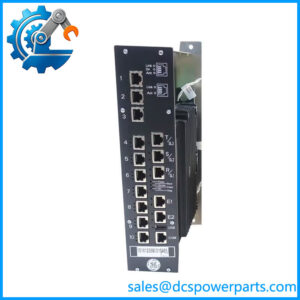
The board’s physical signature is modest and useful: a long, narrow plug-in card with conformal coating, which is the standard treatment for the wind and outdoor-cabinet boards in this family. Conformal coating is not cosmetic — in a nacelle or a tower-base cabinet, humidity and condensation are the ordinary operating conditions, and the coated boards are the ones specified for them. A plant replacing an AEBI board should therefore confirm that the article in hand is coated, because an uncoated board of the same function is a different environmental specification.
What the channel says about this board is inconsistent to the point of being unusable. IS210AEBIH1BED is sold as a “PLC module for wind turbine control systems” — which describes the controller, not a bridge interface board; as a “high-integrity digital input module” with a 24 Vdc supply and 11 W typical consumption — a digital input module’s job and a bridge interface’s job are not the same; as an “analog input module (AEBI pack)” — it is a board, not a pack, and its function is not analogue acquisition; as a “VME communication PCB” sitting between controller and I/O subsystems — the VME backplane in this cabinet belongs to the controller and top-box assemblies, and the AEBI’s boundary is the energy bridge, not the VME bus; and as an “actuator” in the tag lists of several listings, which is simply a mis-tagged product category.
One matter of nomenclature needs correcting openly, because it affects the entries around this one. The trade routinely expands AEPA as “Exciter Power Amplifier”, and the last two entries in this catalogue reported that expansion as the trade’s consistent description while flagging that no OEM data sheet confirmed it. The wind-series board set gives a second reading that must be placed beside it: in the same family catalogue, the AEPA boards appear as Alternative Energy Power Assembly and, in their IS215 assemblies, as Wind Pitch Axis Control modules. A wind pitch-axis control board and an exciter power amplifier are not the same product, and the same four letters cannot mean both. Either GE used the acronym twice in different product lines — which is possible in a company with several control businesses — or one of the two expansions is invented by the secondary market. Until an OEM document settles it, the honest position is that AEPA is unresolved and that the function must be taken from the board’s own assembly number and its cabinet, not from the acronym’s expansion.
The buying rule for this board follows from its position. An AEBI board is identified by the full number including the tail, it is specified with conformal coating, and it is ordered against the wind-series cabinet it serves, with the installed software generation consulted before a revision change is accepted. A board bought as a “PLC module” and fitted as a bridge interface will not do the job the slot requires.
Technical Specifications
| Parameter | Value |
|---|---|
| Model | IS210AEBIH1BED |
| Acronym | AEBI |
| Acronym expansion | Alternative Energy Bridge Interface |
| Manufacturer | GE (GE Energy), Mark VIe Speedtronic lineage |
| Product series | Mark VIe Wind — Alternative Energy board set |
| Board type | Plug-in interface printed-circuit board |
| Function | Signal and data interface between the turbine’s energy bridge (converter) and the Mark VIe control system |
| Hardware revision field | H1 |
| Functional revision field | B |
| Build code | ED |
| Coating | Conformal coated |
| Board format | Long, narrow plug-in card |
| Peer boards — I/O | AEAA (conformal-coated I/O), AEAB (thread I/O), AEAC (master I/O), AEAD (grid fork I/O) |
| Peer boards — bridge interfaces | AEBI (this board), AEDB (DB bridge interface) |
| Peer boards — converter and power | MACCH (multiple application converter control), AEPS (AE power supply, several revisions) |
| Peer assemblies — top box and pitch | WEMA, WETB, WETC, WETA; WEPA and AEPA pitch assemblies |
| Sibling revisions of this board | IS210AEBIH1BAC, IS210AEBIH1BEA, IS210AEBIH2B, IS210AEBIH3B (with BBC/ED tails) |
| Supply voltage | Not published by the OEM for this board; the 24 Vdc figure in the channel is not confirmed |
| Power consumption | Not published |
| Dimensions and mass | Not published (channel figures such as 38 × 115 × 45 mm are unverified) |
| Operating temperature | Not published per board; wind cabinet environment applies |
| Firmware / software dependency | Board revision must be accepted by the installed ControlST generation |
| Configuration | Governed by the controller’s configuration; the board carries no application logic of its own |
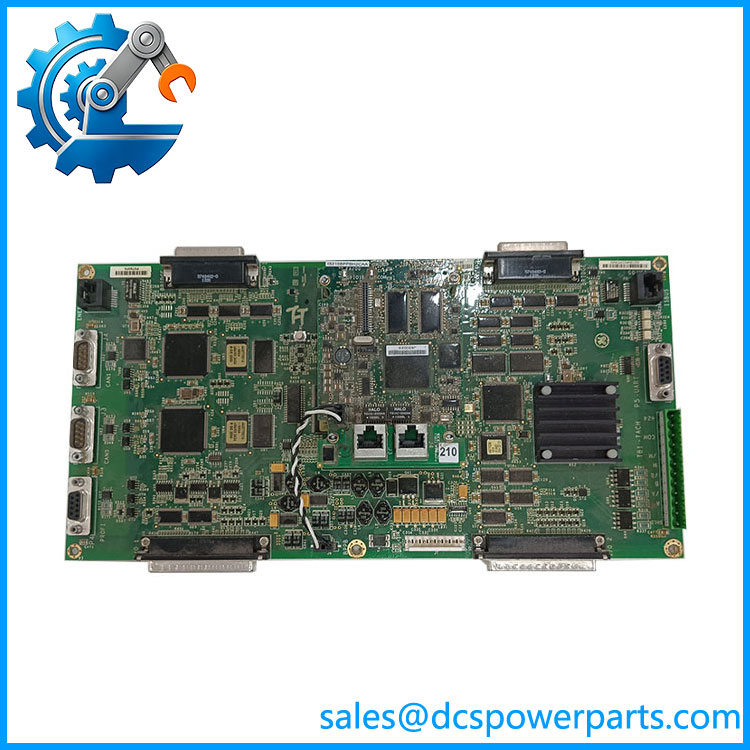
GE IS210MACCH1AGG
Key Features and Advantages
An acronym that states its own function: Alternative Energy Bridge Interface, decoded from the board number, with no need to rely on a listing’s description.
A defined boundary: the board sits between the energy bridge and the control system, which is the interface a converter-driven wind turbine needs and a PLC module cannot provide.
Conformal coating as standard: the wind-series treatment, specified because nacelle and tower-base cabinets see condensation as normal operation.
A revision ladder that is legible: H1 to H2 to H3 with build tails that can be matched to the cabinet in service, rather than guessed at.
A board set rather than a single spare: AEAA, AEAB, AEAC, AEAD, AEDB, AEPS, MACCH, WEMA and WETB, WETC and WETA, WEPA and AEPA — the whole cabinet’s board population is documented at the same level.
Board-level maintainability: a plug-in card that can be replaced from the front of the assembly without dismantling the cabinet’s power section.
Software compatibility that can be checked: the revision and the ControlST generation are both visible before the board is fitted.
A correction made openly: the AEPA acronym conflict is stated rather than smoothed over, which is what a plant holding both wind and excitation cabinets needs to know.
Applications
Wind turbine converter control: the bridge interface between the machine’s energy bridge and the controller, in the cabinet that governs power conversion.
Grid-side interface: together with the AEAD grid fork board, forming the grid-facing I/O and bridging function of the turbine.
Pitch-axis control cabinets: the WEPA and AEPA assemblies that govern blade pitch, where the AEBI board’s interface function supports the cabinet’s signal routing.
Top-box signal routing: the WEMA and WETB, WETC and WETA assemblies that collect and distribute signals in the turbine’s top box.
Multi-application converter control: cabinets using MACCH as the converter control board, where AEBI provides the bridge boundary.
Spares and revision management: replacing a failed board from a spares pool while matching the H-level and build code to the cabinet.
Legacy wind fleet support: turbines out of warranty where board-level spares are the only route and the AE board set is the parts universe.
Repair and exchange: failed boards identified by full number with the tail, repaired to that build level.
Related Products
IS210AEBIH3B — the H3 hardware revision of this board; a later level of the same function and a different article. IS210AEBIH2B — the H2 revision, described in the family catalogue as the Alternative Energy Bridge Interface module. IS210AEBIH1BAC / IS210AEBIH1BEA — the H1/B board at other build codes; the immediate siblings of this ED build. IS210AEDBH3A — the DB bridge interface board, the other bridge board in the wind set. IS200AEADH1A — the input/output grid fork board, the grid-facing I/O of the same cabinet. IS210AEAAH1A / IS210AEABH1A / IS210AEACH1A — the conformal-coated I/O, thread I/O and master I/O boards of the set. IS210MACCH3A — multiple application converter control board, the converter-control element of the cabinet. IS210AEPSG1A / G1B / G2B — the AE power supply boards, in coated and uncoated forms. IS215WETAH1A / IS200WETBH1A / IS200WETCH1A — the top-box A, B and C assemblies. IS215WEPAH2A / IS215AEPAH1CA — the wind pitch-axis control assemblies.
Installation and Maintenance
Before installation: confirm the full number including the tail, and confirm that the installed software generation accepts the board revision — an H3 board in a cabinet configured for H1 is a commissioning risk, not an upgrade. Confirm that the article is conformal coated, since the cabinet’s environmental specification assumes it. Identify the cabinet and the assembly the board belongs to, because the AEBI’s function is defined by its position between the energy bridge and the controller rather than by the board alone.
Installation: isolate the cabinet, seat the board fully on its backplane connector and secure the fixings, and confirm that the bridge-side connections and any interconnecting harnesses are made before power is applied. On power-up, verify that the controller recognises the board and that the bridge interface is established, and use the controller’s diagnostics rather than the board’s own indicators alone — a bridge interface that is present but not exchanging data looks like a healthy board from the outside.
Maintenance: treat coating condition as part of the inspection — a scratched or damaged coating on a wind board defeats the reason it was specified. Check connectors for corrosion and fretting, which is the failure mode a nacelle environment produces, and verify that the revision held in spares matches the cabinets in service. Keep the cabinet’s heating, ventilation and desiccant condition within specification, since the board’s environment is the cabinet’s environment. Record the full number with its tail and the software generation in the asset register, so that the next spare is bought at the right revision.
Warranty and Quality
Every IS210AEBIH1BED is supplied as the GE Mark VIe Wind series Alternative Energy Bridge Interface board — the plug-in interface board at the H1 hardware revision, functional revision B, build code ED, conformal coated and long and narrow in format, whose function is the signal and data boundary between the turbine’s energy bridge and the Mark VIe control system, in a board set that includes the AEAA, AEAB, AEAC and AEAD I/O boards, the AEDB DB bridge interface, the AEPS power supplies, the MACCH converter control board, the WEMA, WETB, WETC and WETA top-box assemblies and the WEPA and AEPA pitch assemblies. Units are offered as used, refurbished or surplus stock exactly as described, inspected for backplane connector damage and fretting, coating integrity and scratches, component and capacitor condition, contamination and corrosion, and signs of heat damage, with the full number including the H-level and build tail recorded against the board rather than shortened to the acronym. Six corrections are stated plainly: IS210AEBIH1BED is an Alternative Energy Bridge Interface board and not a PLC module, a high-integrity digital input module, an analogue input pack, an actuator or a VME communication PCB; the 24 Vdc supply and 11 W consumption figures circulating in the channel are not OEM figures for this board and are not adopted here; the H1, B and ED fields are hardware revision, functional revision and build code rather than any measure of channel count or capacity; the board’s boundary is the energy bridge and the control system, and the VME backplane in this cabinet belongs to the controller and top-box assemblies; the conformal coating is a specified environmental treatment for wind cabinets and an uncoated board of similar function is not equivalent; and the AEPA expansion conflict is left open — the wind-set catalogue reads AEPA as Alternative Energy Power Assembly and wind pitch-axis control, while the trade elsewhere reads it as Exciter Power Amplifier, and no OEM document retrieved here settles which applies. A 12-month repair, replacement or refund commitment applies. Technical support covers acronym and function identification across the AE board set, revision and build-code matching against cabinets in service, coating verification, bridge-interface diagnostics, software-generation compatibility, and the spares, repair and legacy-support options for Mark VIe wind turbine cabinets.
免费
今天 11:43