Description
Key Technical Specifications
| Parameter | Specification |
|---|---|
| Product Model | IS200VSVOH1B |
| Manufacturer | General Electric |
| Product Family | Mark VI |
| Board Family | IS200 |
| Functional Designation | VSVO Servo Control |
| Board Type | VME Servo Control Board |
| Revision | B |
| Servo Channels | 4 |
| Servo Output | Bidirectional current outputs |
| Feedback | LVDT valve-position feedback |
| LVDT Function | Excitation and feedback acquisition |
| Pulse Inputs | 2 pulse-rate inputs |
| Terminal Boards | TSVO or DSVO |
| Control Architecture | Simplex / TMR applications |
| Main Application | Gas and steam turbine control |
GE’s Mark VI documentation describes four servo channels, each incorporating bidirectional current output, LVDT position feedback, LVDT excitation, and active pulse-rate inputs. The TSVO terminal board supports up to six LVDT valve-position inputs across the associated servo-control arrangement.
Product Introduction
GE IS200VSVOH1B is a VME-based servo processor board for the GE Mark VI turbine control system. Its primary task is closed-loop control of electro-hydraulic servo valves. The board works with TSVO or DSVO terminal hardware, receives valve-position feedback through LVDTs, and executes the servo control algorithm required to regulate turbine valves.
This board is therefore much more than a conventional analog output card. A Mark VI servo loop depends on the relationship between the VSVO board, terminal boards, servo coils, LVDT circuits, and turbine control configuration. Replacing the PCB without checking those interfaces can leave the board apparently healthy while the actual servo loop remains incorrectly configured.
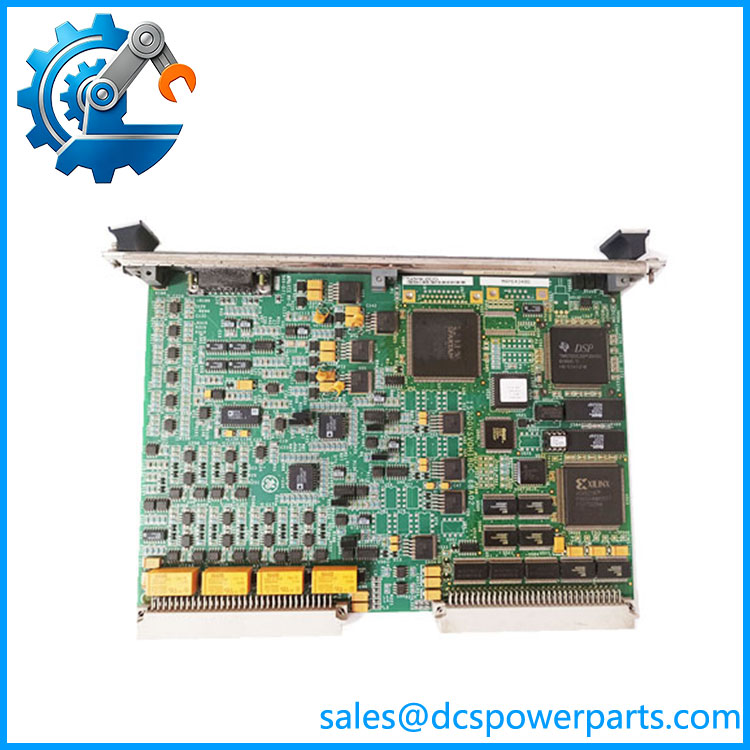
IS200VSVOH1B
Application Scenarios & Field Pitfalls
Engineering Pain Point
Turbine valve control requires continuous feedback rather than a simple open-loop analog command. The VSVO architecture combines servo current output with LVDT position feedback so the control system can regulate valve movement and monitor the resulting position. GE documentation also identifies pulse-rate inputs for turbine flow-measurement applications.
Typical Applications
- Gas turbine fuel-valve control — regulating electro-hydraulic fuel valves through servo outputs.
- Steam turbine control — controlling steam-valve actuators through closed-loop servo regulation.
- Combined-cycle power plants — supporting turbine control systems where fuel and steam valve positioning are coordinated.
- Legacy Mark VI maintenance — replacement of failed VSVO boards while retaining the existing turbine control architecture.
The board’s four servo channels are normally distributed through associated servo terminal boards, with LVDT feedback used for valve-position measurement. In redundant Mark VI arrangements, the terminal-board connections also provide the signal paths required for TMR operation.
Technical Pitfalls to Avoid
- Do not treat IS200VSVOH1B as a generic analog-output board. Its servo-loop function, LVDT interfaces, and terminal-board relationships are specific to the Mark VI turbine-control architecture.
- Verify the terminal-board arrangement before replacement. GE documentation identifies TSVO and DSVO configurations and specific J3/J4/J5 connections. A wiring mismatch can prevent an otherwise functional board from operating correctly.
- Check the complete part number and revision.
IS200VSVOH1Bis not equivalent to every VSVO board simply because the VSVO designation matches. The H1 board group and B revision should be confirmed against the existing hardware and system documentation. - Investigate the field loop before condemning the board. A failed servo output can originate from the VSVO, terminal board, servo coil, LVDT circuit, cabling, or configuration. Replacing the PCB without checking the complete loop can result in repeat failures.
Related Products
- GE IS200VSVOH1A — earlier VSVO board revision; verify revision and system compatibility before considering it as a replacement.
- GE TSVO — servo/LVDT terminal-board hardware associated with VSVO servo-control channels; handles field-side servo and LVDT connections.
- GE DSVO — alternative servo terminal-board arrangement used with the VSVO architecture.
- GE IS200VTURH1B — Mark VI VME turbine-control board; performs a different turbine-control function and is not a substitute for VSVO.
- GE IS200VPROH2B — Mark VI VME protection assembly; associated with turbine protection rather than servo-loop regulation.
- GE IS200VAICH1D — Mark VI VME analog input card; provides a different I/O function.
- GE IS200VVIBH1C — Mark VI VME vibration card; used for vibration monitoring rather than valve servo control.
Procurement Check
For IS200VSVOH1B, verify the complete board number, H1 group, B revision, VME installation, and associated TSVO/DSVO terminal-board configuration before purchasing. The most important field-side checks are the four servo channels, LVDT feedback/excitation wiring, pulse-rate inputs, and the simplex or TMR architecture. GE’s Mark VI documentation shows that these functions are tightly integrated into the servo-control loop, so a visually similar Mark VI board should not be treated as a drop-in replacement without configuration verification.