Description
GE Fanuc IC698CPE040-HN PACSystems RX7i CPU
Product Overview
The GE Fanuc IC698CPE040-HN is a high-performance central processing unit for the PACSystems RX7i programmable automation controller platform. It uses a 1.8 GHz Intel Pentium-M processor and provides 64 MB of user memory, making it one of the higher-performance CPU options in the legacy RX7i CPE family. The controller communicates with RX7i rack modules through the VME64 backplane and provides embedded Ethernet and serial communications for programming, supervisory connectivity, and legacy devices.
The -HN suffix should not be ignored during procurement. GE’s release documentation specifically identifies IC698CPE040-HN with CPU firmware 6.75 and Ethernet firmware 6.13. Earlier and later CPE040 revisions have different firmware histories, so a physically similar CPE040 is not automatically equivalent at the installed-system level. GE also documents a later -Jx hardware generation with changes related to smart-battery low-voltage detection.
In an operating RX7i system, the CPE040 is the controller’s processing core rather than an I/O interface. It executes the application program, manages I/O and backplane communications, and handles the controller’s embedded communication services. The CPU depends on the RX7i rack, appropriate power supply, fan tray, battery arrangement, and compatible programming environment; it should therefore be evaluated as part of the complete controller assembly rather than as an isolated processor board.
Product Introduction
For an older RX7i installation, IC698CPE040-HN remains a practical maintenance reference because the exact hardware revision and firmware combination can matter more than the nominal CPE040 model. The HN revision is documented with CPU firmware 6.75 and Ethernet firmware 6.13, providing a clear baseline for a legacy replacement.
The engineering check is straightforward: compare the CPU revision, firmware, battery system, rack configuration, application project, and communication requirements before installation. The 1.8 GHz Pentium-M processor and 64 MB user-memory specification alone do not establish drop-in compatibility.
Key Technical Specifications
| Parameter | Specification |
|---|---|
| Product Model | IC698CPE040-HN |
| Manufacturer | GE Fanuc / GE Intelligent Platforms |
| Product Family | PACSystems RX7i |
| Product Type | CPU / Central Processing Unit |
| Processor | Intel Pentium-M |
| Processor Speed | 1.8 GHz |
| User Memory | 64 MB |
| Discrete I/O Reference Capacity | Up to 32 Kbits for %I / %Q |
| Analog I/O Reference Capacity | Configurable up to 32 Kwords for %AI / %AQ |
| Program Blocks | Up to 512 |
| Maximum Program Block Size | 128 KB |
| Ethernet | Embedded auto-sensing 10/100 Mbps |
| Ethernet Duplex | Half/full duplex |
| Serial Communications | RS-232 / RS-485 |
| Serial Protocols | SNP, Serial I/O, Modbus RTU Slave |
| Ethernet Protocols | SRTP and other supported RX7i Ethernet services |
| Backplane | VME64, ANSI/VITA 1 |
| Typical Boolean Execution Speed | Approximately 0.02391 ms per 1,000 Boolean contacts/coils |
| Backplane Supply | +5 VDC, approximately 6.8 A nominal |
| Auxiliary Supply | +12 VDC / -12 VDC, approximately 0.003 A nominal each |
| Operating Temperature | 0 to +60°C |
| Cooling | RX7i fan tray / forced airflow required |
| CPU Firmware for HN | 6.75 |
| Ethernet Firmware for HN | 6.13 |
| Battery Retention | Battery-backed memory architecture |
| Mounting | RX7i VME rack |
| Firmware Status | Revision-specific |
The published CPE040 data identifies 6.8 A nominal at +5 VDC for the CPU. That is a substantial backplane load and should be included in the RX7i power-budget calculation rather than treating the CPU as a low-consumption controller module.
GE’s release history specifically associates the HN revision with CPU firmware 6.75 / Ethernet firmware 6.13. The same documentation shows a long sequence of earlier CPE040 revisions, including AA through GN and later JP, each associated with different firmware combinations.
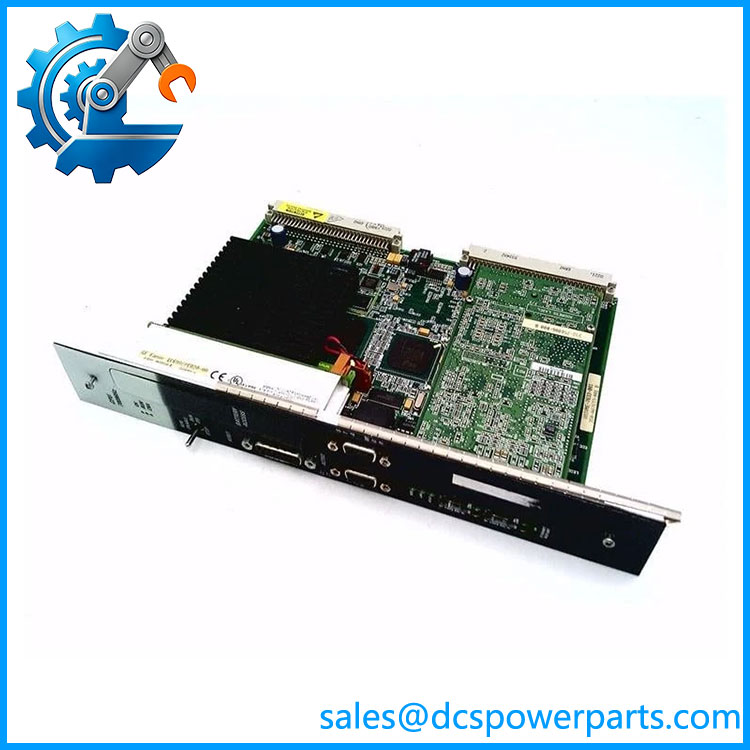
IC698CPE040-HN
Major Features and Practical Advantages
1. 1.8 GHz Pentium-M processing
The uses an Intel Pentium-M processor running at 1.8 GHz. For the RX7i platform, this provides substantially more processing capacity than earlier CPU generations and is intended for demanding real-time control applications.
The processor specification alone should not be used to estimate actual PLC scan time. Application size, communications workload, I/O configuration, programming structure, and diagnostics all influence controller loading.
2. 64 MB user memory
The CPU provides 64 MB of user memory for application resources. Published documentation also defines configurable memory areas for discrete I/O, analog I/O, %W, and managed symbolic/I/O variables.
For a replacement CPU, preserve the existing application project and retained data rather than assuming the replacement’s factory memory state represents the operating machine configuration.
3. Embedded 10/100 Mbps Ethernet
The incorporates an auto-sensing 10/100 Mbps Ethernet interface with half- and full-duplex operation. This provides the RX7i controller with network connectivity without requiring a separate Ethernet CPU module.
Supported services include the Ethernet communications functions used by the RX7i platform. The exact network configuration, IP addressing, station settings, and application-level services remain project-dependent.
4. Legacy serial connectivity
RS-232 and RS-485 communications allow the to interface with legacy equipment and programming/service devices. Published specifications identify SNP, Serial I/O, and Modbus RTU Slave among the supported serial protocols.
That matters on older production equipment where replacing a CPU may otherwise appear to require redesigning every serial interface.
5. VME64 RX7i backplane
The communicates with the RX7i rack through the VME64 architecture, following ANSI/VITA 1. The CPU therefore belongs specifically to the RX7i rack ecosystem and is not a standalone PLC controller.
This also means that rack power, slot arrangement, module compatibility, and backplane configuration remain part of the replacement assessment.
6. Revision-specific firmware
The HN suffix gives this unit a defined position in the revision history. GE documents:
- IC698CPE040-HN
- CPU firmware: 6.75
- Ethernet firmware: 6.13
This is useful when troubleshooting an old installation because it provides a known hardware/firmware baseline.
Do not, however, conclude that every -HN in circulation currently contains those exact firmware revisions. A previously serviced unit may have been updated.
7. Battery-backed memory
The RX7i uses battery-supported memory retention. Emerson’s later battery documentation distinguishes -Hx and earlier from -Jx and later hardware regarding smart-battery support and low-battery detection. The HN unit therefore falls into the earlier hardware group.
This is a real procurement concern. Do not assume that a later smart-battery feature available on -Jx hardware is present on an -HN CPU.
8. Forced-air cooling requirement
The requires the RX7i fan-tray cooling arrangement for normal operation at its specified temperature range. The published data identifies a 0 to +60°C operating range with fan-tray cooling.
For a CPU that has been running for many years, inspect the fan tray and cabinet airflow at the same time as the CPU. Replacing the processor while leaving a degraded cooling system in service is a poor maintenance strategy.
Related Products
- IC698CPE030 — Lower-performance RX7i CPE CPU family; similar architecture but different processor/performance characteristics.
- IC698CRE040 — RX7i redundancy CPU family; intended for redundant controller architectures rather than the standard role.
- IC698CPE040-JP — Later revision; should not be assumed identical to the HN revision because hardware and firmware characteristics changed across the revision history.
- IC698CPE040-GN — Earlier revision with a different documented firmware baseline.
- IC698CPE040-GM — Earlier revision within the same Pentium-M CPU family.
- IC698CPE040-GL — Earlier hardware revision.
- — Earlier revision with an earlier firmware generation.
- IC698ACC701 — RX7i battery family used for memory retention; exact revision must match CPU support.
- PACSystems RX7i Power Supply Modules — Provide the rack-level power required by the CPU and installed VME modules.
- RX7i Fan Tray — Required forced-air cooling assembly for the operating environment.
FAQ
What is the diffeen and ?
identifies the CPU family, while -HN identifies a specific hardware revision. GE’s release history associates HN with CPU firmware 6.75 and Ethernet firmware 6.13. For maintenance procurement, the suffix should therefore be retained rather than shortened to .
Is a PLC CPU?
Yes. More precisely, it is the central CPU of the GE PACSystems RX7i programmable automation platform. It executes the control application and communicates with rack I/O and intelligent modules through the VME64 backplane.
Can I replace an HN CPU with a JP CPU?
Do not assume an unconditional drop-in replacement. GE’s revision history shows significant firmware changes across revisions, and the later Jx hardware generation introduced smart-battery low-voltage detection capabilities. Verify the application, firmware, programming software, rack configuration, and battery arrangement before changing revisions.
What es use?
GE’s release documentation lists CPU firmware 6.75 and Ethernet firmware 6.13 for the HN revision. A serviced CPU may have been updated since manufacture, so verify the actual firmware displayed by the controller before replacement.
es support Modbus?
The documentation identifies Modbus RTU Slave among its serial communication protocols. Ethernet services are handled through the CPU’s embedded Ethernet subsystem, with the exact protocol configuration determined by the RX7i project.
Can I hot-swap the -HN?
Do not treat it as a hot-swappable I/O module. The CPU is the controller core of the RX7i rack. Follow the approved shutdown/replacement procedure, preserve the application and retained data, and verify the battery condition before removing power.
Does the HN CPU use a smart battery?
The HN revision belongs to the -Hx and earlier hardware group. Emerson’s battery documentation distinguishes these CPUs from -Jx and later revisions, which support smart-battery low-voltage detection with appropriate firmware. Do not assume Jx battery behavior applies to HN hardware.
What should I check before purchasing a replacement?
Record the complete CPU marking, including the -HN suffix. Then check:
- Hardware revision.
- Actual CPU and Ethernet firmware.
- RX7i rack and power-supply configuration.
- Fan-tray condition.
- Battery type and remaining retention capacity.
- Application project and retained data.
- Ethernet configuration and serial-device dependencies.
- Programming-software compatibility.
The 5 VDC / approximately 6.8 A CPU load should also be included in the rack power calculation.
Procurement Note
The is a revision-specific RX7i CPU. Its core specifications—1.8 GHz Pentium-M processor, 64 MB user memory, embedded 10/100 Mbps Ethernet, VME64 backplane, and 0 to +60°C operating range with required cooling—are well established.
For legacy replacement work, the -HN suffix should remain part of the procurement description. GE’s documented revision history shows that hardware evolved over many generations, with corresponding changes in CPU firmware and Ethernet firmware.
Battery management deserves special attention. Emerson’s battery documentation shows that -Hx and earlier hardware has different smart-battery behavior from -Jx and later revisions. If a later CPU revision is being considered as a substitute, verify the battery system rather than assuming the newer feature set is backward-compatible.
For New Surplus or previously installed inventory, inspect the CPU label, hardware revision, battery compartment, Ethernet and serial connectors, front-panel condition, and any evidence of fan-related thermal stress. Confirm the actual firmware after receipt if the CPU will be used in a production RX7i controller.
The practical rule is simple: matchte revision and controller environment, not merely the base number. That avoids the common mistake of treating a revision-sensitive RX7i CPU as a generic processor replacement.