Description
Product Introduction
High starting current can cause voltage dips, mechanical shock, and unnecessary stress on belts, couplings, and driven equipment. A soft starter limits the electrical and mechanical impact of motor starting by controlling the applied voltage during acceleration, making it useful for conveyor systems and other industrial drives.
The ASTAT XL 0076B V5 C1 soft starter, associated with part number 872245-QL21B076D, is intended for three-phase motor control in industrial installations. Before replacement, verify the current rating, motor nameplate, starting duty, bypass arrangement, and control-terminal configuration. The complete suffix matters when matching an older starter.
Key Technical Specifications
| Parameter | Specification |
|---|---|
| Part number | 872245-QL21B076D |
| Associated model | ASTAT XL 0076B V5 C1 |
| Product type | Soft starter |
| Rated current | 76 A |
| Supply voltage | 200–525 VAC |
| Supply frequency | 50/60 Hz |
| Reference motor rating | 37 kW / 50 hp at 400 VAC |
| Motor supply | Three-phase AC |
| Starting method | Solid-state voltage ramp / current-limited starting, depending on configuration |
| Application class | Confirm AC-53B duty and permitted starts per hour against the original datasheet |
| Control inputs | Verify the specific terminal configuration |
| Bypass | Confirm the installed bypass arrangement and starter variant |
| Installation | Industrial motor control panel |
| Protection features | Confirm the model-specific manual and configuration |
| Condition / warranty | Seller-specific; request written confirmation |
The part number is listed with a 76 A rating and a 37 kW reference application at 400 V. Confirm the motor’s actual rated current and the starter’s duty rating before selecting it for a replacement.
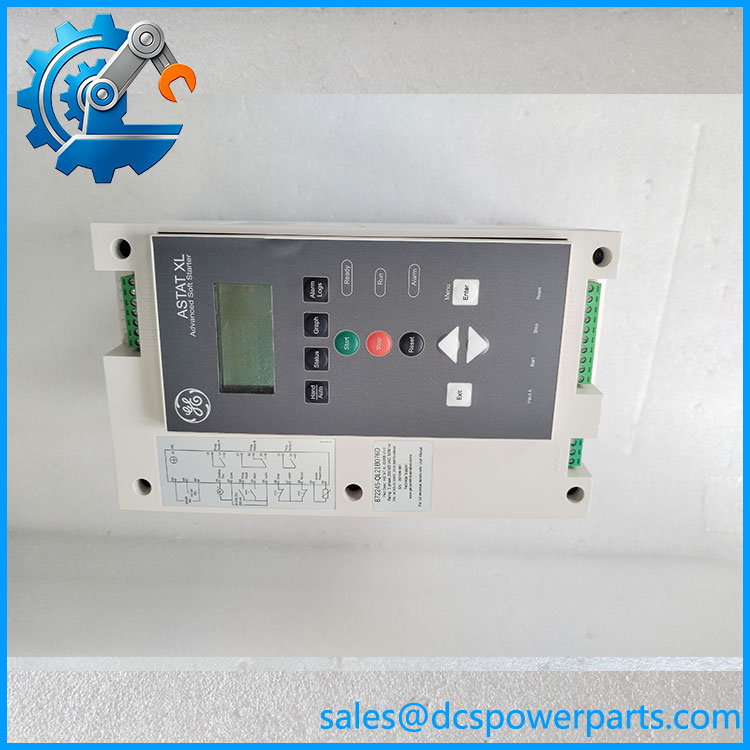
872245-QL21B076D
Application Scenarios & Pain Points
Motor starting problems often show up as nuisance trips, belt shock, or supply-voltage dips. A correctly selected soft starter can reduce starting stress, but only if its current rating and duty match the motor and driven load.
- Ship-loader conveyors: Gradual acceleration can reduce belt and gearbox stress during startup.
- Industrial material handling: Helps control the starting behavior of conveyor motors and related machinery.
- Pumps and fans: Can reduce abrupt mechanical loading when configured for the driven load.
- Plant motor control panels: Provides a solid-state starting option where a direct-on-line starter would create excessive starting current or mechanical shock.
Field note: A conveyor that starts reliably when unloaded but trips under load may need more than a starter replacement. Check mechanical binding, belt tension, motor current, ramp settings, and the permitted start frequency before increasing current limits.
Related Products
These are related product references for evaluating a replacement; they are not guaranteed drop-in substitutes.
- ASTAT XL 0076B V5 C1 — The model designation associated with this part number.
- ASTAT XL 0052B — Lower-current ASTAT XL family option; confirm voltage range and motor duty.
- ASTAT XL 0105B — Higher-current ASTAT XL family option; confirm physical size, control interface, and starting duty.
- ABB PSTX soft starter — A different soft-starter family that may be considered for an engineered upgrade.
- ABB PSE soft starter — A separate soft-starter family for applications within its rated operating range.
- Three-phase contactor and overload relay assembly — An alternative motor-starting arrangement that requires a separate design and protection review.
- Variable-frequency drive (VFD) — A different solution when adjustable operating speed is required, rather than startup control alone.
Engineer’s Guide: Three Replacement Pitfalls
1. Match motor current and duty. Warning: Do not size the replacement using kilowatts alone. Compare motor full-load current, starting time, load inertia, start frequency, ambient temperature, and AC-53B duty requirements.
2. Verify the bypass and control wiring. Check the existing starter’s power terminals, bypass arrangement, control supply, start/stop inputs, fault contacts, and any PLC interlocks. Similar-looking starters may have different terminal assignments.
3. Review settings before the first start. Record the original motor-current setting, ramp-up and ramp-down times, current limit, overload protection, and fault behavior. Test under an approved commissioning procedure before returning the driven equipment to production.
Frequently Asked Questions
Q1: What is 872245-QL21B076D?
It is associated with the ASTAT XL 0076B V5 C1 industrial soft starter, a device used to control starting and stopping of three-phase AC motors.
Q2: What is the rated current of this soft starter?
The associated listing specifies 76 A. Actual suitability depends on motor full-load current, start duration, starts per hour, ambient conditions, and the manufacturer’s duty rating.
Q3: Can it operate a 37 kW motor?
A 37 kW motor at 400 VAC is the listed reference application. Confirm the actual motor nameplate current and load duty before installation; the kW rating alone does not guarantee suitability.
Q4: Can I replace it with another 76 A soft starter?
Not automatically. Check the voltage range, starting-duty rating, bypass configuration, control terminals, fault outputs, panel dimensions, and communication or interlock requirements.
Q5: What should I check when buying a refurbished unit?
Request photos of the actual nameplate, a written condition statement, inspection or functional-test details, and warranty terms. Ask whether the power section, control electronics, terminals, and bypass components have been inspected.
Q6: What information is needed for a replacement quotation?
Provide the complete part number, motor nameplate current and voltage, load type, starting time, expected starts per hour, control voltage, and existing wiring diagram. This helps determine whether the same model or a suitable engineered alternative is required.