Description
Key Technical Specifications
| Parameter | Specification |
|---|---|
| Product Model | FBM215 |
| Manufacturer | Foxboro / Schneider Electric |
| System | I/A Series / Foxboro Evo |
| Product Type | HART Communication Output Module |
| Output Channels | 8 isolated |
| Analog Output | 4–20 mA |
| HART Support | HART Revision 5, 6, and 7 |
| HART Communication | Point-to-point, half-duplex |
| HART Baud Rate | 1200 baud |
| HART Message Rate | 2 messages/second |
| Output Accuracy | ±0.05% of span |
| Resolution | 13 bits |
| Maximum Load | 750 Ω |
| Maximum Output Change Rate | 20 mA in 60 ms |
| Module Fieldbus | Redundant 2 Mbps |
| Supply Voltage | 24 VDC ±5%, redundant |
| Maximum Consumption | 7 W |
| Operating Temperature | -20 to +70°C (-4 to +158°F) |
| Humidity | 5–95% RH, non-condensing |
| Mounting | Modular baseplate; DIN rail or rack-mounted baseplate |
| Termination | Dedicated termination assembly |
Schneider Electric’s current Foxboro documentation identifies the FBM215 as an 8-channel isolated HART output module. Each channel can provide a standard 4–20 mA output with a HART FSK digital signal superimposed on the analog loop.
The module communicates with the fieldbus through either side of the redundant 2 Mbps module Fieldbus. Its field-device interface supports HART 5, 6, and 7 instruments, with 1200-baud point-to-point, half-duplex communication. Analog output accuracy is specified at ±0.05% of span, with 13-bit resolution and a maximum 750 Ω load.
Product Introduction
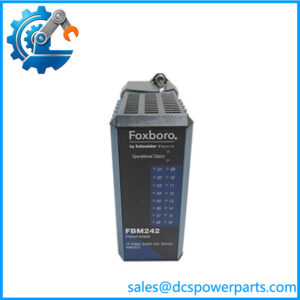
The Foxboro FBM215 is an eight-channel HART communication output module for Foxboro I/A Series and Foxboro Evo DCS installations. It generates isolated 4–20 mA control outputs while providing bidirectional HART communication with compatible smart field devices. This makes it suitable for control loops involving valve positioners, actuators, and other HART-enabled devices where both the analog command and digital device information are required.
For plant maintenance, the important distinction is that FBM215 is an output module, not a HART analog-input module. Its channel isolation, integrated HART modem, redundant fieldbus connection, and dedicated termination architecture are part of the module’s system-level function. Replacing it with an FBM214 or another HART module simply because the model numbers look similar can result in an incorrect signal direction and incompatible field wiring.
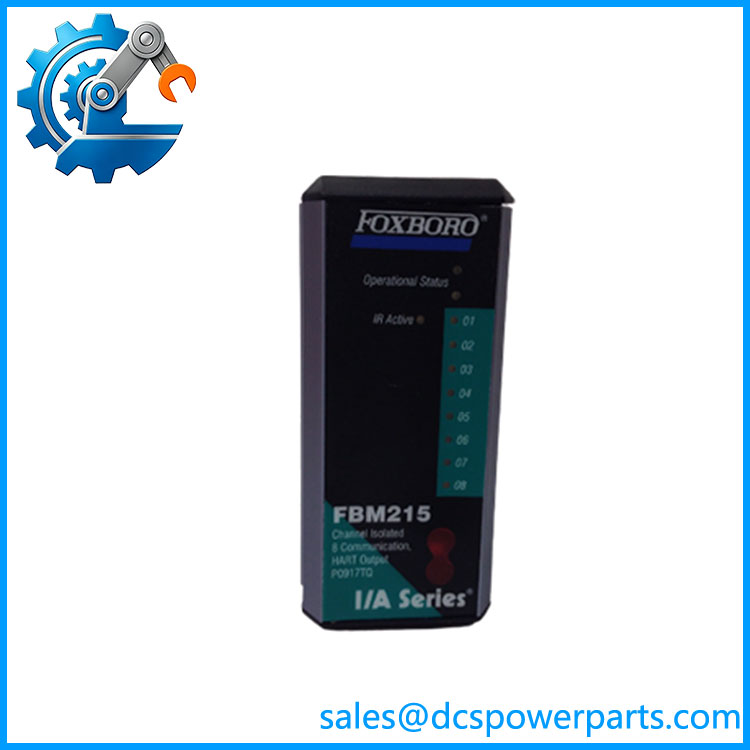
FBM215
Application Scenarios & Field Pitfalls
Engineering Pain Point
The FBM215 is commonly found where a DCS needs to control smart field equipment over conventional 4–20 mA loops while retaining HART communication.
The practical challenge is maintaining the complete FBM + baseplate + termination assembly + field device chain. The electronics module alone does not define the complete installation. Schneider documentation specifically identifies termination assemblies as the connection point between field wiring and the FBM subsystem.
Typical Applications
- Control valve positioning — 4–20 mA commands to HART-enabled valve positioners.
- Process actuator control — Analog control outputs with access to HART device information.
- Power-generation DCS — Boiler, turbine auxiliary, and balance-of-plant control loops.
- Oil, gas, and chemical processing — Smart final-control elements requiring analog control plus digital HART communication.
The FBM215 can act as the host for HART field devices, allowing the Foxboro system to request digital information from the device. The documented message-pass-through function supports HART universal, common-practice, and device-specific commands, but does not support HART burst communication.
Technical Pitfalls to Avoid
1. Do not confuse with FBM214.
FBM214 is an HART input module, while is an HART output module. This is a fundamental signal-direction difference, not a minor firmware variation.
2. Check the termination assembly.
The uses dedicated termination assemblies for field wiring. Before replacing an older module, verify the existing TA and cable arrangement rather than assuming every Foxboro FBM termination is interchangeable.
3. Do not expect HART burst mode.
The module supports HART digital communication and message pass-through, but published documentation explicitly states that burst communication mode is not supported. This matters when replacing an existing HART interface in a system that depends on a particular device communication strategy.
4. Verify the exact hardware variant.
appears in standard and compact 200 Series implementations. The mounting/baseplate architecture must match the installed DCS hardware. The compact version uses a Compact 200 Series baseplate, while standard FBM documentation specifies the modular baseplate architecture.
Related Products
- FBM214 — 8-channel HART analog-input module; receives 4–20 mA/HART signals rather than generating control outputs.
- FBM216 — Redundant 8-channel HART analog-input module; intended for applications requiring redundant input architecture.
- FBM217 — 32-channel discrete-input module for high-density status acquisition.
- FBM219 — Mixed discrete I/O module combining discrete inputs and outputs.
- FBM208 — 8-channel mixed analog I/O module with four inputs and four outputs.
- FBM204 — 8-channel mixed analog I/O module for 0–20 mA applications.
- FBM237 — 8-channel analog-output module for redundant-ready control applications; its architecture differs from the HART-focused .
- FBM212 — Differential thermocouple analog-input module for temperature measurement rather than analog control output.
Procurement Check
For an , specify the complete module identification and verify 8-channel HART output function, baseplate type, termination assembly, system generation, and field-device requirements before approving a replacement.
The most important technical check is signal direction: = HART analog output. If the existing cabinet requires transmitter signal acquisition, FBM214/FBM216-class hardware is the relevant family instead. Schneider Electric’s own documentation supports the ‘s eight isolated 4–20 mA HART outputs, redundant 2 Mbps fieldbus interface, and 24 VDC redundant power architecture.