Description
Key Technical Specifications
| Parameter | Specification |
|---|---|
| Product Model | FBM214 |
| Manufacturer | Foxboro / Schneider Electric |
| Part Number | P0922VT |
| Series | I/A Series 200 |
| Product Type | HART Communication Input Interface Module |
| Number of Inputs | 8 |
| Input Signal | 4–20 mA |
| HART | HART V6 |
| HART Communication | Point-to-point, master/slave, half-duplex |
| HART Baud Rate | 1200 baud |
| HART Messaging | Up to 2 messages/second |
| Input Resolution | 15 bit |
| Accuracy | ±0.03% of full scale, including nonlinearity |
| Update Rate | 100 ms |
| Input Resistance | 280 Ω minimum |
| Internal Loop Power | 24 VDC ±10% |
| Module Supply | 24 VDC ±5%, redundant |
| Maximum Consumption | 7 W |
| Heat Dissipation | 4 W maximum |
| Fieldbus | Redundant 2 Mbps module Fieldbus |
| Operating Temperature | -20 to +70°C |
| Humidity | 5–95% RH, non-condensing |
| Module Dimensions | 102 × 45 × 104 mm |
| Approx. Weight | 284 g |
The original Schneider Electric/Foxboro specification identifies FBM214 as an eight-channel HART communication input interface. Each channel accepts a conventional 4–20 mA signal or a HART FSK signal superimposed on that current loop.
Product Introduction
The Foxboro FBM214 P0922VT is an I/A Series 200 fieldbus module designed to bring eight 4–20 mA process signals into the DCS while retaining bidirectional HART communication with intelligent field instruments. Each channel includes a dedicated HART modem, allowing the control system to access supported HART device information rather than treating the transmitter as a simple analog source.
The module uses sigma-delta conversion with 15-bit resolution and specifies ±0.03% full-scale accuracy, 100 ms update rate, and 24 VDC redundant module power. Its fieldbus connection to the associated control processor uses a redundant 2 Mbps module Fieldbus. These characteristics make FBM214 particularly useful where an existing I/A Series installation needs both process-value acquisition and HART device communication without replacing the field transmitters.
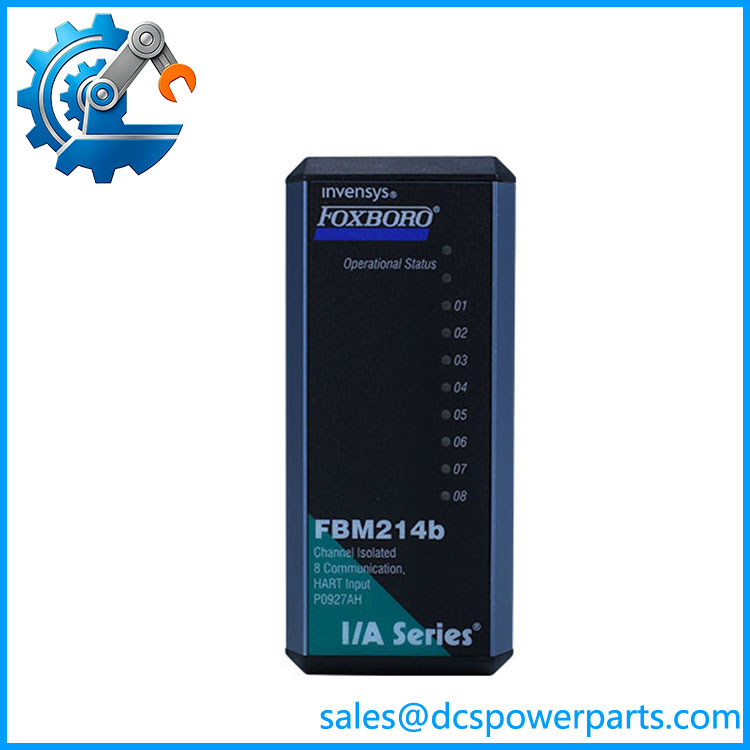
FBM214
Application Scenarios & Field Pitfalls
Engineering Pain Point
The important distinction with FBM214 is that it is not simply an 8-channel analog input card. The HART communication layer is part of its intended function. A standard 4–20 mA transmitter can be connected, but when a HART device is used, the module also communicates digitally with that instrument.
The original Foxboro documentation specifies dedicated FSK modems for the eight channels and support for HART universal commands.
Typical Applications
- Process transmitters — pressure, flow, temperature, and level instruments using 4–20 mA/HART.
- Oil and gas facilities — bringing intelligent field transmitters into legacy I/A Series DCS installations.
- Chemical and petrochemical plants — analog process measurement combined with remote HART diagnostics.
- Plant instrumentation upgrades — retaining existing 4–20 mA wiring while adding access to HART device information.
Technical Pitfalls to Avoid
- Do not confuse FBM214 with FBM215. is a HART input module; FBM215 provides HART output functionality.
- Check the exact generation. The original and newer FBM214b are closely related but are not identical products. The newer FBM214b provides individually isolated channels, whereas the original specification describes the eight inputs as group-isolated from ground and module logic.
- Do not assume channel-to-channel galvanic isolation. For the original , the eight channels are isolated as a group rather than individually isolated from one another.
- Check loop resistance when using HART. The documented total input resistance is approximately 280 Ω minimum, while compliance voltage and field-device power requirements must be considered together.
- Do not assume burst-mode HART operation. The module supports point-to-point HART communication at 1200 baud and up to two messages per second; newer FBM214b documentation also explicitly states that burst communication mode is not supported.
Related Products
- FBM214b — Later HART input version with eight individually isolated 4–20 mA/HART channels; verify system generation before substitution.
- FBM215 — Eight-channel HART analog output module; complementary to but electrically a different function.
- FBM216 — Redundant eight-channel HART analog input module for applications requiring redundant input architecture.
- FBM216b — Newer redundant HART input design with channel isolation; not automatically interchangeable with .
- FBM212 — 14-channel analog input module for differential/thermocouple applications; does not provide the same HART function.
- FBM217 — 32-channel redundant-ready discrete I/O module; intended for discrete signals rather than HART instrumentation.
- P0922VT — Original module part number and an important procurement identifier.
- P0903SV — Cable Balun module used in certain externally powered HART loop arrangements.
Procurement Check
For , specify rather than purchasing against the generic description “Foxboro HART input card.” Confirm the installed I/A Series generation, baseplate, termination assembly, fieldbus architecture, and whether the system actually requires the original group-isolated or can accommodate the newer FBM214b architecture.
The most important distinction for a replacement project is vs. FBM214b. Their names and functions are close, but their channel-isolation architecture differs, so a newer module should not be accepted as a drop-in replacement without checking the system documentation.