Description
Foxboro FBM203 RH914SV — Product Details
Product Overview
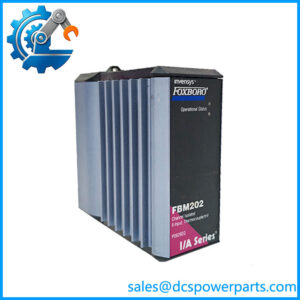
The Foxboro FBM203 RH914SV is an eight-channel resistance temperature detector (RTD) input module used in Foxboro distributed control systems. It converts resistance signals from compatible field temperature sensors into digital process values for the control system. Typical applications include temperature monitoring in chemical processing, power generation, oil and gas facilities, water treatment, and other continuous-process environments where reliable temperature feedback is required for control, alarms, and equipment protection.
The module accepts 2-wire or 3-wire RTD inputs over a nominal resistance range of 0–320 Ω per channel. Compatible sensor families include platinum RTDs following DIN, SAMA, and IEC standards, as well as supported nickel RTDs. Each channel is galvanically isolated from the other channels and ground, helping reduce the effect of electrical disturbances between measurement circuits. Independent sigma-delta conversion provides new input values at intervals as short as 25 ms, while the integration period can be configured to average readings and reduce process noise or power-line interference.
For engineering evaluation, the Foxboro FBM203 RH914SV specifies ±0.03% of span analog accuracy, including linearity, and a temperature coefficient of ±50 ppm/°C. The standard FBM203 uses a nominal sensor excitation current of 0.19 mA DC. For 2-wire inputs, lead resistance and changes in lead resistance with temperature are not corrected; 3-wire installations also require attention to lead balance because imbalance can reduce measurement accuracy. These wiring details can matter more than the module’s nominal accuracy when troubleshooting small temperature deviations over long cable runs.
The module communicates with its associated Fieldbus Communication Module or Control Processor through the redundant 2 Mbps module fieldbus. It mounts on a compatible modular baseplate and uses an appropriate termination assembly and cable to connect field wiring. RH914SV supersedes P0914SV, but a replacement should still be checked against the installed baseplate, termination arrangement, sensor wiring, and DCS configuration. The FBM203 should not be confused with the FBM203b extended-range RTD module or the FBM203c low-resistance copper RTD variant.
Product Introduction — Practical Field Focus
Temperature measurement faults often originate in the sensor element, extension wiring, terminal connections, or RTD configuration rather than in the I/O module itself. The Foxboro FBM203 RH914SV provides eight isolated RTD channels for compatible platinum and nickel temperature sensors, allowing multiple process measurements to enter the DCS through one module.
Before replacing a channel or module, verify the RTD type, 2-wire or 3-wire arrangement, lead resistance, termination assembly, and configured input scaling. During commissioning, compare readings against a known reference and check the wiring balance before attributing a measurement deviation to the module.
Key Technical Specifications
| Parameter | Specification |
|---|---|
| Module model | |
| Part number | RH914SV |
| Previous designation | P0914SV |
| Manufacturer | Foxboro / Schneider Electric |
| Module function | RTD analog input |
| Number of input channels | 8 |
| Channel isolation | Galvanic isolation between channels and ground |
| Input resistance range | 0–320 Ω per channel |
| Supported RTD wiring | 2-wire and 3-wire |
| Supported sensor types | Platinum and nickel RTDs |
| Typical platinum sensor | 100 Ω at 0°C |
| Typical nickel sensor | 235 Ω at 0°C |
| Nominal sensor current | 0.19 mA DC |
| Maximum lead resistance | 50 Ω per lead for /FBM203b |
| Analog accuracy | ±0.03% of span, including linearity |
| Accuracy temperature coefficient | ±50 ppm/°C |
| Conversion method | Independent sigma-delta conversion per channel |
| New input value rate | Up to every 25 ms |
| Integration period | Software configurable |
| Common-mode rejection | Greater than 125 dB at 50/60 Hz |
| Normal-mode rejection | Greater than 95 dB at 50/60 Hz |
| Fieldbus interface | Redundant 2 Mbps module fieldbus |
| Power input | 24 VDC, +5%/-10% |
| Maximum power consumption | 3 W |
| Maximum heat dissipation | 3 W |
| Operating temperature | -20°C to +70°C |
| Storage temperature | -40°C to +70°C |
| Relative humidity | 5–95%, noncondensing |
| Operating altitude | -300 to +3,000 m |
| Storage altitude | -300 to +12,000 m |
| Vibration | 0.75 g from 5 to 500 Hz |
| Approximate module weight | 284 g |
| Module dimensions | 102 × 45 × 104 mm |
| Height including mounting lugs | 114 mm |
| Mounting | Modular baseplate; DIN rail or rack-mounted baseplate |
| DIN-rail termination assembly | RH916XJ for the specified compression-terminal configuration |
| Baseplate-mounted termination assembly | RH924WN for compatible paired /b/c arrangements |
| Ring-lug termination assembly | P0917JM |
| Maximum termination cable length | 30 m |
| Calibration requirement | Module and termination assembly calibration not required |
Specifications are for the standard . The FBM203b, FBM203c, and FBM203d have different resistance ranges, sensor arrangements, or termination requirements. Verify the exact module variant before applying specifications to an installation.
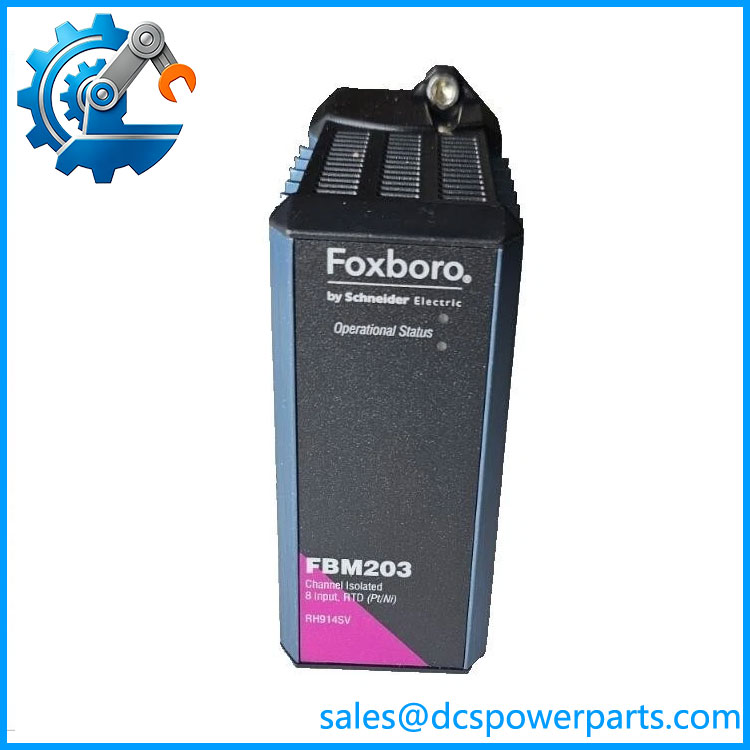
FBM203 RH914SV
Related Products
- FBM203b RH922UA — Eight-channel RTD input module with an extended 0–640 Ω input range.
- FBM203c RH922UD — Eight-channel low-resistance input module for compatible copper RTDs, with a 0–30 Ω range.
- FBM203d RH927AM — Eight-channel RTD module supporting 4-wire sensor inputs.
- FBM214b RH927AH — Eight-channel HART analog input module for 4–20 mA field transmitters.
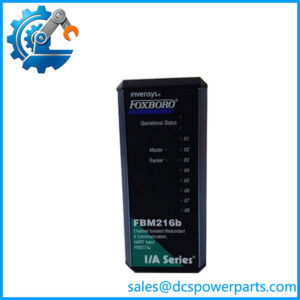
- FBM216b RH927AJ — Redundant-ready HART analog input module for compatible input-redundancy arrangements.
- FBM211 — Sixteen-channel 0–20 mA analog input module for standard current-loop measurements.
- RH916XJ — DIN-rail-mounted compression-screw termination assembly for the specified family configuration.
- RH924WN — Baseplate-mounted termination assembly for compatible paired /b/c installations.
These are related Foxboro I/O products, not automatic substitutes. Confirm channel type, sensor characteristics, termination wiring, and system compatibility before selecting an alternative.
Frequently Asked Questions
Q1. What does the Foxboro do?
It measures resistance from up to eight compatible RTD sensors and supplies corresponding process values to the Foxboro DCS. It is primarily used for temperature monitoring and temperature-related control functions.
Q2. Which RTD sensors can the support?
The standard supports compatible platinum RTDs, including DIN, SAMA, and IEC types, and nickel RTDs following supported specifications. Typical nominal resistances are 100 Ω for platinum and 235 Ω for nickel at 0°C. Confirm the actual sensor curve and DCS configuration before commissioning.
Q3. What is the difference between , FBM203b, and FBM203c?
The standard has a 0–320 Ω input range. The FBM203b extends the range to 0–640 Ω, while the FBM203c is designed for low-resistance copper RTDs and has a 0–30 Ω range. Their excitation currents and accuracy specifications differ, so they should not be treated as interchangeable.
Q4. Can the be replaced online?
The modular design supports removal and replacement within the appropriate system architecture, but live replacement must follow the site’s approved maintenance procedure. Confirm system support, process consequences, and the permitted replacement method before removing an installed module.
Q5. Which termination assembly should be ordered with ?
The appropriate assembly depends on the physical installation. The published specification lists RH916XJ for a DIN-rail compression-terminal arrangement, RH924WN for compatible baseplate-mounted paired /b/c arrangements, and P0917JM for a ring-lug configuration. Check the existing terminal hardware and cable type before ordering.
Q6. Why might the temperature reading be inaccurate?
Common causes include an incorrect RTD type or curve, wiring resistance, mismatched lead resistance in a 3-wire circuit, poor terminal contact, incorrect scaling, or electrical interference. For a 2-wire RTD, lead resistance is not corrected by the module. Check the complete sensor circuit before replacing the I/O module.
Q7. Does the require calibration?
The manufacturer states that calibration of the module and termination assembly is not required. However, commissioning should include comparison against a suitable temperature or resistance reference, verification of channel assignments, and confirmation of the correct sensor configuration.
Q8. What should procurement verify for used or refurbished stock?
Request photographs of the module label and connectors, confirmation of the complete part number, condition and revision details, documented test scope, warranty terms, and information about included accessories. A general “tested” claim does not establish that all eight RTD channels have been verified across the required input range.