Description
Product Overview
FBM232 P0926GW is the single-port member of Foxboro’s Field Device System Integrator (FDSI) family, and its role is best understood as a translation service rather than an I/O card. It presents one RJ-45 copper Ethernet port toward the plant, and it presents a set of standard DCI control blocks toward the Foxboro DCS control database. What happens in between is decided by a software driver that is downloaded into the module: the hardware is deliberately generic, and the protocol personality — Modbus/TCP, Triconex TSAA, or any of the other library drivers, including custom-developed ones — arrives as firmware rather than as a different part number.
That architecture is why the module carries no I/O channels at all. It does not have analogue inputs, it does not have discrete terminals, and it does not have a serial port. Its entire field-facing surface is one Ethernet socket on the front panel, and everything it knows about the plant arrives as packets from devices reached through that socket — directly in the simplest case, or through Ethernet switches and hubs when more than one device is involved. Officially the module talks to one external device or up to 64, with the actual number governed by the driver and by performance rather than by a hard limit in the hardware.
The “single” in its official title is the operative word, and it is the distinction that governs architecture. FBM232 is a simplex module on one network; FBM233 is the redundant Ethernet sibling on two networks. The same logic separates the serial pair: FBM230 carries four serial ports for simplex use, FBM231 P0926GV is the redundant version for dual-ported devices. So a plant that wants a redundant Ethernet path to its third-party devices either uses a pair of FBM232 modules on two separate networks, or moves to the FBM233. Ordering the single-port module and expecting redundancy to be a configuration choice is the most common architectural misunderstanding around this part.
Upward, the module speaks the standard Foxboro module fieldbus: it communicates with its associated FCM100Et, FCM100E, FCP270 or FCP280 over the redundant 2 Mbps module fieldbus, and it accepts communication from either path, so a single path failure or a system-level switchover does not take the module offline. Downward, capacity is expressed in DCI terms: up to 2000 DCI block connections, which resolves to as many as 2000 analogue values or as many as 64000 digital values when packed at 32 points per connection — or any mix of the two that the control processor’s sizing guidelines allow. The fastest allowed ECB block period is 500 ms, so this is a data-integration path, not a fast control loop.
Configuration is file-based rather than knob-based. The FDSI Configurator builds XML port and device configuration files: the port side carries addressing behaviour — DHCP or a fixed IP — while the device configurator, needed only for some devices, sets scan rate, the address of the data to be transferred and the size of a single transaction. Nothing on the module is set by jumpers, and nothing needs calibration; Foxboro states plainly that calibration of the module is not required.
Physically it is the familiar 200 Series shape: a 102 mm high extruded aluminium body, 45 mm wide, 104 mm deep, 284 g, mounted on a Modular Baseplate that takes four or eight modules on DIN rail or in a 19-inch rack. The front panel carries LEDs for module status and for Ethernet transmit and receive. It can be removed and replaced without removing power. Unlike the serial FDSI modules, it has no termination assembly — the field connection is the front RJ-45, with cable runs of 1 m to 100 m to the hub, switch or device, and a null hub adapter cable (P0971PK) for the direct single-device case where no hub or switch is present.
Two details in the specification reward reading the revision. Operating temperature is −20 to +70 °C for revisions A through J, but 0 to +70 °C from revision K onward — the same part number, two different low-end ratings depending on the label. And for multi-device installations Foxboro points at its own DIN-rail 5-port 10/100BaseTX switch, P0972WE (a Phoenix Contact SFNB 5TX 2891001), rated for four devices per switch and interconnectable up to the 64-device ceiling; rack and chassis switch options are covered in the control network Ethernet equipment specification.
The trade’s descriptions of this part are consistently wrong in the same direction — inventing field interfaces it does not have. One seller lists FoxCom as the protocol, 16 I/O channels, RS-485, thermocouple inputs and a −40 to +85 °C range. Another claims Foundation Fieldbus and HART support with password protection and a plug-and-play design. None of that exists: the module is Ethernet only, has no channels, no serial port and no field-termination capability, and its certified envelope is −20 to +70 °C on older revisions and 0 to +70 °C on current ones. The device protocols it can speak are the ones a driver has been written for, and those are listed in Foxboro’s driver documentation, not in a marketplace table.
Technical Specifications
| Parameter | Value |
|---|---|
| Model | FBM232 |
| Part number | P0926GW |
| Manufacturer | Foxboro (Schneider Electric), USA |
| Product type | Field Device System Integrator (FDSI) communication module, Ethernet, single |
| Platform | EcoStruxure Foxboro DCS / I/A Series, 200 Series I/O |
| Communication type | Ethernet, copper |
| Transmission rate | 10 Mbps or 100 Mbps |
| Transport / protocol | UDP/IP or TCP/IP; device protocol set by downloadable driver (e.g. Modbus/TCP, Triconex TSAA) |
| Ports | One RJ-45 on the front panel; no serial port, no I/O channels |
| IP addressing | Fixed or DHCP, set through the FDSI Configurator (XML port and device files) |
| Device capacity | 1 to 64 external devices via hub or switch (driver and performance dependent) |
| DCI capacity | Up to 2000 DCI connections — up to 2000 analogue values or up to 64000 packed digital values |
| Data types | 2- or 4-byte signed/unsigned integers, 4-byte IEEE single precision, binary; packed digital up to 32 points per connection |
| Fastest ECB block period | 500 ms |
| Module fieldbus | Redundant 2 Mbps module fieldbus to FCM100Et, FCM100E, FCP270 or FCP280; accepts either path |
| Power | 24 VDC +5 %/−10 %, redundant inputs; 7 W maximum consumption and heat dissipation |
| Dimensions | 102 mm H (114 mm with mounting lugs) × 45 mm W × 104 mm D |
| Weight | 284 g approximate |
| Mounting | Modular Baseplate, 4 or 8 modules, DIN rail horizontal/vertical or 19-inch rack |
| Cabling | RJ-45, 1 m to 100 m to hub/switch/device; null hub adapter cable P0971PK |
| Replacement | Removable and replaceable without removing power |
| Calibration | Not required |
| Environment | Operating −20 to +70 °C (Rev A–J), 0 to +70 °C (Rev K and later); storage −40 to +70 °C; 5–95 % RH non-condensing; Class G3 harsh per ISA S71.04 |
| Certification | EMC 2014/30/EU, EN 61326-1:2013 Class A; UL/UL-C Class I Div 2 Groups A–D T4; DEMKO Ex nA IIC T4 Zone 2; ABS Type Approved and BV Marine EC31 |
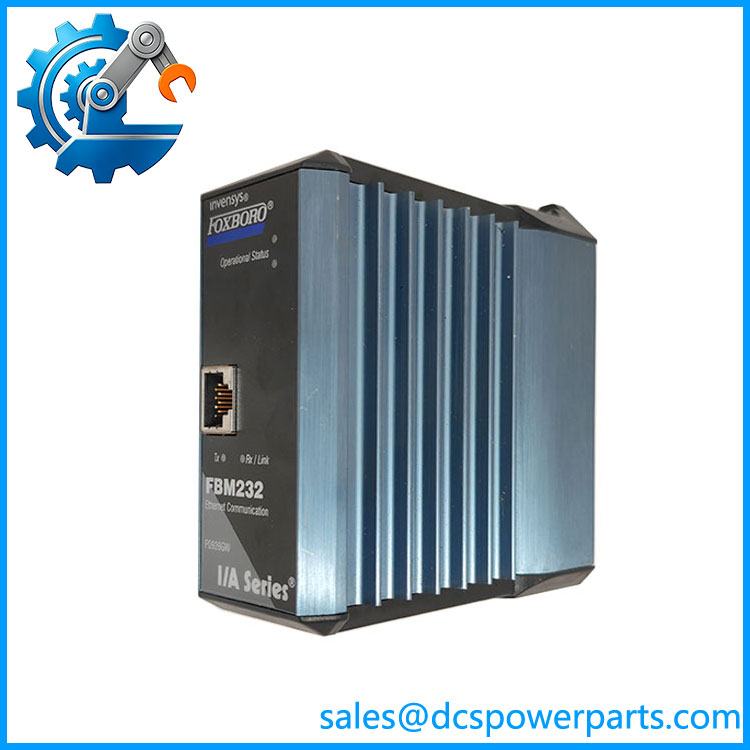
FBM232 P0926GW
Key Features and Advantages
Generic hardware, protocol by download: one part number covers every supported device protocol because the driver — not the board — defines the personality. A plant that later adds a different vendor’s package does not need a different module; it needs a different driver, which is downloaded to the module without disrupting the rest of the system. For a site with a heterogeneous installed base, that is the difference between one spare and five.
Single-port discipline as an architectural statement: FBM232 P0926GW is simplex by design. Redundancy at this layer comes from a second module on a second network, or from the FBM233 pair. Knowing that before the bill of materials is written prevents the classic outcome where a redundant architecture is specified, a simplex module is purchased, and the redundancy turns out to live in a document rather than in the cabinet.
Device reach with a small footprint: up to 64 devices through hubs and switches, from a module 45 mm wide. The capacity is real but conditional — the fastest ECB period of 500 ms and the 2000-connection ceiling are what actually bound it, and a driver’s own device limit can bind tighter still. The Triconex integrator driver, for example, caps at ten devices per module and asks the controller for data no faster than every 50 ms.
Packed digital efficiency: 32 digital points per connection means a single DCI connection can carry a whole valve island’s status. That is how 2000 connections become 64000 digital values, and it is why a modest connection count is not a modest data count.
The 2 Mbps module fieldbus with path independence: the module communicates with its FCM or FCP over the redundant fieldbus and accepts either path, so a single path failure or a system-level switch does not interrupt device data. Redundancy here is inherited from the control backbone rather than added at the module.
Field-grade construction without a field enclosure: extruded aluminium body, Class G3 harsh rating per ISA S71.04, and enclosures up to that class — for a cabinet-mounted module talking to devices in a plant environment, that is the appropriate level of protection, and it is honest about being a cabinet device rather than pretending to be IP65.
Serviceability by design: removable and replaceable without removing power, no calibration, LEDs for module status and Ethernet transmit and receive. The half-hour job is a half-hour job.
Configurator-built configuration: XML port and device files, DHCP or fixed addressing, per-device scan rate and transaction sizing. The configuration lives in a file that can be version-controlled and compared, which is a genuine improvement over DIP switches and a genuine improvement over undocumented on-site edits.
Honest limits: no analogue or discrete channels, no serial port, no Foundation Fieldbus, no HART, no IP65, no redundancy in the single module. Those are not missing features to be apologised for; they are the design, and misreading them is what produces the wrong module on site.
Applications
Modbus/TCP device integration: flow meters, analysers, power monitors, drives, motor management devices and packaged skids that expose Modbus/TCP. The FDSI driver presents them as DCI blocks that behave like any other Foxboro control block, so the operator display and the plant management functions treat them as native data rather than as a foreign system.
Safety system data exchange: the Triconex integrator driver brings Tricon and Trident controllers into the Foxboro system over the TSAA protocol, with device diagnostic displays modelled on TriStation, enhanced diagnostic monitor launch from System Manager, and sequence-of-events handling through Aprint. This is the case where the “no more than ten devices” and “no faster than 50 ms, no slower than a two-minute request interval” constraints matter most.
Analyser shelters and utility packages: a small cluster of instruments with Ethernet ports and no DCS-native interface. One module, one switch, and the cluster becomes part of the control database with 500 ms resolution — adequate for composition and emissions monitoring, and correctly not applied to fast control loops.
Motor control and electrical rooms: intelligent MCCs and protection relays that publish over Modbus/TCP. The packed-digital capability is what makes a board full of status bits economical in DCI connections.
Water, wastewater and cement plants: geographically spread packaged equipment from multiple vendors, where the value of the FDSI approach is that each addition is a driver download rather than a new interface card and a new engineering exercise.
Life extension of I/A Series installations: a system running I/A Series software at v8.0 or later with third-party devices to integrate; the FDSI family — FBM230 for serial, FBM231 P0926GV for redundant serial, FBM232 P0926GW for single Ethernet, FBM233 for redundant Ethernet — is the supported path, and the choice among them is decided by the device’s port count and the plant’s redundancy requirement, not by preference.
Where the module does not fit: any device that is serial-only (that is FBM230 or FBM231 territory), any requirement for a redundant Ethernet path at the module level (that is FBM233), and any application needing channel-level I/O in the same cabinet, which is a different FBM entirely.
Related Products
FBM233 — the redundant Ethernet FDSI module; two networks, two modules, one logical interface, and the correct choice when the path to the devices must survive a cable or switch failure. FBM231 P0926GV — the redundant serial FDSI module for dual-ported RS-232/422/485 devices; the serial counterpart of the redundancy question this module answers with “no”. FBM230 — the four-port serial FDSI module for single-ported serial devices, each port individually configurable. FCM100Et / FCM100E — fieldbus communications modules that interface the redundant 2 Mbps module fieldbus carrying the FBM232’s data. FCP270 / FCP280 — field control processors that host the module and its DCI connections, and that enforce the sizing limits within which the 2000-connection capacity is usable. P0972WE — DIN-rail 5-port 10/100BaseTX switch (Phoenix Contact SFNB 5TX 2891001) for connecting up to four devices per switch and interconnecting toward the 64-device ceiling. P0971PK — null hub adapter cable, used for a direct module-to-device connection where no hub or switch is installed. Modular Baseplate (PSS 31H-2SBASPLT) — the 4- or 8-position baseplate, DIN rail or rack mounted, that supplies the module’s redundant 24 VDC and the module fieldbus connections.
Installation and Maintenance
Before installation: confirm the architecture first. FBM232 P0926GW is a single-port module — if the design calls for a redundant Ethernet path, this is the wrong part and no amount of configuration will change that; the answer is a second module on a second network or a move to . Check the revision on the label against the ambient rating the cabinet actually sees: revisions A to J are rated from −20 °C, revisions K and later from 0 °C, and a cold-climate installation that was specified against the older rating needs that confirmed. Verify the baseplate has positions free, that redundant 24 VDC feeds are available, and that the Ethernet plan — fixed addressing or DHCP — is written down before the configurator is opened. Confirm the driver for the target device is available for the system release in use.
Installation: mount on the Modular Baseplate, seat the module and connect the front RJ-45. For a single directly connected device with no hub or switch, use the null hub adapter cable P0971PK; for multiple devices, install the switch (P0972WE or the rack-mounted equivalent) and keep cable runs within 1 m to 100 m. Load the XML port and device configuration through the FDSI Configurator, set the scan rate and transaction size per device, and confirm the module’s LEDs show module status plus transmit and receive activity. Nothing requires calibration.
Maintenance: the module is replaceable without removing power, which makes it a genuine five-minute swap — but record the configuration file identity first, because a replacement module arrives empty and needs the same XML files. Keep the driver version in the maintenance record alongside the module, since a driver mismatch after a system upgrade produces device timeouts that look like network faults. Watch for the two structural limits in service: a driver’s own device count, and the 500 ms fastest ECB period — a device that “keeps dropping out” at 200 ms scan is usually being asked for data faster than the module is allowed to provide. On the network side, keep switches documented and replace hubs with switches where the device supports it; a hub in a chain of analysers is the usual cause of intermittent communication faults that move when a cable is touched.
Warranty and Quality
Every FBM232 P0926GW is supplied as a Foxboro Field Device System Integrator module, single 10/100 Mbps Ethernet, matched to the part number and revision family published in specification PSS 41H-2S232, with the label’s revision checked against the required ambient rating — revisions A to J at −20 °C, revisions K and later at 0 °C. Units are inspected for RJ-45 socket condition, baseplate connector wear, extruded body and labelling integrity, and evidence of prior rework. Where a 200 Series bench arrangement is available, the module is powered from redundant 24 VDC, its status and Ethernet LEDs are confirmed, and communication is exercised against a device with the appropriate driver loaded before dispatch. A 12-month repair, replacement or refund commitment applies. Technical support covers the questions this module actually raises: why a single-port FDSI cannot be made redundant by configuration, when to specify instead, how many devices a given driver really supports, why 500 ms is the floor for ECB block periods, what the null hub adapter cable is for, and which revision’s temperature rating the installed label carries.
免费
今天 14:58