Description
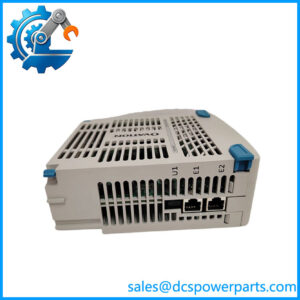
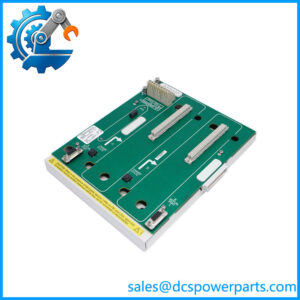
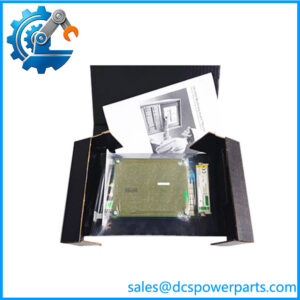
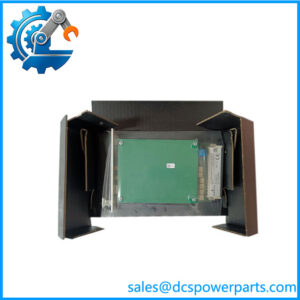
Emerson EC3-X33 Universal Superheat Controller
Product Introduction
Refrigeration systems become difficult to tune when evaporator load, pressure, and valve position do not stay synchronized. The Emerson EC3-X33 addresses that control problem by regulating evaporator superheat and commanding an Emerson electronic expansion valve. It is a stand-alone controller intended for refrigeration, air-conditioning, chillers, heat pumps, packaged equipment, and other cooling applications where stable refrigerant flow matters. Emerson documentation identifies the controller for use with its EX4–EX8 electrical control valves, while later instructions also reference FX5–FX9 valves.
The EC3-X33 accepts an Emerson temperature sensor and 4–20 mA pressure-transmitter signal, provides a 4–20 mA pressure signal for use by another controller, and includes a digital demand input and alarm relay. The ECD-002 keypad/display can be connected for commissioning and parameter adjustment but is not required for the EC3-X33 to remain operational. For replacement work, the valve type, refrigerant, pressure-sensor configuration, wiring, and controller revision should be checked rather than assuming that any EC3-family controller is interchangeable.
Key Technical Specifications
| Parameter | EC3-X33 Specification |
|---|---|
| Product Model | EC3-X33 |
| Manufacturer | Emerson |
| Product Type | Universal superheat controller |
| Primary Function | Superheat control / electronic expansion-valve control |
| Supply Voltage | 24 VAC ±10% |
| Supply Frequency | 50/60 Hz |
| Supply Current | 1 A |
| Maximum Power Consumption | 25 VA, including connected EX4–EX8 valve |
| Digital Input | 0/24 VAC/DC start/stop or demand signal |
| Temperature Input | Emerson ECN-N60 NTC temperature sensor |
| Pressure Input | Emerson 4–20 mA pressure transmitter |
| Analog Output | 4–20 mA pressure-signal feed-through |
| Alarm Relay | SPDT contacts; 24 VAC/DC, 2 A inductive load |
| Stepper Valve Output | Maximum 0.8 A at nominal 24 VDC |
| Valve Compatibility | EX4–EX8; later documentation also identifies FX5–FX9 |
| Keypad/Display | ECD-002 |
| ECD Connection | ECC-Nxx or CAT5 cable with RJ45 connectors |
| Terminal Type | Removable screw terminals |
| Wire Size | 12–20 AWG |
| Mounting | DIN rail |
| Protection Class | IP20 |
| Grounding | 1/4-inch / 6.3 mm spade earth connection |
The specifications above are taken primarily from Emerson/Copeland instruction material. The exact valve family supported can vary with the documentation revision, so the installed controller’s documentation and valve model should be checked before a field replacement.
Major Features / Advantages
Dedicated Superheat Regulation
The is designed around one specific refrigeration-control problem: maintaining appropriate evaporator superheat while controlling an electronic expansion valve. Rather than functioning as a general-purpose programmable controller, it combines temperature and pressure feedback with a dedicated stepper-motor valve output. This makes it suitable for packaged refrigeration equipment where predictable valve behavior is more important than broad PLC functionality.
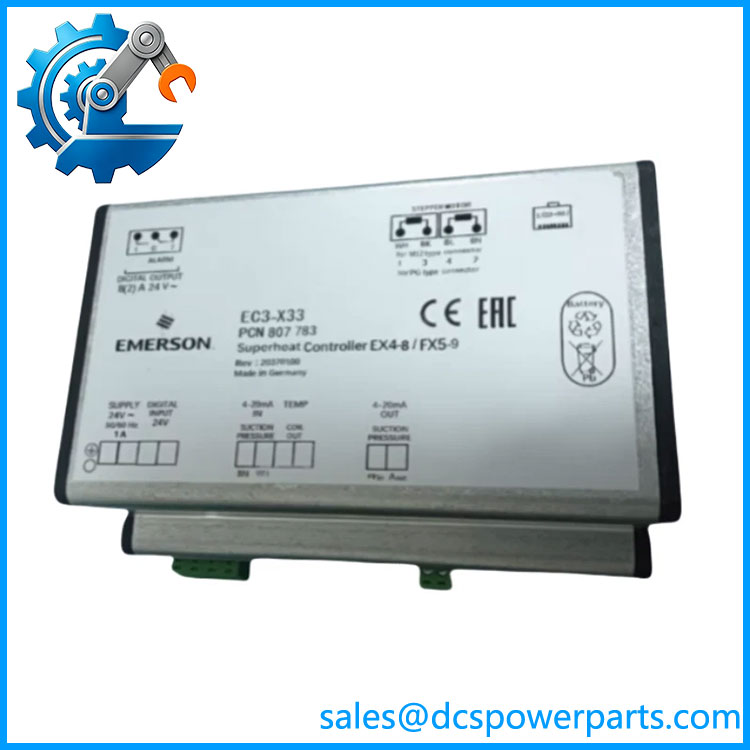
EC3-X33
Electronic Expansion-Valve Control
The controller provides a stepper-motor output for compatible Emerson electrical control valves. Published technical information specifies a maximum output current of 0.8 A with a nominal 24 VDC operating voltage. Valve selection is therefore not a minor configuration detail. The valve family and size must correspond to the controller configuration and operating conditions.
Pressure and Temperature Feedback
The combines an NTC temperature input with a 4–20 mA pressure-transmitter input. Emerson documentation identifies the ECN-N60 temperature sensor and compatible PT-series pressure transmitters in its technical documentation. The pressure measurement can also be passed through as a 4–20 mA analog signal to another controller, reducing the need for a second pressure transmitter where the system architecture permits signal sharing.
Stand-Alone Operation
The ECD-002 keypad/display is primarily a commissioning and adjustment interface. The can operate without the keypad/display after configuration, and the ECD-002 can be connected or disconnected as required. This is useful when the display is mounted on a cabinet door while the controller remains on the DIN rail inside the control enclosure.
DIN-Rail Installation
The is designed for standard DIN-rail mounting and uses removable screw terminals. Its IP20 construction is intended for installation inside a suitable electrical enclosure rather than direct exposure to washdown conditions. Wiring should keep sensor and controller circuits separated from mains wiring to reduce electrical interference and installation-related faults.
Built-In Alarm Handling
The controller includes an SPDT alarm relay. The published instruction sheet specifies 24 VAC/DC relay contacts with a 2 A inductive-load rating. The relay logic is also tied to the controller’s operating/alarm state, so commissioning personnel should verify the actual alarm behavior against the control-system sequence rather than assuming the contact behaves like a generic PLC output.
Application Scenarios & Field Pain Points
- Chillers and packaged cooling equipment: The can regulate electronic expansion valves where evaporator superheat needs dedicated control rather than a general PLC loop.
- Industrial process cooling: It can be applied to refrigeration circuits where pressure and temperature feedback are already available through compatible Emerson sensors and transmitters.
- Heat pumps and refrigeration packages: The controller’s dedicated valve-control function reduces the need to build a separate stepper-valve control routine in a PLC.
- Cold-room and food-process equipment: The published product overview identifies cold rooms and food-process applications among intended application areas.
A common field mistake is treating the as simply a 24 VAC controller and replacing it without checking the valve type parameter, refrigerant parameter, and pressure-sensor configuration. Emerson specifically requires these main parameters to be checked during startup. The valve should also be driven to its proper closed position before charging the refrigeration system.
Related Products
- ECD-002 — Keypad/display unit used for setup, monitoring, and parameter adjustment.
- EX4–EX8 — Emerson electrical control valves directly identified with documentation.
- FX5–FX9 — Valve family identified in later operating instructions; verify the exact controller revision before procurement.
- ECN-N60 — Emerson NTC temperature sensor specified for the .
- PT4-07M / PT4-18M / PT4-30M — Emerson pressure-transmitter models identified in documentation.
- ECC-Nxx — Cable family identified for connection between and ECD-002.
Engineer’s Guide — Field Pitfalls to Avoid
1. Do not assume the is part of the controller itself.
The can operate without the display/keypad after configuration. If purchasing a replacement, confirm whether the project requires only the controller or a complete controller/display package.
2. Check the valve parameter before startup.
The controller requires the valve type to be configured correctly. Emerson specifically identifies valve type, refrigerant type, and pressure-sensor type as main startup parameters.
3. Do not apply mains voltage to the inputs.
The controller uses low-voltage control and sensor circuits. Emerson’s installation instructions explicitly warn against connecting inputs to mains voltage and call for a Class II 24 VAC transformer.
4. Keep sensor wiring away from mains wiring.
The installation documentation recommends physical separation between controller/sensor wiring and mains wiring. Ignoring this can create unstable measurements that look like a refrigeration-control problem when the actual cause is electrical interference.
5. Inspect the internal rechargeable battery on older units.
The documentation identifies a rechargeable lead-acid/VRLA battery and recommends attention to battery condition. An old unit may therefore require more than a simple power-on functional check before being returned to service.
FAQ
Is the Emerson a PLC?
No. It is a dedicated universal superheat controller for refrigeration and air-conditioning applications. It performs dedicated superheat and electronic expansion-valve control rather than providing general-purpose PLC programming and I/O functionality.
Does the require the display?
No. Emerson documentation states that the is used for setup and parameter adjustment, while the remains fully functional without it. The display can be connected or removed after configuration.
What power supply does use?
The published specification is 24 VAC ±10%, 50/60 Hz, with a rated supply current of 1 A and maximum power consumption of 25 VA including the connected EX4–EX8 valve.
What sensors connect to the ?
The controller provides an NTC temperature input for the Emerson ECN-N60 and a 4–20 mA pressure input for compatible Emerson pressure transmitters. The exact sensor/transmitter selection must match the configured parameters and refrigeration application.
Can control a third-party electronic expansion valve?
Procurement should not assume that compatibility. The published controller documentation specifies Emerson electrical control valves, including EX4–EX8 and, in later instructions, FX5–FX9. A third-party stepper valve should not be treated as a direct substitute merely because its electrical ratings appear similar.
What should be checked when buying a replacement ?
Verify the complete model identification, controller revision, valve family, refrigerant configuration, pressure-transmitter type, requirement, terminal condition, and battery condition. For used or surplus inventory, the physical condition of the terminal block and enclosure should also be inspected. Do not assume that an older unit has the same configured parameters as the controller being replaced.
Is suitable for an exposed outdoor installation?
The published protection class is IP20, so the controller is intended for protected enclosure installation rather than direct outdoor exposure. The surrounding cabinet must provide the environmental protection required by the installation.