Description
ABB 1SVR040000R1700 CC-U/STD Universal Signal Converter
Product Introduction
Analog signals rarely stay uniform across an industrial control installation. A sensor, controller, PLC input, and field instrument may use different voltage, current, or resistance ranges, while galvanic isolation may be needed to prevent ground-loop and potential-difference problems. The ABB 1SVR040000R1700 CC-U/STD is a universal analog signal converter designed for this type of interface work. ABB documentation identifies it as a standard signal converter within the CC-U range with three-way electrical isolation and configurable signal ranges.
The unit accepts a broad selection of voltage, current, and resistance inputs and converts them to selectable voltage or current outputs. Input and output ranges are configured through accessible DIP switches, while gain and offset can be adjusted from the front. For legacy PLC/DCS panels, this makes the CC-U/STD useful as an interface device between field instrumentation and control-system analog channels. One important procurement issue is lifecycle: ABB announced the CC-U family for full obsolescence in July 2019, with no replacement products offered by ABB in that announcement.
Key Technical Specifications
| Parameter | Specification |
|---|---|
| Manufacturer | ABB |
| Product Model | CC-U/STD |
| Complete Part Number | 1SVR040000R1700 |
| EAN | 4013614351341 |
| Product Type | Universal analog signal converter |
| Series | CC-U |
| Function | Standard signal conversion / isolation |
| Input Signal | ±0.9 mA to ±55 mA |
| Input Voltage | ±45 mV to ±11 V |
| Resistance Input | 470 Ω to 1 MΩ |
| Output Current | 0 to ±55 mA |
| Output Voltage | 0 to ±11 V |
| Electrical Isolation | 3-way |
| Supply Voltage | 24 VAC / 24–48 VDC |
| Input Ranges | 28 configurable ranges |
| Output Ranges | 41 configurable ranges |
| Configuration | Lateral DIP switches |
| Gain Adjustment | Front operating element |
| Offset Adjustment | Front operating element |
| Output Protection | Short-circuit proof |
| Installation | DIN rail |
| Protection Rating | IP20 |
| Operating Temperature | 0 to 60°C |
| Dimensions | 22.5 × 105 × 120 mm |
| Net Weight | Approx. 0.125 kg |
| Connection | Pluggable terminals |
ABB’s product documentation specifies 28 input ranges and 41 output ranges, comprising standard and non-standard configurations. The published input range includes ±0.9–55 mA, ±45 mV–11 V, and 470 Ω–1 MΩ; output selection covers 0–±55 mA and 0–±11 V.
Major Features / Advantages
1. Universal Analog Signal Conversion
The CC-U/STD is intended for installations where different analog signal standards must be interfaced without adding a separate converter for every signal type. Its input stage accommodates current, voltage, and resistance signals across a comparatively broad range. That flexibility is useful in mixed instrumentation panels where a PLC or DCS analog channel may need to receive a signal that does not directly match the original field transmitter.
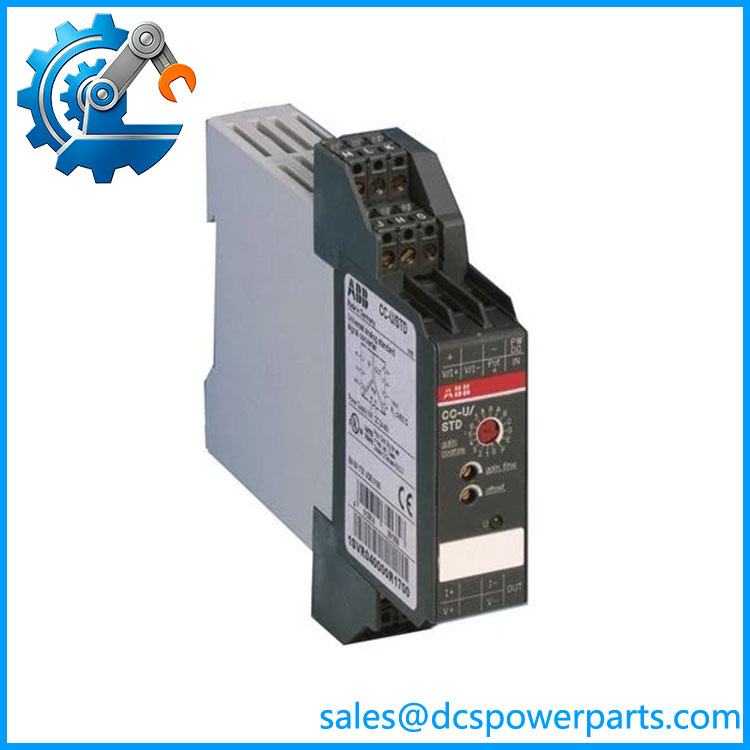
1SVR040000R1700
2. Three-Way Electrical Isolation
ABB specifies 3-way electrical isolation for the CC-U/STD. In practical control-panel work, this separates the relevant input, output, and supply circuits, helping prevent unwanted electrical interaction between field instrumentation and the receiving control system. Isolation should still be considered as part of the complete wiring design rather than treated as a substitute for correct grounding and shielding.
3. Broad DIP-Switch Configuration
One of the useful characteristics of the CC-U/STD is that signal ranges are configured directly through lateral DIP switches. ABB specifies 28 input signal ranges and 41 output signal ranges. This makes the module considerably more flexible than a converter dedicated to one fixed input/output combination.
For maintenance teams, that flexibility creates a second responsibility: a replacement unit with the same part number can behave differently if its DIP-switch settings have not been copied from the original installation.
4. Front Gain and Offset Adjustment
The converter provides front-accessible adjustment elements for gain and offset. This allows the converted signal to be trimmed to the required engineering range after the basic input/output configuration has been selected. Field technicians should document the original adjustment positions before removing an existing unit rather than assuming factory-center settings will reproduce the installed calibration.
5. Short-Circuit-Proof Signal Outputs
ABB specifies short-circuit-proof signal outputs. This is useful in control cabinets where analog output wiring may be routed through terminal blocks and marshalling systems with a greater possibility of accidental shorting during maintenance. It does not eliminate the need to follow the applicable output-load and wiring limits.
6. Compact DIN-Rail Construction
At approximately 22.5 mm wide, 105 mm high, and 120 mm deep, the CC-U/STD occupies relatively little cabinet rail space. It is intended for DIN-rail mounting and uses pluggable connecting terminals.
For retrofit work, the narrow housing can be useful when replacing an older signal-conditioning arrangement. Still, terminal position, wiring clearance, and the actual cabinet rail layout should be checked before assuming a direct physical replacement.
7. Useful Legacy Interface Component
The CC-U/STD can still be relevant to plants maintaining older ABB-based control panels. However, ABB’s lifecycle announcement placed the CC-U range into an obsolete phase in 2019 and stated that no replacement products were offered by ABB at that time. Procurement should therefore focus on exact part-number matching and verified inventory rather than assuming normal current-production availability.
Application Scenarios & Pain Points
PLC Analog Input Conditioning
A field transmitter may provide a voltage or current range that does not match the PLC input card. The CC-U/STD can convert the signal into an appropriate voltage or current output while providing electrical isolation between the circuits.
DCS Signal Isolation
Ground-potential differences between field devices and DCS cabinets can create unstable analog readings. The three-way isolated architecture provides a dedicated signal-conditioning layer between the field circuit and control-system input.
Mixed Instrumentation Panels
Older plants often contain instruments using different signal conventions. A universal converter can accommodate multiple voltage, current, and resistance input types without requiring a separate hardware family for every signal.
Legacy Control-System Maintenance
The CC-U/STD is particularly relevant when an existing panel was engineered around ABB CC-U modules. Matching the exact 1SVR040000R1700 part number and reproducing the original DIP-switch configuration can be less disruptive than redesigning the entire signal-conditioning layer.
Related Products
- ABB CC-U/STD — 1SVR040000R1700 — Universal standard analog signal converter covered by this page.
- ABB CC-U/RTD — CC-U family converter for RTD-related signal-conditioning applications.
- ABB CC-U/TC — CC-U family converter associated with thermocouple signal conditioning.
- ABB CC-U/RTDR — CC-U family temperature/resistance conversion variant.
- ABB CC-U/STD-230 — Related CC-U signal-converter configuration with different supply arrangement.
- ABB CC-U/STD-120 — Related CC-U configuration used with an alternative supply arrangement.
Exact interchangeability among CC-U variants should not be assumed. The input/output function, supply arrangement, and configuration code must be compared against the original module.
Engineer’s Guide — Field Pitfalls to Avoid
1. Do not treat the part number as the signal configuration.
The 1SVR040000R1700 identifies the CC-U/STD hardware, but the actual input/output behavior depends on the DIP-switch configuration and front gain/offset settings.
2. Photograph the DIP switches before replacement.
This is one of the simplest and most important maintenance steps. A new unit with factory settings may power up normally while producing the wrong engineering value.
3. Check the output loading.
A converter that can generate a 0–10 V or current output is not automatically compatible with every receiving input. Confirm the receiving PLC/DCS channel’s expected signal type and input impedance.
4. Verify the supply voltage.
ABB specifies 24 VAC or 24–48 VDC for this model. Do not infer the supply requirement from the input or output signal range.
5. Do not confuse isolation with signal compatibility.
Three-way isolation solves one class of electrical-interface problems; it does not correct an incorrectly selected signal range, polarity, scaling, or load.
6. Watch the lifecycle status.
ABB’s 2019 announcement placed the CC-U family into the obsolete phase and stated that no replacement products were offered by ABB. If this is for a critical plant spare, verify actual stock condition and consider documenting the existing configuration for future migration.
FAQ
What is ABB 1SVR040000R1700?
1SVR040000R1700 is ABB’s CC-U/STD Universal Signal Converter, used for analog signal conversion and electrical isolation in industrial control panels.
What signals can the CC-U/STD accept?
The documented input capability includes ±0.9 mA to ±55 mA, ±45 mV to ±11 V, and resistance from 470 Ω to 1 MΩ. The actual usable range must be selected through the module’s configuration switches.
What outputs are available?
The published output range is 0 to ±55 mA or 0 to ±11 V, with the exact output range selected through the module configuration.
Is 1SVR040000R1700 electrically isolated?
Yes. ABB specifies three-way electrical isolation for the CC-U/STD.
What power supply does it require?
The specified control supply is 24 VAC or 24–48 VDC.
How is the signal range configured?
The CC-U/STD uses accessible lateral DIP switches for input and output range selection. Gain and offset are adjusted through front-side operating elements. ABB specifies 28 input ranges and 41 output ranges.
Is ABB 1SVR040000R1700 still a current-production product?
ABB’s published lifecycle announcement placed the CC-U family into the obsolete phase, with full obsolescence scheduled for July 1, 2019, and stated that ABB offered no replacement product at that time. Current listings can still exist because remaining inventory is held by suppliers, but availability should not be confused with current production status.
What should be verified before purchasing a replacement?
Verify the complete 1SVR040000R1700 part number, input/output DIP-switch configuration, gain and offset settings, supply voltage, terminal arrangement, and actual inventory condition. For a critical legacy installation, retain a record of the installed configuration before removing the existing converter.