Description
EDO-32MB | 32 MB EDO Memory Module | Legacy Industrial Computer Memory
Product Introduction
refers to a 32 MB Extended Data Out DRAM memory configuration used in legacy computing equipment. In industrial automation, EDO memory can be found in older single-board computers, industrial PCs, embedded controllers, VME systems, and other computing hardware that predates widespread SDRAM adoption.
For procurement, the capacity alone is not sufficient to establish compatibility. A replacement must match the original module’s physical format, pin count, voltage, memory organization, speed rating, and host-system requirements. For example, documented 32 MB EDO modules exist as both 72-pin SIMMs and 144-pin 3.3 V SODIMMs.
Application Scenarios & Field Pitfalls — The Engineer’s Perspective
Engineering Pain Point
A 32 MB EDO module may look interchangeable with another 32 MB module, but legacy BIOS and memory-controller limitations can make apparently equivalent modules incompatible. The most common procurement mistake is specifying only “32 MB EDO RAM” without identifying the host computer and original memory module.
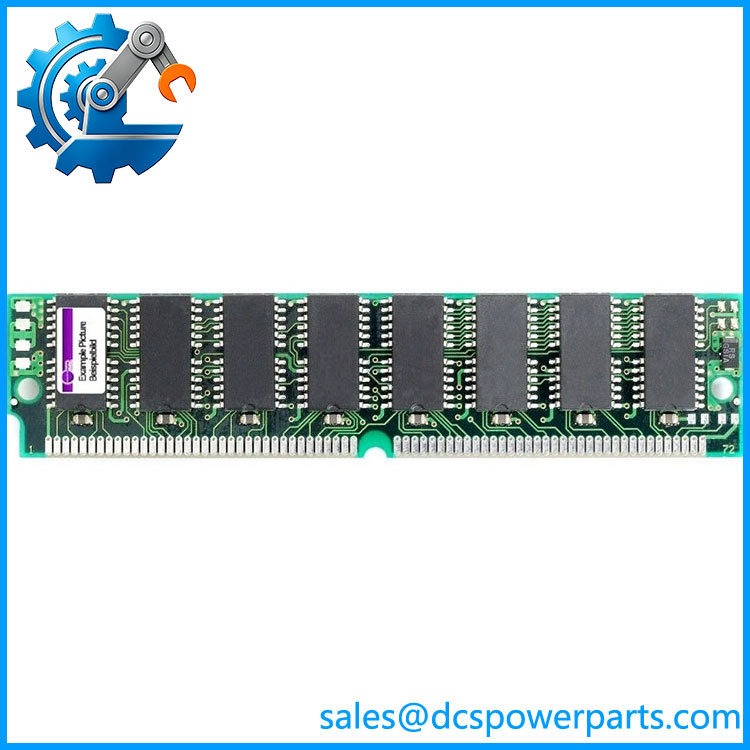
EDO-32MB
Typical Applications
- Legacy industrial PCs requiring EDO DRAM.
- VME and single-board computers from older automation generations.
- Embedded industrial controllers using conventional DRAM sockets.
- Legacy test and measurement equipment with proprietary memory configurations.
Technical Pitfalls
1. Confirm the physical format.
Determine whether the original module is a SIMM, SODIMM, DIMM, or another proprietary format. A 32 MB capacity does not determine the mechanical interface.
2. Verify pin count.
72-pin and 144-pin EDO modules are both documented in 32 MB configurations. They are not interchangeable.
3. Check voltage carefully.
Some documented 32 MB EDO modules use 3.3 V operation, while older EDO memory platforms may use different electrical requirements.
4. Match memory organization.
The host memory controller may require a particular x32, x36, x64, or other organization. ECC requirements can also prevent a physically compatible module from operating correctly.
5. Check speed requirements.
EDO modules are available in different access-speed grades. Some legacy platforms specify 60 ns or faster memory, while others have more restrictive requirements.
6. Preserve the original module information.
Before ordering, record the memory chip markings, PCB label, number of chips, pin count, voltage marking, and host equipment model. A photograph of the existing module is often the fastest way to establish an exact replacement.
Related Products
- 32 MB 72-pin EDO SIMM — common legacy desktop and industrial-computer format.
- 32 MB 144-pin EDO SODIMM — compact notebook/embedded-computer format.
- 16 MB EDO DRAM — lower-capacity configuration used by some legacy systems.
- 64 MB EDO DRAM — higher-capacity configuration where supported by the host memory controller.
- EDO ECC Memory — error-correcting configuration used in selected industrial/server platforms.
- FPM DRAM — older memory technology that should not automatically be substituted for EDO.
- SDRAM — later memory technology; physical and electrical compatibility must be confirmed before considering migration.
Procurement Note
is not specific enough to establish an exact replacement. If this is an industrial automation spare, provide the manufacturer/model of the host equipment or a clear photograph of the existing module, including its label and connector edge. That would allow the exact manufacturer, form factor, voltage, speed, and compatible replacement to be identified without guessing.