Description
ABB PSE170-600-70 | 171A Softstarter | 208–600VAC Motor Starting
Key Technical Specifications
| Parameter | Specification |
|---|---|
| Product Model | PSE170-600-70 |
| ABB Product ID | 1SFA897111R7000 |
| Product Family | PSE |
| Product Type | Softstarter |
| Rated Operational Voltage | 208–600 VAC |
| Main Frequency | 50/60 Hz |
| Rated Operational Current | 171 A |
| Control Supply Voltage | 100–250 VAC |
| Control Supply Frequency | 50/60 Hz |
| Control Circuit Voltage | 24 VDC |
| Rated Power at 230 V | 45 kW |
| Rated Power at 400 V | 90 kW |
| Rated Power at 500 V | 110 kW |
| Service Factor | 100% |
| Adjustable Motor Current | 30–100% of Ie |
| Starting Capacity | 4 × Ie for 10 s |
| Start Ramp | 1–30 s |
| Stop Ramp | 1–30 s |
| Initial Voltage During Start | 30–70% |
| Current Limit | 1.5–7 × Ie |
| Built-in Bypass | Yes |
| Overload Protection | Integrated electronic overload protection |
| Underload Protection | Yes |
| Locked Rotor Protection | Yes |
| Kick Start | Yes |
| Analog Output | Yes |
| Communication | Modbus RTU / FieldBusPlug option |
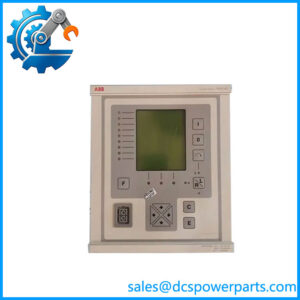
| Display | Illuminated graphical display |
| External Keypad | Optional IP66 keypad |
| Dimensions | 295 × 130 × 220 mm |
| Net Weight | Approx. 4.4 kg |
| Protection Rating | IP00 |
| Operating Temperature | -25 to +60°C |
ABB’s current technical data specifies 171 A, 208–600 VAC, 100–250 VAC control supply, 24 VDC control circuit voltage, built-in electronic overload protection, 30–100% adjustable motor current, 4×Ie starting capacity for 10 seconds, and 1–30 second start/stop ramps.
The ABB catalog also lists dimensions of 295 × 130 × 220 mm and IP00 protection. The current ABB eMart record gives an ambient-temperature range of -25 to +60°C.
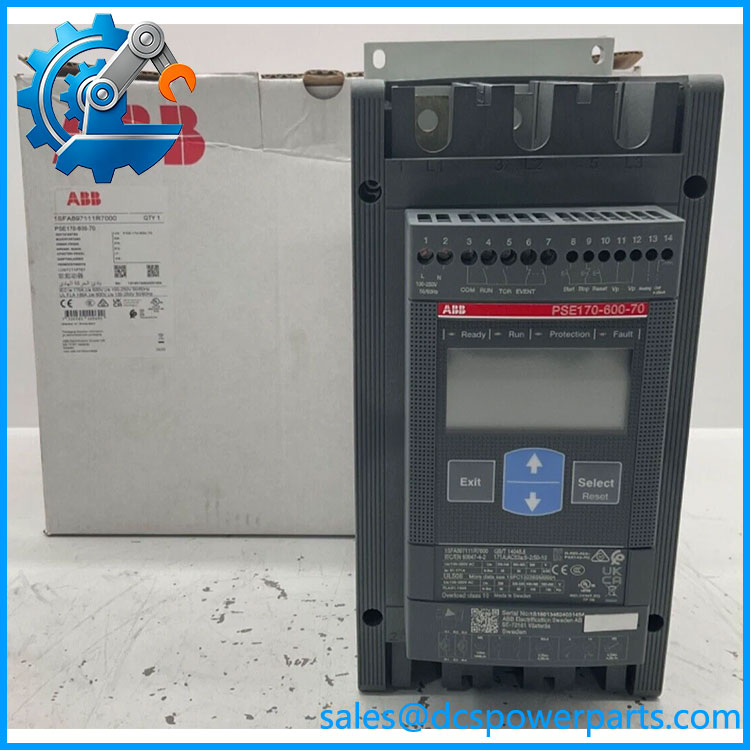
PSE-170-600-70
Product Introduction
The ABB PSE170-600-70 is a high-current PSE-series softstarter designed for three-phase motors operating from 208 to 600 VAC. With a 171 A rated operational current, it sits in the PSE frame-B range and is intended for applications such as pumps, fans, compressors, and conveyors where controlled acceleration and reduced mechanical/electrical starting stress are required.
The unit provides voltage-ramp and torque-ramp starting and stopping, current limiting, kick-start, electronic overload protection, underload detection, and locked-rotor protection. A built-in bypass reduces the need for a separate external bypass contactor in applications where the integrated bypass arrangement is appropriate.
Engineering Pain Point
For the PSE170-600-70, the main commissioning risk is not simply matching the 171 A nameplate. The starter must be selected against the actual motor full-load current, supply voltage, starting duty, ramp requirements, and protection coordination. ABB specifies 4×Ie for 10 seconds at maximum rated current, so applications with unusually high inertia, long acceleration times, or frequent starts need a separate duty check rather than assuming that the 171 A rating covers every starting condition.
Typical Applications
- Large centrifugal pumps: Controlled acceleration and pump-oriented torque management.
- Industrial fans: Reduced starting current and controlled mechanical acceleration.
- Compressors: Soft starting where direct-on-line starting produces excessive electrical or mechanical stress.
- Conveyors: Adjustable starting characteristics and kick-start capability for difficult loads.
Technical Pitfalls to Avoid
- Do not size it from motor kW alone. The motor’s actual rated current and service conditions must remain within the selected softstarter’s operating envelope.
- Check the starting duty. The published 4×Ie / 10-second capability is a defined condition, not permission to repeatedly run long high-current starts without checking the application duty.
- Verify the control supply separately from the motor supply. The main circuit accepts 208–600 VAC, while the rated control supply is 100–250 VAC. The 24 VDC control circuit is a separate specification.
- Do not confuse the PSE with a variable-frequency drive. A softstarter controls the motor’s starting and stopping behavior; it is not a substitute for a VFD when continuous speed regulation is required.
- Check bypass behavior during troubleshooting. The PSE170 includes an internal bypass arrangement. A motor running normally after acceleration does not necessarily mean the semiconductor power stage is carrying the continuous motor current in the same way as during starting.
- Coordinate upstream protection. ABB’s PSE documentation specifies semiconductor-fuse and circuit-breaker coordination for the PSE170-600-70, including an IEC semiconductor fuse type 170M5810 rated 500 A in the referenced protection table. The exact protective device must still be selected according to the installation and applicable coordination requirements.
- Confirm communications before procurement. Modbus RTU is an available communication method, but a particular installation may instead use hardwired start/stop and reset signals or a FieldBusPlug arrangement.
Related Products
- ABB PSE142-600-70 — Same PSE family and 600 V class, but 142 A rather than 171 A; motor application must be checked against actual current and starting duty.
- ABB PSE105-600-70 — Lower-current PSE softstarter for applications below the PSE170 current range.
- ABB PSE210-600-70 — Higher-current PSE model for applications requiring more than the ‘s 171 A rating.
- ABB PSTX300-690-70 — PSTX-series softstarter with a different product architecture and higher voltage/current range; not an automatic PSE replacement.
- ABB PSTX470-690-70 — Higher-current PSTX-series alternative for larger motor applications; application and control requirements must be checked.
- ABB PSR72-600-70 — Smaller PSR-series softstarter with a simpler feature set; not a functional equivalent for a installation.
- ABB PSE170-600-70-1 — Related designation that must be checked carefully against the installed unit because the suffix can represent a different ordering configuration.
Procurement Note
For replacement of an , the critical identifiers are and ABB product ID 1SFA897111R7000. Confirm the motor’s nameplate current, line voltage, starting frequency, acceleration time, bypass arrangement, control supply, communication method, and upstream protection before approving the replacement.
Do not substitute a PSE142 or PSE210 merely because it belongs to the same PSE family. Current ABB documentation places these models in different current classes, and the correct selection depends on the motor’s actual operating and starting duty.