Description
GE IS200STAOH2AAA | Mark VIe STAO Analog Output Terminal Board | 8-Channel 0–20 mA
Key Technical Specifications
| Parameter | Specification |
|---|---|
| Manufacturer | General Electric |
| Model | IS200STAOH2AAA |
| Series | Mark VIe |
| Board Type | STAO Simplex Analog Output Terminal Board |
| Analog Outputs | 8 |
| Output Signal | 0–20 mA |
| Output Configuration | Single-ended, one side connected to common |
| Associated I/O Pack | PAOC |
| I/O Pack Connection | D-type connector |
| Field Wiring | 36-terminal Euro-block arrangement |
| Customer Load | Up to 900 Ω with PAOC pack |
| Operating Temperature | -30 to +65 °C |
| Mounting | DIN rail or flat mounting |
| System Architecture | Simplex |
| Diagnostics | On-board identification and output-current feedback |
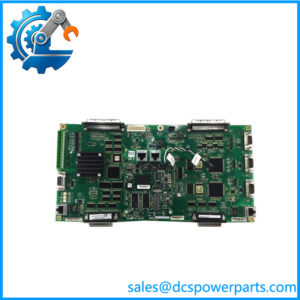
| Board Technology | Surface mount |
GE’s Mark VIe documentation identifies STAO as a compact simplex analog-output terminal board with eight 0–20 mA outputs. The PAOC I/O pack plugs into the board through the D-type connector and communicates with the Mark VIe controller through Ethernet. GE also specifies a customer load of up to 900 Ω when used with the PAOC pack.
Product Introduction
The is a Mark VIe STAO Simplex Analog Output Terminal Board used to terminate and distribute analog control signals from the PAOC I/O pack to external field devices. It provides eight 0–20 mA current-output circuits for applications such as valve positioning, actuator commands, and other continuously controlled equipment within GE turbine-control systems.
The should not be treated as a standalone analog output module. The actual digital-to-analog conversion and current regulation are handled within the associated I/O pack, while the STAO provides the field termination, signal conditioning, current sensing, and interface circuitry. This distinction is important when diagnosing a failed output because replacing the terminal board will not correct a problem originating in the PAOC pack, Ethernet I/O path, or field wiring.
The is the STAOH2 terminal-board configuration. GE documentation distinguishes STAOH1 and STAOH2 by their terminal-block arrangement: STAOH1 uses a permanently mounted terminal block, while STAOH2 uses a right-angle header that accepts compatible pluggable terminal blocks.
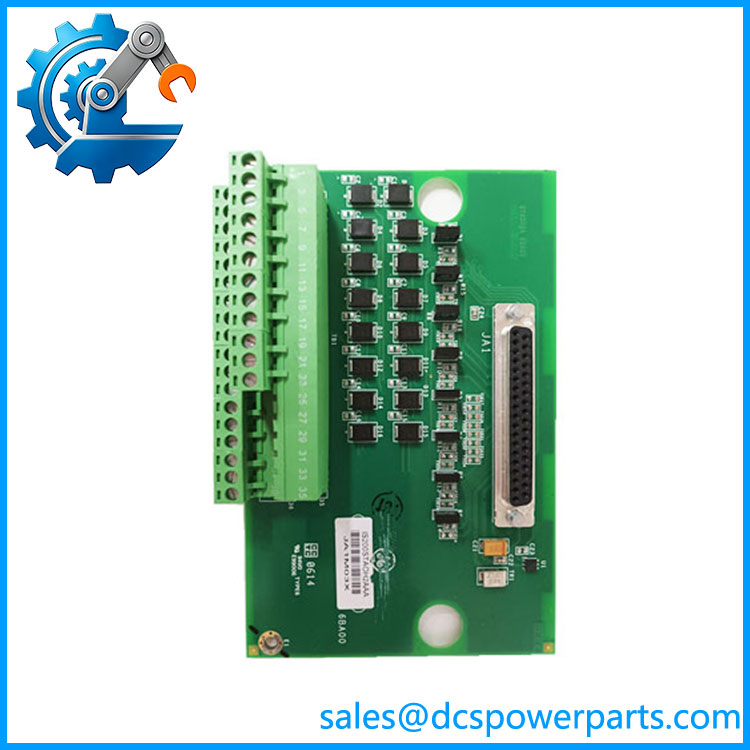
IS200STAOH2AAA
Application Scenarios & Field Pitfalls — The Engineer’s Perspective
Engineering Pain Point
A Mark VIe analog-output fault can easily be misdiagnosed because the terminal board and I/O pack perform different functions. If a valve command is missing, checking only the controller output value is not enough. The PAOC pack, STAO board, board identification circuit, output loop, field wiring, and receiving device all need to be considered.
Typical Applications
1. Turbine valve control
The eight 0–20 mA channels can provide continuous control signals to valve positioners and other turbine-control actuators.
2. Speed and process control
Analog current outputs can be used for proportional commands to external control equipment where a current-loop interface is required.
3. Mark VIe distributed I/O
The STAO board provides the field-side interface for the PAOC distributed I/O architecture, with the I/O pack communicating with the controller over Ethernet.
4. Legacy turbine-control maintenance
The board is useful as a maintenance spare where an existing Mark VIe installation depends on the original STAO/PAOC architecture.
Technical Pitfalls
Do not confuse the STAO board with the PAOC pack.
The is a terminal board. The PAOC I/O pack contains the processor and analog-output electronics. A failed PAOC can produce symptoms that look like a terminal-board failure.
Check the exact STAOH2 configuration.
The STAOH2 arrangement differs from STAOH1 in its field-terminal interface. GE documentation identifies as using a right-angle header for compatible pluggable terminal blocks.
Verify the terminal-board identity.
The board contains an identification device that allows the I/O processor to verify the board type, revision, serial information, and connector location. A mismatch can generate a hardware incompatibility fault.
Check the current loop before replacing hardware.
STAO monitors voltage across a series current-sensing resistor so the I/O processor can evaluate output-current behavior. An open loop, incorrect field wiring, excessive load, or field-device fault can therefore produce symptoms that are not caused by the board itself.
Observe the load limit.
GE specifies up to 900 Ω customer burden when the STAO is driven by the PAOC pack. Cable resistance and the connected device should be included when evaluating the actual loop.
Do not assume redundancy.
STAO is a simplex terminal-board architecture. GE documentation explicitly states that the Mark VIe STAO/PAOC arrangement supports simplex operation.
Related Products
- GE IS220PAOCH1A — PAOC analog output I/O pack used with compatible STAO terminal boards.
- GE IS220PAOCH1B — later PAOC analog output pack variant; verify exact system compatibility before substitution.
- GE IS200STAOH1A — STAO analog output terminal board with a different terminal-block arrangement.
- GE IS200STAOH2A — base STAO/ board designation associated with the assembly.
- GE IS200TBAOH1C — TBAO analog output terminal-board family for Mark VIe applications.
- GE IS200TBAOH2A — alternate TBAO analog-output terminal-board configuration.
- GE IS220PAICH1A — PAIC analog input pack; different signal direction and function.
- GE IS220PDIOH1A — Mark VIe discrete I/O pack for digital signals.
Procurement Note
For an replacement, match the complete board number and hardware revision rather than purchasing solely against the description “STAO analog output board.” Confirm the installed PAOC pack, terminal-block configuration, board identification, field wiring, and Mark VIe system revision before substitution.
For used or surplus inventory, inspect the 36-terminal field interface, D-type connector, board identification device, current-sensing circuitry, PCB condition, and mounting hardware. If the reported fault is a single bad 0–20 mA channel, test the field loop and associated PAOC output before concluding that the itself has failed.