Description
Product Overview
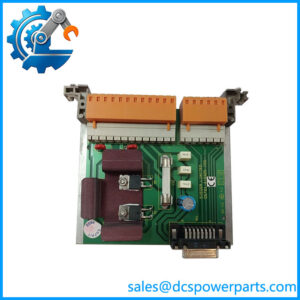
PSMU-350-34 is the power module that sits at the left-hand end of a CCC Vanguard card cage and feeds everything to its right: the main processor, the I/O processor, the analog and digital cards, and the speed and surge-control loops that make a compressor train behave. Its family name is explicit in Honeywell’s own Vanguard S5P literature, where the cage illustration labels the CompactPCI power positions as PSMU-350-3 and PSMU-350-5 — the 350 W and 500 W members of the same plug-in power family. The “-34” suffix identifies the ordering variant within that family, so the practical rule is to read it as a PSMU-350-3 build rather than as a separate product line.
Understanding the part in those terms matters because a turbomachinery controller is not a general-purpose PLC. It runs anti-surge algorithms, speed and load sharing, and start-up sequencing on a machine whose trip is measured in lost production and, on some trains, in mechanical risk. The power module is therefore judged on three things: whether its rails hold within tolerance while the processor and I/O cards draw their transient load, whether a single module failure leaves the cage alive, and whether the failed module can be changed without dropping the processor. A module that merely delivers “350 W” satisfies none of them.
The last point is where the public record fails. Search results for PSMU-350-34 describe a B&R MULTI CPU with 42 KB SRAM, a 34 VDC single-output industrial supply, a 110 VAC rack supply with +5/±12/+24 V outputs, a three-phase 220 V unit with -40 to +85 °C rating, and a DIN-rail device with IP65 and Modbus RTU. Each is a plausible-sounding power product and none is a CCC CompactPCI module; the number was used as a template variable rather than looked up. What survives the cross-check is narrower and more useful: a 6U CPCI plug-in, 350 W class, redundant-capable, hot-swap, sitting in a Vanguard cage that supports 576 I/O points and is now migrating to S5P.
For a mill or a pipeline station, that diagnosis changes the spare-parts decision. The question is not “which 350 W supply fits”, but “which variant matches this cage, this backplane keying and this redundant configuration”.
Technical Specifications
| Parameter | Value |
|---|---|
| Model | PSMU-350-34 (PSMU-350-3 family, variant suffix -34) |
| Manufacturer | CCC, Compressor Controls Corporation (Honeywell) |
| Product type | Power supply module, CompactPCI plug-in |
| Platform | Vanguard S5 / S5P turbomachinery control system |
| Output power class | 350 W |
| Output rails | Multi-rail PCI set: +5 V, +3.3 V, +12 V, −12 V |
| Input | Wide-range single-phase AC, 47–63 Hz, via cage inlet |
| Mechanical standard | 6U CompactPCI, IEEE 1101.10 panel with injector/extractor handles and EMC gasket |
| Redundancy | N+1 operation with internal ORing diodes and current sharing on main rails |
| Serviceability | Hot-swap replacement in a redundant cage, without processor shutdown |
| Protection | Overvoltage, overcurrent, short circuit and overtemperature shutdown with front-panel status indication |
| Cooling | Forced air from the cage fan tray; module airflow path aligned to chassis ducts |
| Cage context | S5 Vanguard platform rated for 576 I/O points; S5P plug-in migration retains the same cage and power positions |
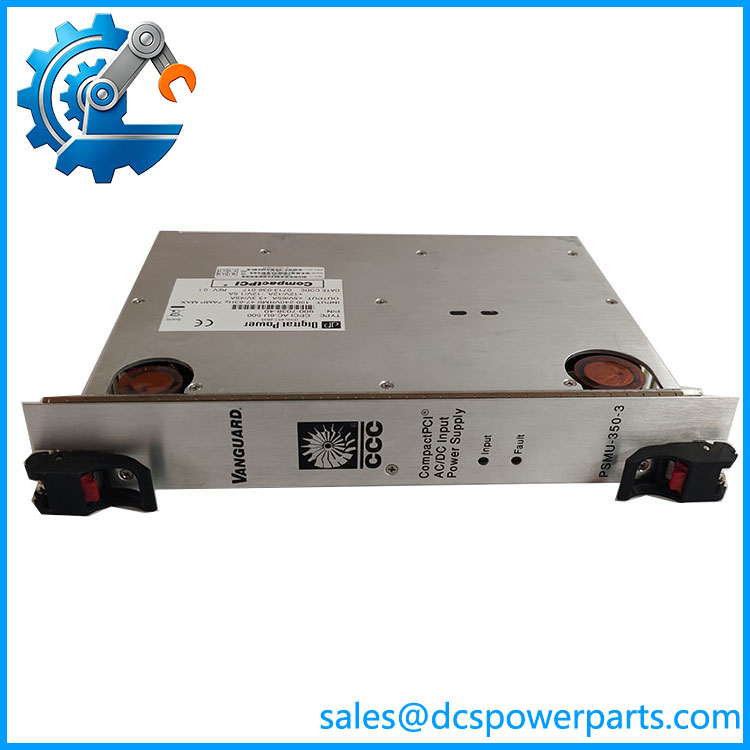
CCC PSMU-350-34
Key Features and Advantages
Rail behaviour under transient load, not nameplate watts
The processor and I/O cards in a Vanguard cage do not draw a steady current; they draw it in steps as scan cycles, communication bursts and output updates coincide. PSMU-350-34 is specified as a 350 W module because the cage power budget is computed per rail, and a supply that holds 5 V and 3.3 V within tolerance during those steps is what keeps the control scan deterministic. Buying “a 350 W supply” on wattage alone is how sites end up with a module that starts, runs, and then trips the train on a load step nobody connected to the power change.
Redundancy that is real only if the sharing works
N+1 operation with ORing diodes means two modules carry the cage together, and a single failure transfers load rather than dropping it. That only works when the paralleled modules share current on the main rails and when the healthy module has headroom for the whole cage. PSMU-350-34 belongs in exactly that arrangement, and the field consequence is that a module can degrade quietly for months while the second unit carries more than its design share — until the second one fails too and the cage goes dark.
Hot-swap is a procedure, not a feature badge
A hot-swappable module still requires the right sequence: confirm which module is actually faulted, confirm the survivor is carrying load, then extract with the handle and seat the replacement firmly. PSMU-350-34 supports that manoeuvre inside a redundant cage, which is why the maintenance window for a power fault is minutes rather than a planned shutdown of a compressor train.
The variant suffix is the compatibility test
Two modules can look identical, fit the same slot, and differ in variant. The reliable check is against the cage’s backplane keying, the CCC power budget drawing for that unit, and the redundant pairing already installed — not against a marketplace photo. This is the single most common cause of a wrong spare arriving for a Vanguard system.
Applications
Natural gas pipeline compressor stations use in the Vanguard cage that runs speed control, load sharing between units and anti-surge protection on a station whose throughput is contracted by the hour. A power module there is judged by whether it survives grid dips and whether its redundant partner covers a failure without a station trip.
Refinery and petrochemical hydrogen recycle and make-up compressors rely on the same cage for surge control on machines that sit close to their operating limit; the control loop’s response time depends on a processor that is not being reset by rail sags.
Air separation and LNG liquefaction trains apply the module in the control cabinet of multi-stage compressor strings, where the S5 platform’s 576-point I/O capacity is typically used close to its limit and the power budget has the least margin at the end of the cage.
Fertilizer and syngas plants running synthesis-gas compressors use it where a spurious trip costs a multi-day restart, and where the power module’s diagnostics are the first evidence examined after a shutdown.
Plants migrating to Vanguard S5P keep the same cage and power positions, so an existing population becomes the installed base that the migration must be sized against — including whether the new cards change the rail budget enough to require the higher-wattage member of the family.
Related Products
PSMU-350-3 — the base model of this module family, and the designation printed in CCC’s own Vanguard S5P cage illustration. PSMU-350-5 — the 500 W member of the same CompactPCI power family, used where cage loading exceeds the 350 W budget. PSMU-300-1 / PSMU-300-2 — earlier 300 W class supplies from the same CCC power lineage, found in older Vanguard and Series 5 cabinets. MCP-1004 — main processor card powered from this module in the Vanguard / XCaliber lineage. TIOC-555HD — high-density transition and I/O card in the same cage, and a major contributor to the 5 V rail load. TMPU-1002 — turbomachinery monitoring processor card sharing the cage power budget. CPCI AC-6U-500 — alternate CCC ordering designation for the 6U CompactPCI AC-input 500 W supply, useful when cross-checking cage bills of material. S5VANGUARD-D01 / S5VANGUARD-S8-03 — Vanguard system configurations whose bills of material determine which power variant belongs in a given cage. SMP-2AC-F — duplex AC power chassis arrangement in the same CCC cabinet family, the enclosure-side counterpart to a redundant module pair. CPCI-10-D2 — ten-slot duplex CompactPCI chassis, the mechanical host for redundant power positions.
Installation and Maintenance
Before installation: identify which module is faulted from the front-panel status and the controller’s diagnostics rather than from a dim LED alone, and confirm that the surviving module in a redundant pair is carrying the full cage load before touching anything. Verify the replacement against the cage’s power budget drawing and the existing module’s variant suffix, check backplane keying and slot position, and inspect the cage fan tray because a 350 W module in still air derates and shuts down. Keep the replacement in anti-static packaging, handle it by the panel and handles rather than the board edges, and confirm the AC feed is on the correct inlet before seating .
Maintenance practice: log the rail voltages and the current share between redundant modules at each turnaround; a drifting share is the earliest sign that one unit is losing regulation and the other is carrying more than its design half. Clean the fan tray filters on the cabinet’s normal interval rather than after a shutdown, since airflow loss is the most common cause of a thermal trip on this class of module. Keep one matched spare per cage — matched meaning the same variant, not merely the same family — because a warm spare that does not key correctly provides no protection at the moment it is needed.
Warranty and Quality
is supplied as a genuine CCC CompactPCI power module, identified against the Vanguard S5 / S5P platform and the PSMU-350 family rather than a reseller’s guessed category, with the variant suffix confirmed before dispatch so the unit keys and pairs correctly in an existing cage. Units come with a 12-month repair, replacement or refund commitment, and every module is bench-tested for rail regulation, transient response, current sharing in a redundant pair and protection trip thresholds before it leaves the warehouse. Technical support covers variant identification from the cage bill of material, redundancy pairing, S5P migration power-budget questions and the interaction between cage airflow and module derating.