Description
Product Introduction (Non-Templated)
An insulation fault in an unearthed power system may develop long before it produces a complete loss of power. The Bender IRDH265-222 ISOMETER monitors insulation resistance in unearthed AC, AC/DC, and DC systems, giving maintenance teams an opportunity to identify deteriorating insulation before a second fault creates a more serious electrical problem.
Designed for industrial electrical installations, the IRDH265-222 uses a DC supply rated at 19.2–84 V and provides adjustable alarm thresholds. For a legacy insulation monitoring system replacement, verify the supply voltage, monitored network, response settings, and alarm-relay wiring before installation. This model is listed as discontinued, so a replacement should be evaluated against the original installation rather than selected by appearance alone.
Key Technical Specifications
| Parameter | Specification |
|---|---|
| Manufacturer | Bender |
| Model | IRDH265-222 |
| Product Family | ISOMETER IRDH265 |
| Product Type | Insulation monitoring device |
| Primary Function | Continuous insulation-resistance monitoring |
| Supported Systems | Unearthed AC, AC/DC, and DC electrical systems |
| Monitored System Voltage | Up to 793 V AC and 650 V DC under specified conditions |
| Supply Voltage | 19.2–84 V DC |
| Response Settings | Two adjustable alarm thresholds |
| Display | LCD |
| Alarm Outputs | Alarm relay outputs with configurable response behavior |
| Monitoring Features | Automatic self-test and connection monitoring |
| Installation | DIN rail or screw mounting |
| Connection Type | Screw terminals |
| Enclosure Protection | IP30 for built-in components; IP20 at terminals |
| Operating Temperature | Generally −10°C to +55°C; check the applicable variant and installation conditions |
| Approximate Weight | 825 g |
| Lifecycle Status | Discontinued according to equipment reseller listings |
Specifications are based on Bender’s IRDH265/IRDH365 technical documentation. The monitored-system voltage limits depend on the system type and applicable operating conditions; they should not be interpreted as the device’s DC supply voltage.
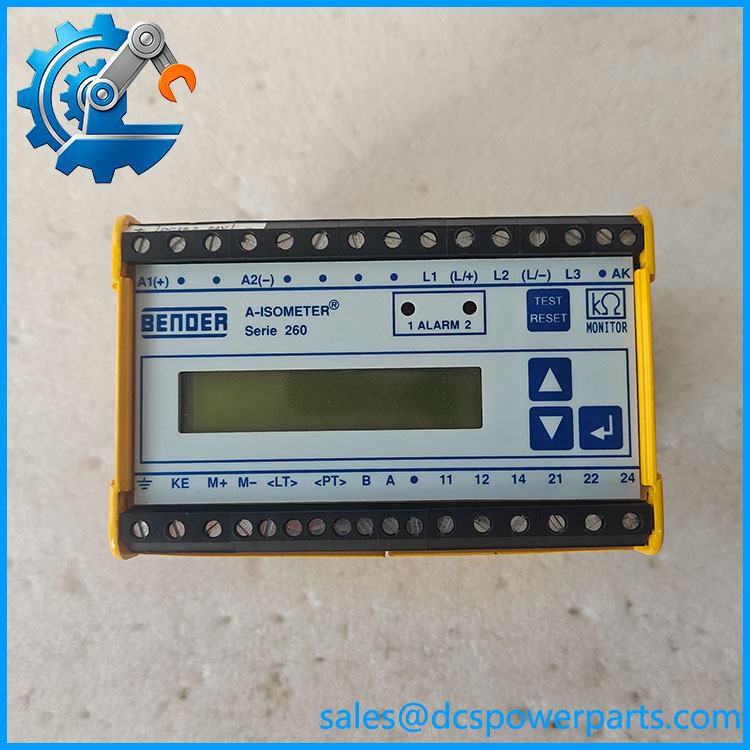
IRDH265-222
Application Scenarios & Pain Points
An insulation monitor is often installed where shutting down a complete power system after the first insulation fault would be unnecessarily disruptive. The challenge is to detect deterioration early while ensuring the alarm thresholds and monitoring arrangement suit the electrical network.
- Industrial DC power systems: Monitors insulation resistance in unearthed DC distribution networks, helping maintenance teams investigate deteriorating cable or equipment insulation.
- AC systems with DC-connected loads: Supports monitoring of specified unearthed AC systems containing rectifiers, converters, and other DC-connected equipment. The network configuration must fall within the device’s documented application range.
- Industrial drives and conversion equipment: Helps identify insulation problems in applicable systems containing power converters or thyristor-controlled drives.
- Legacy electrical panels: Provides a maintenance reference for installations that still use the IRDH265 family and require a correctly matched replacement or repair.
Field note — illustrative scenario: A plant experiences repeated insulation alarms after a motor-drive overhaul. Replacing the monitor immediately could conceal the actual issue: moisture, damaged cable insulation, or a change in system leakage capacitance. Review the measured insulation resistance, alarm history, and network configuration first. Replace the -222 only after the evidence supports a device fault.
Related Products
The following products are relevant to insulation monitoring, fault location, and legacy-system maintenance. Their functions differ, and none should be treated as an automatic drop-in replacement for the -222.
- -222 — The original ISOMETER insulation monitor, supplied from a 19.2–84 V DC source. Match the complete order code when sourcing a replacement.
- -4 — An variant with a 230 V AC supply. Its supply arrangement differs substantially from the -222 version, so it is not a direct electrical substitute.
- -423 — An variant designed for a 77–286 V DC supply. Consider only when the available supply and full system configuration are compatible.
- IRDH365 — A related insulation-monitoring device family. Check the model-specific mounting, dimensions, and technical characteristics before considering it for a panel retrofit.
- ISO685 series — A newer Bender insulation-monitoring family to evaluate for a potential system modernization. Confirm the applicable network type, supply, interfaces, and replacement guidance before migrating.
- AGH520S — A coupling device used in supported insulation-monitoring arrangements for higher-voltage systems. It extends the application range of compatible monitors; it does not replace the monitor itself.
- EDS insulation fault location system — A complementary approach for locating insulation faults in compatible unearthed systems. Fault location is a different task from continuous insulation monitoring.
- COM465ID — A communication and system integration device documented for compatible Bender insulation-monitoring arrangements. Check the relevant interface and system documentation before pairing it with legacy equipment.
The Engineer’s Guide: Field Pitfalls to Avoid
Warning 1: Confusing the DC supply with the monitored system voltage
The uses a 19.2–84 V DC supply, but its monitoring function covers specified unearthed AC and DC networks at much higher voltages.
How to avoid it: Verify the supply voltage at the correct terminals and compare the monitored network against the applicable manual. Do not select a replacement based only on the voltage of the power system being monitored.
Warning 2: Reusing alarm settings without checking the network
System leakage capacitance, converters, and connected loads can affect insulation-monitoring behavior. Incorrect response thresholds may produce nuisance alarms or delay fault detection.
How to avoid it: Record the existing alarm thresholds and response settings before replacement. Confirm that they remain appropriate for the current electrical network, and test alarm relay operation under an approved procedure.
Warning 3: Incorrect grounding or connection wiring
Insulation monitoring depends on the correct connection between the device and the monitored system. Incorrect wiring at the measurement and grounding terminals can impair monitoring or compromise safe operation.
How to avoid it: Follow the exact terminal diagram for the installed variant. Verify grounding connections, supply polarity where applicable, relay wiring, and any coupling-device requirements. Isolate hazardous circuits and follow site electrical safety procedures before handling conductors.
Frequently Asked Questions (FAQ)
1. What does der monitor?
It continuously monitors insulation resistance in supported unearthed AC, AC/DC, and DC electrical systems. When insulation resistance falls below configured alarm thresholds, the device can activate alarm indications and relay outputs. This helps maintenance personnel investigate the first insulation fault before an additional fault creates a more serious operating problem.
2. What power supplthe require?
The is specified for a 19.2–84 V DC supply.IRDH265 variants use different supply arrangements, including 230 V AC and higher DC ranges.
Before ordering, check the complete model suffix on the installed unit and measure the available supply. A monitor with a different supply variant may fit the panel but still be electrically unsuitable.
the discontinued?
Equipment resellerthe as discontinued. Bender’s documentation portal also indicates that some requested documents concern discontinued equipment. Confirm the manufacturer’s current support and replacement guidance before planning a migration.
For urgent maintenance, specify the complete part number, acceptable condition, test requirements, and required delivery date. Do not assume that a listed item is physically available or factory-tested.
4. Can I rthe with an ISO685-series monitor?
Potentially, as part of a verified replacement or modernization project—not as an assumed plug-in exchange. Differences in supply, monitored network, terminals, alarm configuration, and system interfaces can require wiring or panel changes.
Compare the original circuit diagram against the proposed device documentation, and establish whether an approved replacement arrangement is available. Commissioning should include verification of insulation measurement and alarm response.
5. How can I verifylus before buying it?
Request the unit’s label photographs, serial or identification details, physical inspection results, and a documented functional test. Pay particular attention to the terminal block, display, enclosure, and evidence of moisture or overheating.
A power-on test alone does not establish that the device measures insulation resistance accurately or that its alarm relays operate at the configured thresholds. Ask what tests were performed and whether the results are traceable to the actual unit.
6. What warranty should I expect for a rhed ?
Warranty terms depend on the supplier and the unit’s condition. New surplus stock may not carry the original manufacturer’s warranty, and refurbished equipment may have separate repair or replacement coverage.
Obtain the warranty duration, exclusions, return procedure, and replacement terms in writing. For a critical electrical installation, confirm that the supplier can address a failed unit without leaving the panel without required insulation monitoring.
7. How quickly can I an for an emergency repair?
Lead time depends on physical stock, condition, testing, and delivery arrangements. No fixed delivery estimate should be accepted until the exact model and the availability of the specific unit are confirmed.
Request confirmation of inventory, test-report availability, dispatch timing, and estimated transit time. If the original monitor has failed, maintain the site’s approved electrical safety arrangements while replacement or repair is pending; do not bypass required insulation monitoring without an authorized risk assessment.
Procurement recommendation: For der , verify the DC supply variant, monitored-system requirements, alarm settings, and test evidence. The most important distinction is between a unit that powers up and one that correctly monitors insulation resistance and operates its alarm outputs under the intended conditions.