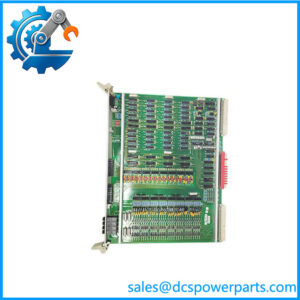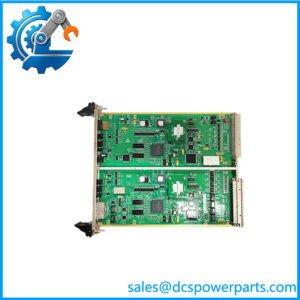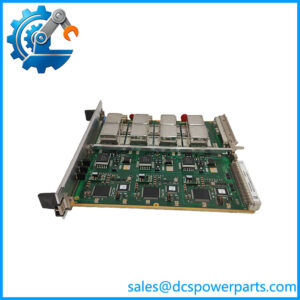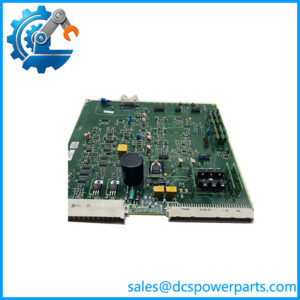
Description
Key Technical Specifications
| Parameter | Specification |
|---|---|
| Product Model | N897164624A |
| Manufacturer | ALSTOM |
| Product Type | Pulse Output / I/O Module |
| Platform Association | ALSTOM 800 Series |
| Primary Function | Pulse signal output |
| Hardware Format | Rack-mounted Eurocard-style module |
| Application Area | Industrial automation / power generation |
| Typical System Role | Control pulse generation |
| Installation | Dedicated ALSTOM control rack |
| Compatibility | System- and revision-dependent |
| Replacement Basis | Exact part number, revision, rack position, and application |
| Condition | New Surplus or Fully Tested Refurbished |
Technical caution: I could not locate a sufficiently authoritative public ALSTOM datasheet establishing exact channel count, operating voltage, output-current rating, connector pinout, or environmental specifications for this specific part. Those values should not be invented from secondary listings.
Application Scenarios & Pain Points
Pulse-output hardware is one of those areas where a seemingly minor mismatch can become a major commissioning problem. The module may power up normally while the downstream trigger circuit sees the wrong pulse amplitude, timing, or sequence.
- Power-generation control: Secondary records associate N897164624A with power-generation automation and excitation-related equipment.
- Excitation systems: Available equipment listings describe the unit as a pulse-output module used for excitation trigger-related applications. Treat this as an application reference, not proof of compatibility with every ALSTOM excitation cabinet.
- ALSTOM 800 Series systems: Several independent equipment records identify N897164624A with the 800 Series controller platform.
- Legacy control-system maintenance: The part is particularly relevant when an existing installation cannot economically be redesigned around a current-generation controller.
Field note: If the original board is available, record every front-panel LED state and connector position before removal. For pulse hardware, timing and output behavior matter more than simply seeing the board initialize.
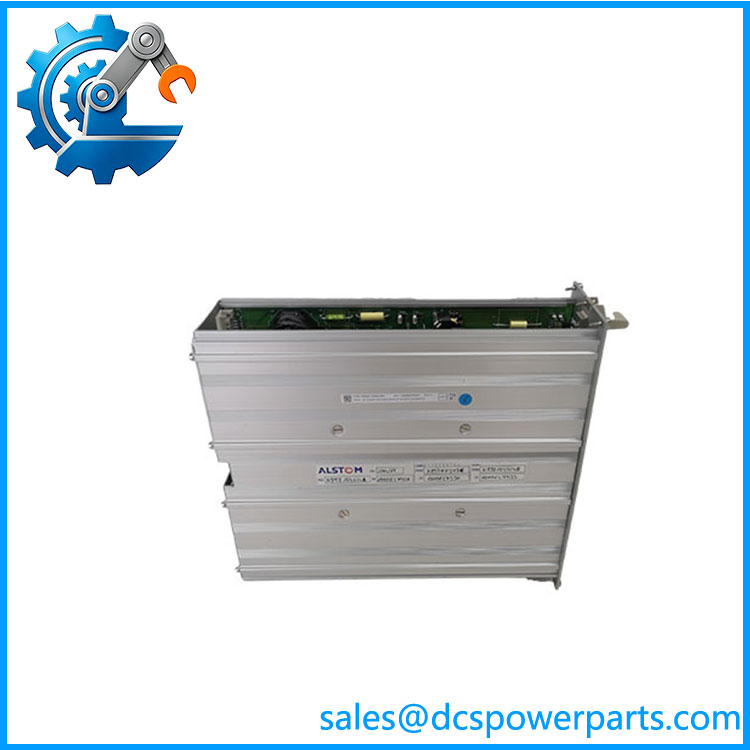
N897164624A
Related Products
- N897164610L — Related ALSTOM N897-series module appearing in the same legacy equipment family. Verify its actual I/O function before considering it as an alternative.
- N897164611M — Another N897-series control/pulse module reported in equipment records. Its function differs from N897164624A, so it should not be treated as a direct substitute without system documentation.
- N70032702L — Related legacy ALSTOM control-system module that may coexist within older control architectures; functional equivalence should not be assumed.
- MMLG01 — ALSTOM-associated module appearing in the same replacement-equipment records; useful as a system-family reference rather than a direct replacement.
- N897163510Q — Another N897-series module listed alongside N897164624A. Exact application and electrical compatibility must be confirmed before substitution.
- ALSTOM UT150-1 — Legacy control board associated with ALSTOM control/network equipment. It serves a different control role and is not a drop-in replacement.
- ALSTOM PIB100G / 3BEE0226 — Power-interface board used in other ALSTOM power-control assemblies; potentially complementary at the system level but not functionally equivalent.
- ALSTOM DX21-M3 — Digital excitation controller from another ALSTOM excitation-control architecture. It represents a controller-level component rather than a pulse-output replacement.
The Engineer’s Guide: Field Pitfalls to Avoid
Warning 1 — Do not confuse a pulse-output module with a digital-input module.
Some secondary product records incorrectly describe N897164624A as a digital-input or generic control module, while other records specifically identify it as a pulse-output module.
How to avoid it: Use the original nameplate and PCB markings as the primary identification. Confirm the rack position and wiring before approving a replacement.
Warning 2 — Do not assume N897-series modules are interchangeable.
The similar numbering is not enough to establish identical electrical characteristics, firmware, or output behavior.
How to avoid it: Compare the complete part number, board revision, connector arrangement, system configuration, and original engineering documentation.
Warning 3 — Pulse timing is a functional parameter, not a cosmetic detail.
A board that passes a basic power-up test can still produce incorrect output timing or amplitude.
How to avoid it: For a refurbished unit, request functional testing of the actual pulse-output circuit where possible. Check the output with appropriate test equipment rather than relying only on front-panel indicators.
Frequently Asked Questions (FAQ)
What is ALSTOM ?
is an ALSTOM pulse-output/I/O module associated with legacy ALSTOM control equipment. Multiple equipment records identify it as a pulse-output module and associate it with the 800 Series platform.
Is a digital input module?
The available public records are inconsistent. Some secondary sources call it a digital-input module, while other records specifically identify it as a pulse-output module.
For procurement, I would use the actual board marking, rack documentation, connector wiring, and installed system function to resolve the discrepancy rather than relying on a generic online description.
Is used in excitation systems?
Available equipment records specifically associate the module with excitation trigger applications and power-generation automation.
That does not mean every excitation system using ALSTOM equipment accepts this board. The excitation controller generation and power-stack interface must be verified.
Can N897164611M replace ?
Not automatically. Both belong to the N897-series family, but available records describe them as different modules. Similar part-number structure is not sufficient evidence of electrical or firmware compatibility.
How should I test a refurbished ?
A meaningful inspection should include:
- Exact part-number verification.
- PCB revision and serial-number recording.
- Visual inspection of connectors and board contacts.
- Power-up verification.
- Output-channel functional testing.
- Pulse amplitude and timing verification where applicable.
- Rack/system communication or operational testing when available.
- Documentation of the test procedure.
For a pulse-output board, a simple “powers on” certificate is not enough.
What should I provide when requesting a replacement?
Send the supplier the complete designation, photographs of the nameplate and connectors, board revision, installed rack position, and the equipment model in which it operates.
If the module drives an excitation or power-conversion circuit, also identify the downstream interface. That information can prevent a physically compatible but electrically incorrect spare from reaching the plant.
What is the main procurement risk with this part?
The biggest risk is misidentification. Publicly available records disagree on the exact functional description, while the module appears in legacy ALSTOM equipment where documentation can be difficult to obtain.
For that reason, I would require an actual unit photograph and revision information before confirming a substitute, especially for an operating power-generation system.