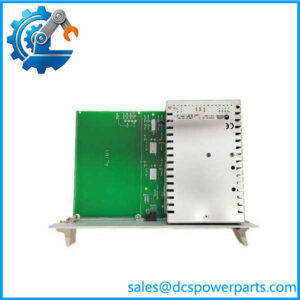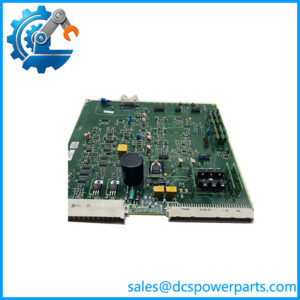
Description
Alstom MVTT14B1BA0772C Static Time-Delay Relay
Product Overview
The Alstom MVTT14B1BA0772C belongs to the MVTT14 family of static time-delay pick-up relays used in legacy electrical protection and control schemes. Relay-model references classify MVTT14 specifically as a static time-delay pick-up device, with timing models identified for seconds and milliseconds depending on the configured variant. MVTT15 belongs to the related static time-delay drop-out family, so the distinction between MVTT14 and MVTT15 matters when reproducing an existing protection scheme.
Unlike a programmable protection relay, the MVTT14 is a dedicated timing element intended to introduce a defined delay into hardwired protection or control logic. In older substations, generator control panels, switchgear, and industrial power systems, this type of relay can sit between a protection initiation signal and a downstream trip, alarm, permissive, or interlock circuit. The exact electrical behavior of MVTT14B1BA0772C, including control voltage, contact arrangement, and timing range, is suffix-dependent and should be confirmed from the physical nameplate or original project documentation rather than inferred from the MVTT14 family name.
For a legacy replacement, that distinction is critical. A timer that performs the correct logical function but has the wrong supply voltage, contact configuration, or timing range can alter the protection sequence. The MVTT14 series is documented as a static time-delay pick-up relay, while commercial records identify the specific MVTT14B1BA0772C as a legacy Alstom protection/timing component.
Product Introduction
Timing relays in older protection panels often look simple, but their settings can be part of the actual protection coordination philosophy. The provides a dedicated static time-delay function rather than relying on software logic in a modern numerical relay.
For replacement work, MVTT14B1BA0772C should be matched by the complete ordering code. Do not substitute another variant solely because the front-panel designation looks similar; the final code determines the configured hardware characteristics.
Key Technical Specifications
| Parameter | Value |
|---|---|
| Product Model | MVTT14B1BA0772C |
| Manufacturer / Brand | Alstom / AREVA legacy |
| Product Series | |
| Product Type | Static Time-Delay Pick-Up Relay |
| Relay Technology | Static / electronic |
| Primary Function | Time-delayed pick-up operation |
| Application | Protection and control logic |
| Timing Type | Pick-up delay |
| Timing Unit | Variant-dependent; references include seconds and milliseconds configurations |
| Control Voltage | Verify from complete suffix/nameplate |
| Contact Configuration | Verify from complete suffix/nameplate |
| Timing Range | Verify from exact factory configuration |
| Mounting | Verify against installed relay case/panel arrangement |
| Environmental Rating | Verify from original equipment documentation |
| Lifecycle | Legacy / discontinued-generation equipment |
The family classification as a static time-delay pick-up relay is supported by relay-model databases referencing Alstom/AREVA equipment. Exact electrical values for the B1BA0772C suffix could not be independently confirmed from an OEM datasheet in the sources available, so they are intentionally not presented as fixed specifications.
Major Features / Practical Advantages
Dedicated time-delay function
The fundamental function of the is simple: introduce a defined delay into a protection or control signal. That can be useful where the original system was engineered around hardwired timing coordination rather than programmable logic.
In a conventional protection panel, a time-delay relay may prevent an instantaneous downstream operation when a temporary condition is expected, provide coordination between protection stages, or establish a defined sequence between separate control functions.
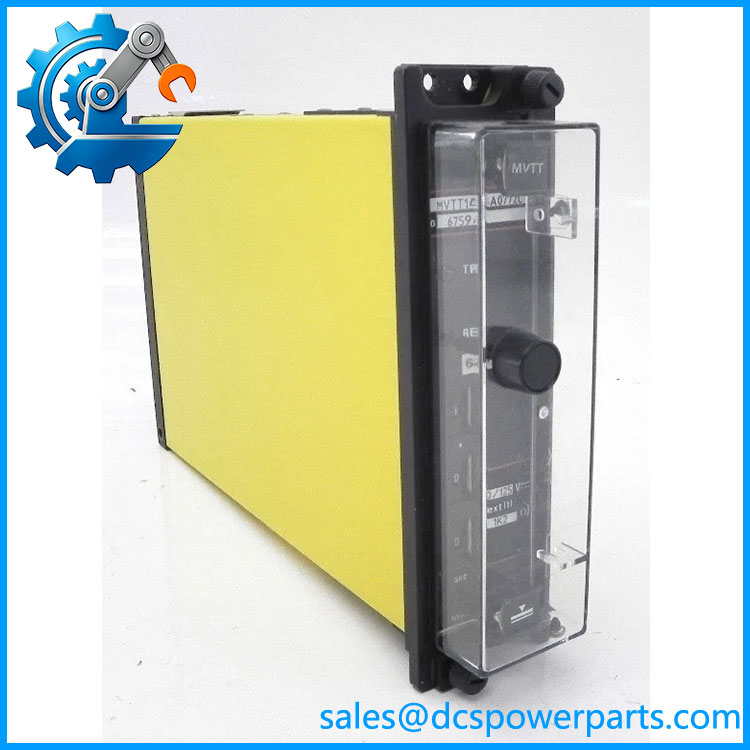
MVTT14B1BA0772C
Static electronic construction
The family is classified as a static relay. That differentiates it from older electromechanical timer designs. Static timing circuits generally avoid the mechanical timing mechanisms associated with conventional electromechanical timers, although the actual service life and timing accuracy of an individual legacy unit still depend heavily on age, environmental exposure, and component condition.
For maintenance teams, this means that age-related inspection should include more than contact continuity. Timing accuracy and repeatability need to be checked against the actual protection scheme requirements.
Pick-up delay rather than drop-out delay
The designation is specifically associated with time-delay pick-up. MVTT15 is separately classified as the corresponding static time-delay drop-out family. This is an important functional distinction during replacement because changing the timing action can change the sequence of a protection or interlock circuit.
Suitable for hardwired protection logic
The belongs to the class of discrete protection components used in conventional relay panels. It can therefore remain relevant in plants where the surrounding protection architecture has not been migrated to a fully numerical platform.
Typical engineering contexts include switchgear control, generator protection schemes, substation auxiliary logic, breaker control, and industrial power-system interlocking. The precise application of a particular must be confirmed from the plant drawings rather than assumed from the part number.
Configuration-specific ordering code
The complete code should be retained when specifying a replacement. The family contains multiple timing configurations, and available relay-model databases explicitly distinguish timing models and parameterization within the family.
This is one of those cases where a generic “ equivalent” is not sufficient procurement information.
Legacy protection-system compatibility
The family appears in legacy Alstom/AREVA/GEC protection equipment references. Modern documentation databases continue to classify as an Alstom static time-delay pick-up relay, while current inventory records identify the specific B1BA0772C variant as legacy hardware.
When maintaining an older panel, retaining the original relay can sometimes be preferable to redesigning the entire timing function, but only after checking availability, testability, and the condition of the surrounding protection equipment.
Related Products
- — The underlying Alstom/AREVA static time-delay pick-up relay family. Individual suffixes can have different electrical configurations and timing parameters.
- MVTT15 — Related static time-delay drop-out relay family. Its timing action differs from the pick-up function.
- MVAJ Series — Alstom/AREVA static high-speed trip relay family used for fast protection-trip functions rather than general time-delay pick-up.
- MVAA Series — Static auxiliary relay family used for auxiliary protection and control functions.
- MVTD11 — Static undervoltage relay family used for voltage-protection functions rather than dedicated timing.
- MVTD12 — Static overvoltage relay family for voltage-protection applications.
- MVTR Series — Static automatic-reclosure relay family, providing a substantially different protection function.
- VTT14 — Electromechanical timer family from the broader Alstom/GEC legacy product range; it should not be assumed electrically interchangeable with .
FAQ
What is the used for?
It is identified as an -series static time-delay pick-up relay. Its role is to introduce a defined delay into a protection or control circuit after the initiating condition is applied.
Is a protection relay or a timer?
Functionally, it is best described as a static time-delay protection/control relay. It does not replace a modern multifunction numerical protection relay. Instead, it performs a dedicated timing function within a larger protection or control scheme.
Can I replace it with another ?
Only after checking the complete ordering code. The family contains different timing configurations, including different timing units/ranges. The B1BA0772C suffix should therefore be matched rather than ordering a generic .
Is the same as MVTT15?
No. is classified as a static time-delay pick-up relay, while MVTT15 is classified as a static time-delay drop-out relay. Those timing actions are not automatically interchangeable.
Can I hot-swap this relay?
Do not assume so. This is a legacy protection relay rather than a modern plug-and-play PLC I/O module. Whether it can be removed under energized conditions depends on the specific mounting arrangement, panel design, isolation procedure, and protection scheme. A controlled isolation and approved maintenance procedure should be used unless the original equipment documentation explicitly permits live replacement.
Does the support firmware v3.1?
No firmware version should be assigned to this part number. The is a dedicated static timing relay, not a firmware-configured PLC/DCS communication module. Its relevant compatibility parameters are the electrical configuration, timing characteristics, contact arrangement, and physical mounting.
What is the exact timing range of ?
The exact range for the B1BA0772C suffix should be verified from the relay nameplate or original Alstom documentation. Available relay-model references confirm that exists in timing configurations using seconds and milliseconds, but they do not provide enough evidence to safely assign one exact range to this suffix.
What control voltage does use?
The complete suffix must be checked. Public commercial records describe the part as a configured relay but do not provide sufficiently authoritative evidence for assigning a specific control voltage to B1BA0772C. For a protection-system replacement, guessing the auxiliary voltage is not acceptable.
Is still a current-generation relay?
It should be treated as legacy Alstom protection hardware. Current references identify the family within Alstom/AREVA legacy protection equipment, while current inventory records continue to list the specific B1BA0772C variant.
Procurement Note
When sourcing an , the complete code is more important than the generic designation. Before approving a replacement, verify the original relay’s control voltage, pick-up timing range, contact arrangement, mounting format, terminal assignment, and application drawing.
For an operating protection panel, I would also recommend checking the relay at several timing points rather than accepting a simple coil/contact continuity test. A timer can pass a basic electrical check while drifting enough to affect a protection sequence. Compare measured delay against the setting and the original protection coordination requirements.
For legacy inventory, request photographs of the actual nameplate and front/rear terminals. Confirm whether the unit is new surplus, refurbished, or previously installed, and ask for a functional timing test when the application is protection-critical. The public documentation available for this exact suffix is limited, so a supplier’s claim of an exact voltage or timing range should be supported by the physical relay marking or original factory documentation.