Description
Key Technical Specifications
| Parameter | Specification |
|---|---|
| Product Model | MMLB-01 |
| Complete Part Number | MMLB01AXAA0011E |
| Manufacturer | Alstom / Alstom Grid |
| Product Family | Midos |
| Product Type | Multi-finger test plug |
| Primary Application | Protection relay testing |
| Compatible Test Block | MMLG |
| Test Sockets | 28 |
| Socket Size | 4 mm |
| Test Lead Type | 4 mm stackable retractable-shroud plugs |
| Retention | Two knurled retaining screws |
| Supplied Shorting Links | 6 |
| Shorting Link Length | 150 mm |
| Optional Test Cable | 2 m cable available |
| Documented Construction | Flame-retardant polycarbonate |
| Reported Rated Voltage | 300 VAC/DC |
| Reported Continuous Current | 20 A |
| Reported Short-Time Current | 400 A for 1 second |
| Reported Insulation Test | 2 kV / 50 Hz / 1 minute |
| Primary System | Midos protection relay/test-block system |
The mechanical and application characteristics are directly consistent across the Midos documentation and GE Vernova’s current MMLB/MMLG product description. The 300 V, 20 A, 400 A/1 s and 2 kV figures are reported in available technical records for the MMLB01 assembly and should be checked against the applicable revision before use in a formal protection-system test procedure.
Product Introduction
The Alstom MMLB-01 is a multi-finger test plug for MMLG protection relay test blocks. It provides a controlled interface between field-installed protection circuits and test equipment, allowing engineers to perform monitoring, isolation, and secondary-injection tests without removing the permanent wiring from the MMLG test block. GE Vernova continues to describe the MMLB/MMLG combination as part of the Midos protection system accessory range.
The plug contains 28 individual 4 mm test sockets, each corresponding to the numbered connections on the associated MMLG test block. It is secured mechanically with two knurled screws and accepts 4 mm stackable test plugs with retractable shrouds. Six shorting plug links are supplied for test-circuit preparation.
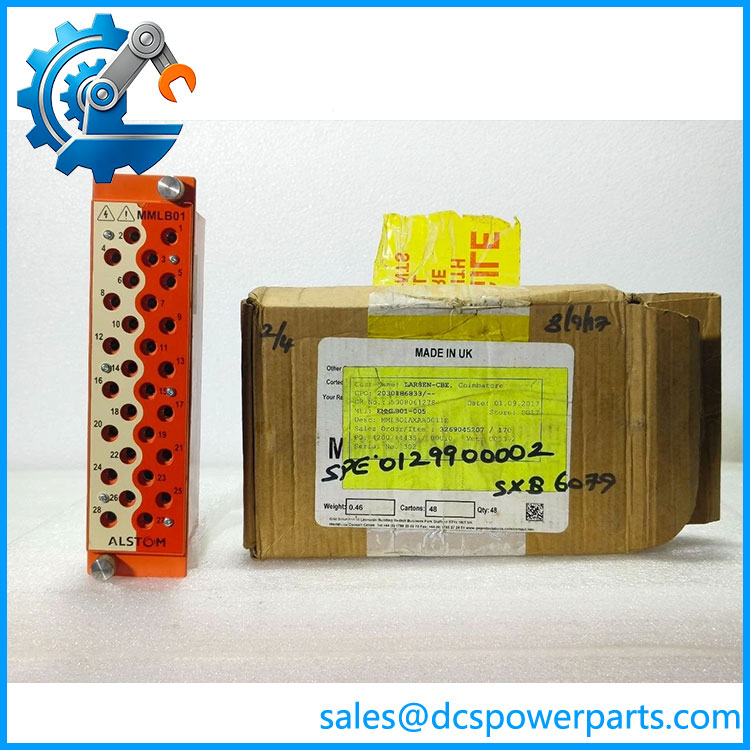
MMLB-01
Engineering Pain Point
The important distinction is that MMLB-01 is a test accessory, not a protective relay or plug-in relay module. Several secondary catalogs incorrectly classify it as a “plug relay,” which can lead to incorrect procurement and wiring assumptions. The OEM description specifically defines MMLB 01 as a multi-fingered test plug intended for the MMLG test block.
Typical Applications
- Secondary-injection testing of Midos protection relay schemes.
- Measurement and monitoring of protection relay circuits.
- Temporary isolation of protection circuits during maintenance.
- Testing of current-transformer and voltage-transformer secondary circuits through an MMLG test block.
- Protection-system commissioning where permanent relay wiring must remain organized and accessible.
Technical Pitfalls to Avoid
- Do not describe MMLB-01 as a conventional relay. The “test plug relay” wording found in some catalogs is misleading; the actual device is a multi-finger test plug.
- Verify the mating test block. MMLB-01 is designed to work with the MMLG test block. It is not a universal protection-relay test connector.
- Do not open-circuit a live CT secondary. Protection test procedures specifically warn that CT secondary circuits must be shorted before isolation or test-plug insertion. Dangerous voltages can develop if a CT secondary is opened while energized.
- Check the shorting links before testing. The MMLB 01 is supplied with shorting links intended for test-circuit preparation. Confirm continuity and the required circuit configuration before connecting secondary-injection equipment.
- Match the complete identification. When replacing an older unit, record both MMLB-01 and the complete designation MMLB01AXAA0011E where present.
- Do not substitute MMLB-02 without checking the test arrangement. is the multi-finger version; the MMLB-02 is a different test-plug configuration.
- Inspect the 4 mm sockets and shrouded leads. Worn contacts, damaged insulation, or poorly fitting test plugs can introduce resistance or intermittent connections during secondary injection.
Related Products
- Alstom MMLG Test Block — The mating test block for . It provides 14 circuits, with each circuit brought to a separate pair of rear terminals.
- Alstom MMLB-02 — Single-finger test plug variant; different from the 28-socket multi-finger configuration.
- Alstom MMLB-03 — Miniature split plug used with certain Midos relay test arrangements rather than as the primary MMLG multi-finger plug.
- Alstom MMLG01 — MMLG-family test block variant; verify exact circuit configuration before replacement.
- Alstom MMLG02 — Another MMLG-family test-block variant; the installed test-block configuration must be matched.
- Alstom MMLG03 — MMLG-family protection test block variant requiring configuration verification.
- Alstom MMLG04 — MMLG-family test block variant; verify socket/circuit arrangement.
- Alstom MMLG07 — MMLG-family test block variant listed with MMLB accessories.
Procurement Note
For procurement, identify the item as:
→ MMLB01 → MMLB01AXAA0011E → Midos Multi-Finger Test Plug
The critical compatibility check is the MMLG test block already installed in the protection panel. Do not purchase based solely on descriptions such as “plug relay” or “test relay.” The correct item must have the required 28 × 4 mm socket arrangement and mechanical interface for the installed MMLG block.
For field testing, the protection engineer should also verify the CT shorting arrangement, test-plug wiring, circuit isolation procedure, and test-equipment connections before inserting the plug. This is particularly important when CT secondary circuits are involved.