Description
Product Overview
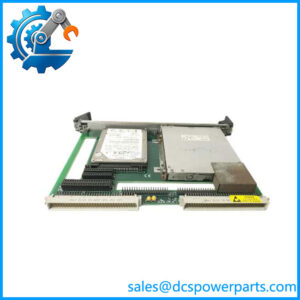
When a legacy VMEbus control or data-acquisition system needs several types of I/O without dedicating a separate carrier board to each function, a modular IndustryPack architecture can reduce board-space requirements and simplify signal integration. The Acromag AVME-9668 serves this purpose by connecting compatible IndustryPack modules to a VMEbus backplane. Its four module positions allow a system designer to combine supported analog input, analog output, digital I/O, or other IndustryPack functions according to the installed modules and application requirements.
The Acromag AVME-9668 is a non-intelligent 6U carrier, not an independent PLC or a universal I/O module. The host system accesses the installed modules through the VMEbus interface, including their I/O, identification, and supported memory spaces. Four front-panel SCSI-2 connectors route field signals, while individually fused and filtered power lines serve the IP module positions. The carrier supports 8 MHz and 32 MHz IP clocks and up to two interrupt requests per module. Before replacing an installed unit, engineers should verify the VMEbus configuration, IP module types, connector wiring, and software access method.
Key Technical Specifications
| Parameter | Specification |
|---|---|
| Product Model | AVME-9668 / AVME9668 |
| Manufacturer | Acromag |
| Product Type | VMEbus IndustryPack carrier board |
| Board Format | 6U VMEbus |
| Carrier Capacity | Four IndustryPack modules |
| VMEbus Role | Non-intelligent slave |
| IP Standard | ANSI/VITA 4-1995 |
| Supported IP Sizes | Single or double size |
| Supported IP Data Width | 32-bit IP modules not supported |
| IP Clock Rates | 8 MHz or 32 MHz, selectable by slot |
| IP Memory Space | Configurable from 1 MB to 8 MB per module |
| Field I/O Interface | Four front-panel 50-pin SCSI-2 connectors |
| VMEbus Data Transfer | A16/A24 addressing; D16/D08 transfer modes |
| Interrupt Handling | Up to two interrupt requests per IP module |
| Module Power | Fused and filtered +5 V, +12 V, and -12 V supply lines |
| Operating Temperature | 0°C to +70°C |
| Storage Temperature | -25°C to +85°C |
| Relative Humidity | 5–95%, non-condensing |
| Installation | Compatible 6U VMEbus card cage |
| Protection Rating | No IP rating specified in the reviewed documentation |
| Operating Accuracy | Depends on the installed IP modules; not a standalone measurement device |
Specifications are based on Acromag documentation. The standard AVME9668 and extended-temperature AVME9668E are different variants; the latter has a documented operating range of -40°C to +85°C. Confirm the exact suffix before ordering.
Major Features and Advantages
Four-slot modular I/O architecture
The AVME-9668 accommodates up to four compatible IndustryPack modules on one 6U VMEbus carrier. This arrangement lets system designers combine different I/O functions within a single backplane position, subject to the installed modules’ electrical and software requirements. The carrier provides the interface; the selected IP modules determine the actual signal types and measurement or output characteristics.
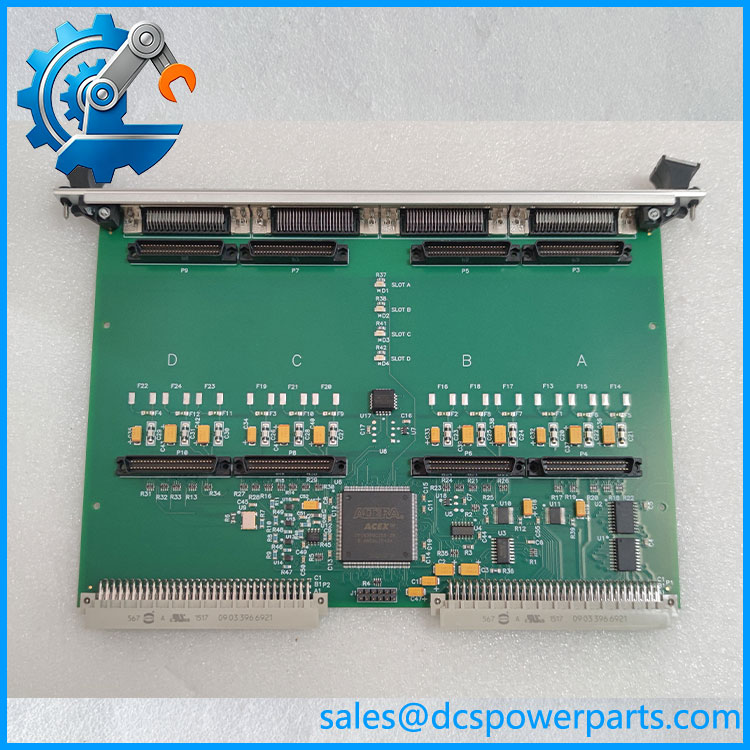
AVME-9668
Direct field wiring through front-panel connectors
Each IP position has a corresponding front-panel 50-pin SCSI-2 connection. This arrangement provides access to field signals without routing them through a separate front-panel connector on every module. Compatible shielded cables and termination panels can support cabinet wiring, but pin assignments must be checked against the specific IP module and termination arrangement.
VMEbus access to module registers and data
The carrier supports access to the installed IP modules’ I/O, identification, and supported memory spaces. Its programmable registers allow software to configure carrier functions and monitor control status. Interrupt requests can be generated by the installed modules, with VMEbus interrupt levels configured through software.
Individual module power filtering
The carrier provides individually fused and filtered power lines for the IP positions. This helps limit the transfer of supply disturbances between the carrier logic and installed modules. It does not replace appropriate field-side isolation, grounding, shielding, or signal conditioning where the application requires them.
Flexible clock selection
The AVME-9668 supports 8 MHz and 32 MHz IP clock operation, selectable independently for each slot. Actual performance depends on the installed module, the host software, and the VMEbus system configuration. A higher clock setting should not be assumed to improve every module’s throughput or timing behavior.
Application Scenarios and Common Pain Points
- Legacy VMEbus data acquisition: Consolidates several compatible analog or digital IP functions on one carrier.
- Industrial test and measurement: Provides a modular interface between a VMEbus computer and supported measurement or signal-interface modules.
- Equipment monitoring and control: Connects supported IP modules to host software for signal collection, status monitoring, and control outputs.
- System refurbishment: Can serve as a replacement carrier when the original hardware uses the same board format, IP modules, wiring, and software interface.
- Specialized control cabinets: Front-panel SCSI-2 connections can simplify access to field wiring when the correct cable and termination hardware are used.
Common procurement and commissioning risks include incorrect IP module selection, mismatched SCSI-2 pinouts, an incompatible VMEbus address configuration, missing driver libraries, and confusion between the standard and extended-temperature variants. These should be resolved before installation rather than during production troubleshooting.
Related Products and Components
The following models and accessories belong to the same carrier family or support its IndustryPack architecture. They are not all direct replacements.
| Model | Product role | Relationship to AVME-9668 |
|---|---|---|
| AVME9668E | Extended-temperature 6U IP carrier | Related variant; verify temperature and suffix requirements |
| AVME9630 | Two-slot VME IP carrier | Related carrier with fewer IP positions |
| AVME9660 | Four-slot VME IP carrier | Related carrier; verify clock and feature differences |
| AVME9670-4 | Four-slot VME64x IP carrier | Alternative carrier architecture; not a drop-in substitute without review |
| IP320 | Analog input IP module | Example of an IP module type; confirm application-specific compatibility |
| IP440A | Isolated digital input IP module | Example IP I/O module; verify channel and electrical requirements |
| 5028-438 | Shielded 50-pin SCSI-2 cable | Documented cable accessory for compatible carrier connections |
| 5028-378 | DIN-rail termination panel | Provides 50 screw terminals for compatible field wiring |
Confirm each component against its own documentation and the intended system design.
Engineer’s Guide: Three Checks Before Replacement
1. Verify the exact hardware variant. Check the board label and part number. Do not substitute AVME9668E for AVME9668—or the reverse—without confirming the operating-temperature requirement and system configuration.
2. Validate module and bus compatibility. Confirm that all installed IP modules are supported, that none requires the unsupported 32-bit IP interface, and that the host’s VMEbus address, interrupt, and memory-space settings match the original configuration.
3. Inspect field wiring and software access. Compare connector pinouts, cable routing, grounding, and termination before reconnecting field signals. Confirm that the host operating system, driver library, and application software can access the carrier and its installed modules.
Important: A carrier board with the correct form factor is not necessarily a functional replacement. Compatibility depends on the complete hardware and software configuration.
Frequently Asked Questions
1. What does the Acromag do?
It connects up to four compatible IndustryPack I/O modules to a VMEbus host system. It is a non-intelligent carrier board, not a standalone PLC or CPU.
2. Which IndustryPack modules can be installed?
The carrier supports standard single- and double-size IP modules that meet its interface requirements. The documentation specifically states that 32-bit IP modules are not supported. Check each module’s electrical interface, timing, memory requirements, and software support before installation.
3. What is the operating voltage of the ?
The carrier documentation specifies +5 V with a ±5% tolerance and identifies the ±12 V supply lines as unused at the carrier level in the listed specification. The installed IP modules also draw power. Verify the card-cage supply and module-specific power requirements before commissioning.
4. Can the replace another VMEbus I/O board?
Not automatically. A replacement must match the required 6U form factor, IP module interface, VMEbus addressing, connector wiring, interrupt configuration, and host software. A carrier with a different slot count or VME64x interface may require hardware and software changes.
5. Is the same as AVME9668E?
No. The AVME9668E is the extended-temperature version, documented for operation from -40°C to +85°C. The standard AVME9668 is rated for 0°C to +70°C. Check the label and application temperature range before purchasing.
6. What should buyers verify when purchasing a used ?
Request clear photographs of the model label, connectors, and board condition. Confirm whether the unit has been functionally tested, whether the four IP positions and VMEbus interface have been checked, and whether accessories are included. A visual inspection alone does not establish functional condition.
7. Is the still manufactured, and what is the lead time?
Some product listings identify the model as discontinued, while current availability depends on remaining stock and supplier status. Confirm actual inventory, condition, testing scope, warranty terms, and dispatch lead time before committing to a project schedule.
Procurement note: For an replacement, the most useful details to provide with the request are the complete board label, the installed IP module model numbers, the operating temperature range, and the required test documentation. These details help reduce the risk of receiving a mechanically compatible but functionally unsuitable carrier.