Description
Product Overview
The ABB TU847 3BSE022462R1 is a passive Module Termination Unit used in ABB S800 I/O architectures where two CI840 or CI840A field communication interfaces operate in a redundant configuration while the associated I/O remains non-redundant. Rather than processing signals itself, the TU847 provides the physical infrastructure around the communication interfaces: power supply connections, electrical ModuleBus connections, PROFIBUS connections, service connections, station-address switches, and the interface required for an optional ModuleBus Optical Port. ABB specifies a 24 VDC supply range of 19.2–30 VDC and PROFIBUS DP-V1 communication.
For ABB TU847 3BSE022462R1, the distinction between communication redundancy and I/O redundancy is important during system design. The unit accepts two CI840/CI840A modules but is specified for single/non-redundant I/O, unlike TU846, which is intended for redundant I/O. The TU847 also uses two rotary switches for station-address settings from 0 to 99 and provides mechanical keying to prevent an incompatible module from being installed in the wrong position. Four mechanical keys, each with six positions, provide 36 possible configurations.
The ABB TU847 3BSE022462R1 is DIN-rail mounted and can be installed vertically or horizontally. ABB specifies that it cannot be replaced with power applied, so it should not be treated as a hot-swappable S800 component. The assembly also needs adequate space on the left for removal. A TB842 ModuleBus Optical Port can be connected through TB806 when the architecture requires optical ModuleBus communication.
For legacy S800 installations, this is a small component with a disproportionately important wiring role. Matching the TU847 configuration, CI840/CI840A arrangement, station address, and mechanical keying is more important than simply confirming that the part physically fits the DIN rail.
Product Introduction
A redundant PROFIBUS interface does not automatically mean redundant I/O. specifically supports two CI840/CI840A communication interfaces while maintaining a single I/O configuration, with 24 VDC power and PROFIBUS DP-V1 connections built into the termination unit.
For an ABB S800 I/O system upgrade or CI840A replacement, verify the required redundancy architecture before ordering. is not a direct substitute for TU846 when the application requires redundant I/O.
Key Technical Specifications
| Parameter | Value |
|---|---|
| Manufacturer | ABB |
| Model | |
| Article Number | 3BSE022462R1 |
| Product Type | Module Termination Unit (MTU) |
| Product Family | S800 I/O |
| Primary Application | Redundant CI840/CI840A communication interface |
| I/O Configuration | Single / non-redundant I/O |
| Communication Protocol | PROFIBUS DP-V1 |
| Module Redundancy | Yes |
| Hot Swap | No |
| Power Input | 24 VDC |
| Permitted Power Range | 19.2–30 VDC |
| Mounting | DIN rail |
| Mounting Orientation | Vertical or horizontal |
| CI840/ Positions | 2 |
| Station Address | 0–99 via rotary switches |
| PROFIBUS Connections | 2 |
| Service Connections | 2 |
| Service Connector | RJ45 |
| PROFIBUS Connector | DSUB9 |
| ModuleBus | Electrical ModuleBus |
| Optical ModuleBus | TB842 via TB806 |
| Mechanical Keying | 4 keys / 36 configurations |
| Rated Insulation Voltage | 50 V |
| ModuleBus Current Distribution | Max. 5 V / 1.5 A; max. 24 V / 1.5 A |
| Weight | Approx. 0.55 kg |
| Operating Temperature | Up to 55°C horizontal; up to 40°C vertical, according to published data |
| Storage Temperature | -25°C to +70°C |
| Condition | New Surplus — verify complete configuration |
The core configuration is confirmed by ABB’s current data sheet and S800 communication-interface documentation.
Related Products
- TU846 3BSE022460R1 — MTU for redundant / communication interfaces with redundant I/O. This is the key comparison when deciding between single and redundant I/O architectures.
- TU847Z — G3-compliant version of . Use it where the installation specifically requires the corresponding G3 environmental compliance.
- 3BSE022457R1 — PROFIBUS communication interface used with the architecture. Two positions are provided for communication redundancy.
- 3BSE041882R1 — Updated communication interface supported by the . Confirm the installed system’s firmware and configuration requirements before substitution.
- TB807 — ModuleBus termination component associated with configurations. It is important when checking whether a surplus is complete.
- TB806 — Interface used when connecting a TB842 ModuleBus Optical Port to the .
- TB842 — Optical ModuleBus Port option that can be connected through TB806 where an optical ModuleBus architecture is required.
- TU848 3BSE042558R1 — MTU designed for redundant TB840/TB840A Optical ModuleBus Modems rather than /. It belongs to the same general communication-interface family but serves a different architecture.
- TU849 3BSE042560R1 — Another redundant TB840/TB840A termination solution, using a different ModuleBus arrangement from .
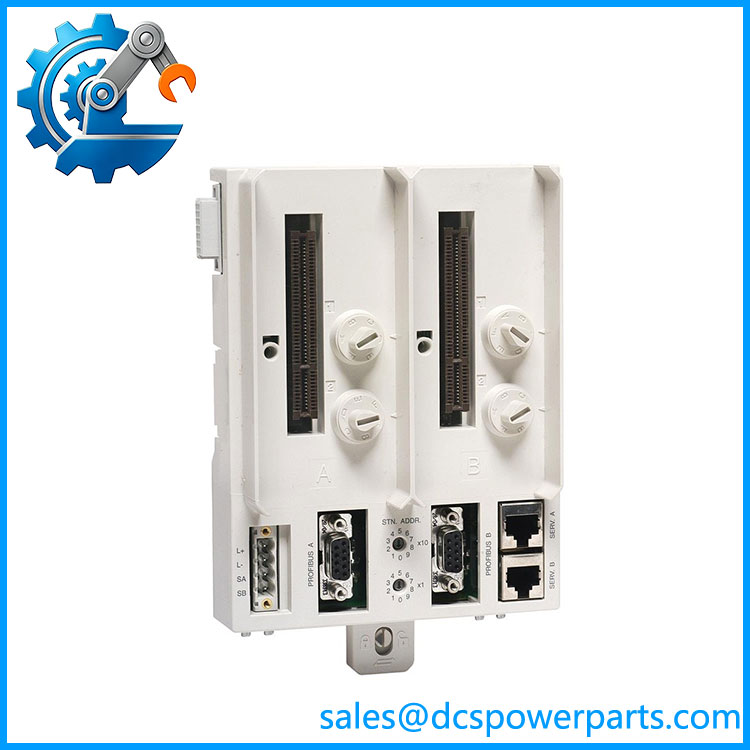
TU847 3BSE022462R1
Frequently Asked Questions
What is ABB 3BSE022462R1 used for?
The is an I/O Module Termination Unit for redundant / communication interfaces.
Its job is to provide the physical connections between the communication interfaces, power supply, ModuleBus, PROFIBUS network, and service equipment. It does not perform control logic or analog/digital signal processing itself.
What is the difference between and TU846?
The critical difference is I/O redundancy.
| Application | Correct MTU |
|---|---|
| Redundant / + single/non-redundant I/O | |
| Redundant / + redundant I/O | TU846 |
ABB’s documentation explicitly distinguishes these configurations.
Do not substitute TU846 for simply because both accommodate redundant / communication interfaces.
Can I hot-swap the ?
No.
ABB explicitly identifies as not hot-swappable. It also requires sufficient clearance on the left side so the assembly can be removed.
For field replacement:
- Put the affected I/O station into the approved maintenance state.
- Isolate the applicable power.
- Verify the PROFIBUS and ModuleBus connections.
- Record station-address switch positions.
- Replace the MTU.
- Confirm mechanical key positions.
- Restore power according to the approved procedure.
- Verify / communication and I/O status.
Does support ?
Yes. ABB specifies the for redundant communication configurations.
The important qualification is that the itself does not determine whether the installed firmware and overall configuration are compatible. Those should be checked separately during a system upgrade.
What power supply does require?
uses 24 VDC, with a specified input range of 19.2–30 VDC.
This is the supply for the MTU and its connected communication architecture. Do not confuse this with a field-device supply specification for the individual I/O modules.
Does provide redundant I/O?
No.
This is probably the most important purchasing check. supports redundant / communication interfaces but single/non-redundant I/O.
If the plant architecture requires two redundant I/O modules per channel group, is the relevant MTU to investigate instead.
What connectors are used on ?
Published technical information identifies:
- PROFIBUS: DSUB9
- Service ports: RJ45
- Power: Dedicated power connection
- ModuleBus: Electrical ModuleBus connection
- Optical ModuleBus: TB842 can be connected through TB806
The unit also provides two PROFIBUS connections and two service-tool connections.
Does have station-address switches?
Yes. provides two rotary switches, with the station address configurable from 0 to 99.
When replacing a unit, photograph or document these settings before removal. Losing the address configuration can turn a straightforward hardware replacement into a communication troubleshooting exercise.
How does the mechanical keying on work?
uses four mechanical keys, with two keys assigned to each module position. Each key has six positions, giving 36 possible configurations. The purpose is to prevent an incorrect module type from being inserted into an incompatible position.
This should be checked carefully when replacing an MTU in an existing cabinet.
How should a New Surplus be tested?
Because is a passive termination unit, testing should concentrate on mechanical integrity, connectors, power distribution, addressing, and communication continuity rather than treating it like an active CPU or I/O card.
Recommended incoming inspection:
- Confirm / 3BSE022462R1 markings.
- Inspect the DIN-rail latch and grounding mechanism.
- Check all PROFIBUS DSUB9 connectors.
- Inspect the RJ45 service ports.
- Verify the power connector.
- Confirm TB807 is present where required.
- Record all four mechanical-key positions.
- Check both station-address rotary switches.
- Inspect the ModuleBus connector.
- Verify compatibility with the planned / modules.
- Power the assembly in a controlled test configuration.
- Confirm both communication paths.
- Verify the connected I/O station reaches the expected operating state.
- Test PROFIBUS communication and diagnostics.
- Record the final station address and test results.
Procurement note: The most important distinction is architectural: = redundant / communication with single I/O. If the existing cabinet uses redundant I/O, stop and verify the MTU type before ordering.