Description
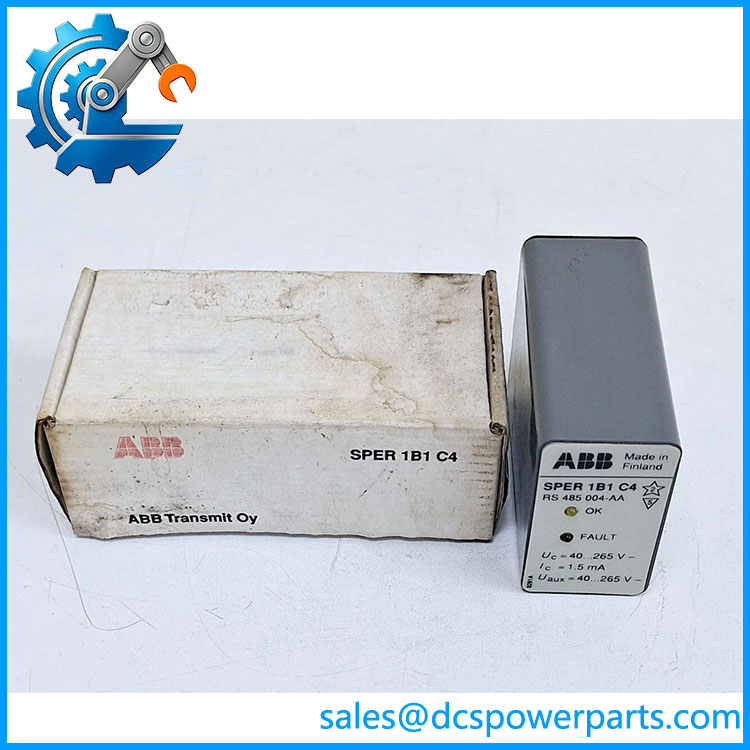
ABB SPER1B1C4
Key Technical Specifications
| Parameter | Specification |
|---|---|
| Product Model | SPER1B1C4 |
| Full Variant Commonly Listed | SPER1B1C4-AA |
| Manufacturer | ABB |
| Product Type | Trip circuit supervision relay |
| Monitored Voltage | 40–265 VDC |
| Typical Supervision Current | 1.5 mA |
| Primary Function | Trip-circuit continuity supervision |
| Application | Circuit-breaker trip circuit |
| Communication Protocol | Not applicable |
| Measurement Principle | Low-level supervision current |
| Installation | Panel/switchgear relay installation |
| Operating Accuracy | Configuration-dependent; not specified in the available records |
| Lifecycle | Legacy/discontinued |
The available product records specifically describe SPER1B1C4-AA as a supervision relay rated for 40–265 VDC with approximately 1.5 mA typical supervision current.
Product Introduction
The ABB SPER1B1C4 is a trip circuit supervision relay used to monitor the electrical continuity of a circuit-breaker trip circuit. Rather than operating as the main protection relay, it supervises the circuit that must remain electrically available when a breaker trip command is required. A field discussion specifically identifies the device in connection with monitoring a medium-voltage breaker trip coil.
The SPER1B1C4 is therefore a small component with an important diagnostic role. A supervision relay can detect an open trip circuit caused by wiring problems, fuse issues, disconnected terminals, or trip-coil circuit problems before an actual protection event occurs. The documented SPER1B1C4-AA version uses a 40–265 VDC monitored circuit and approximately 1.5 mA supervision current.
SPER1B1C4
Engineering Pain Point
A trip-circuit supervision device is often overlooked because it does not perform the primary breaker protection function. That is a mistake during troubleshooting. If the breaker control circuit has an open conductor, failed fuse, disconnected trip coil, or incorrect auxiliary contact arrangement, the protection system may issue a legitimate trip command without the breaker responding as expected. The supervision circuit provides an independent indication that the trip path itself is available.
Typical Applications
- Medium-voltage circuit breakers — monitoring the availability of the breaker trip circuit.
- Switchgear protection panels — supervision of DC trip/control wiring.
- Substation breaker control circuits — detecting loss of trip-circuit continuity.
- Industrial power distribution systems — providing a supervisory alarm before a breaker operation is required.
Technical Pitfalls to Avoid
- Do not treat SPER1B1C4 as the main protection relay. Its job is trip-circuit supervision, not primary overcurrent, earth-fault, differential, or distance protection.
- Verify the complete suffix. The commonly documented SPER1B1C4-AA version is specified at 40–265 VDC. Do not assume another SPER configuration has identical electrical characteristics.
- Check the actual trip-circuit voltage. The supervision relay must be compatible with the station/breaker DC control voltage. A nominal 110 VDC or 220 VDC system should be checked against the relay’s permitted range and the actual circuit design.
- Verify supervision-current compatibility. The approximately 1.5 mA monitoring current must not cause unintended operation of the breaker trip coil, auxiliary relay, PLC input, or other circuit elements.
- Inspect the breaker auxiliary contacts. Trip-circuit supervision commonly depends on the correct position and wiring of breaker auxiliary contacts. A relay replacement will not correct an incorrectly configured 52a/52b circuit.
- Do not substitute by voltage alone. A modern supervision relay with a similar DC voltage range may use a different terminal arrangement, supervision method, alarm contact logic, or minimum circuit current.
Related Products
- SPER1C1AA — another ABB SPER supervision-relay variant; electrical characteristics and application should be checked before substitution.
- SPAJ115C — ABB SPACOM protection relay for restricted/residual earth-fault applications; fundamentally different from .
- SPAJ140C — ABB SPACOM overcurrent/earth-fault protection relay; not a trip-circuit supervision replacement.
- SPAM-150C-AA — ABB motor protection relay; different protection function and application.
- SPAU140C — ABB SPACOM voltage supervision/protection family; not a direct SPER substitute.
- SPAG-310-C1-AA — ABB SPACOM overcurrent/earth-fault protection relay family.
- SPAF140 — ABB SPACOM protection relay family; verify application-specific function before considering any replacement.
Procurement Note
For , verify the complete suffix, monitored DC voltage, terminal arrangement, breaker trip-coil circuit, auxiliary-contact logic, and alarm contact configuration before replacement. The available records identify SPER1B1C4-AA as the 40–265 VDC / 1.5 mA version, while the base designation appears in legacy inventories without the complete suffix.
Do not approve a replacement solely because the label says “trip circuit supervision relay.” For a live switchgear retrofit, compare the original schematic and terminal numbering against the replacement device before energizing the DC trip circuit.