Description
ABB SPBRC410 | BRC410 Bridge Controller | Symphony Plus DCS
Key Technical Specifications
| Parameter | Specification |
|---|---|
| Manufacturer | ABB |
| Type Designation | SPBRC410 |
| Catalog Description | Controller with Modbus TCP Interface |
| Product Type | Central Unit |
| Controller Family | HR Series / Symphony Plus |
| Processor | Industrial-grade RISC-type processor |
| DRAM | 8 MB |
| NVRAM | 2 MB |
| Controller Power | 2 A at 5 VDC, 10 W |
| PBA Power | 100 mA at 5 VDC, 0.5 W |
| Serial Interfaces | 2 × RS-232-C, or 1 × RS-232-C + 1 × RS-485 |
| Ethernet | 1 × 10/100 Mbps |
| Diagnostic Port | 1 × mini-USB |
| Controller Communications | INFI-Net / PN800, Controlway, I/O expander bus, HN800 |
| S800 I/O | Supported through IOR810 |
| Programming | Function codes, Batch 90, user-defined function codes |
| Operating Temperature | 0 to 70°C |
| Modbus TCP Capacity | Up to 4,000 points with the applicable gateway configuration |
ABB’s product catalog identifies the SPBRC410 as an HR Series controller with an industrial RISC processor, 8 MB DRAM, 2 MB NVRAM, serial interfaces, 10/100 Mbps Ethernet, and a mini-USB diagnostic interface. It also identifies communication with HR Series I/O, SD Series I/O, and S800 I/O through IOR810.
ABB’s product-detail record classifies SPBRC410 as a Central_Unit and describes it specifically as a Controller with Modbus TCP Interface.
Product Introduction
The ABB SPBRC410 is the Symphony Plus version of the BRC410 bridge controller used in ABB’s HR Series control architecture. It operates as a central control processor and communication point, handling control functions while providing connections to HR Series I/O, SD Series I/O, S800 I/O through IOR810, engineering stations, HMI systems, and controller peer-to-peer communications.
The important procurement distinction is that SPBRC410 is not a conventional digital I/O module or a simple Modbus gateway. ABB defines it as a central controller, with Modbus TCP functionality provided through the applicable Symphony Gateway software. ABB’s current catalog states that the BRC410 configuration can support up to 4,000 Modbus TCP points.
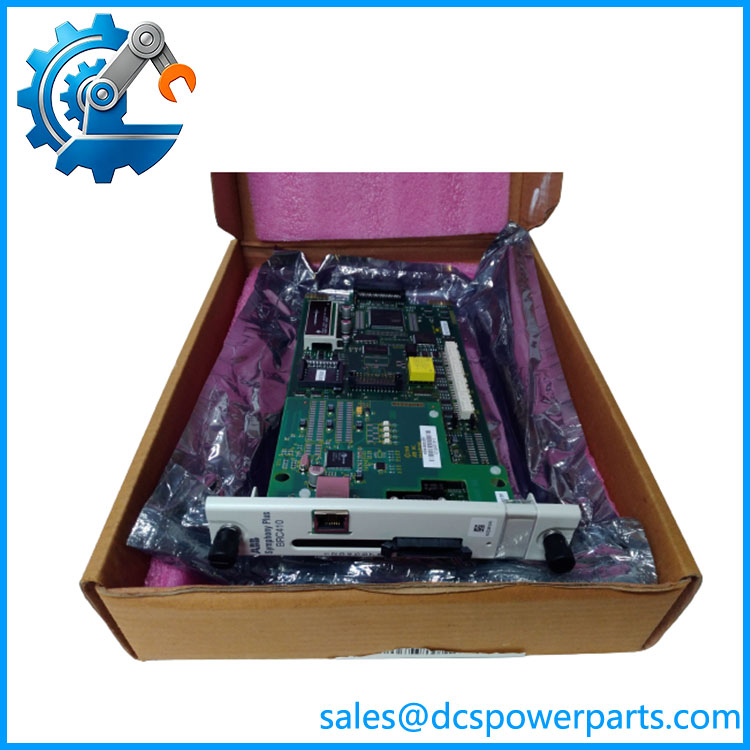
SPBRC410
Application Scenarios & Field Pitfalls — Engineer’s Perspective
Engineering Pain Point
A failed can affect much more than one communication link because the unit participates in the controller and system communication architecture. A replacement therefore has to be checked against the existing Symphony Plus/HR configuration, software revision, controller redundancy arrangement, I/O architecture, and communication licensing rather than treated as a simple plug-in communication card.
Typical Applications
- ABB Symphony Plus HR Series DCS controller applications.
- Legacy Bailey / INFI 90 migration projects where BRC410 functionality is retained within newer Symphony Plus architecture.
- Plant control systems requiring Modbus TCP integration with intelligent electrical devices, transmitters, actuators, motor control centers, or other Ethernet-based equipment.
- S800 I/O installations where S800 I/O is connected through an IOR810 gateway.
Technical Pitfalls to Avoid
- Do not classify as a Modbus RTU-to-TCP converter.
Some secondary listings describe it that way, but ABB’s own documentation identifies as an HR Series controller / Central Unit with Modbus TCP interface. The controller has broader DCS control and communication responsibilities. - Do not confuse the controller with the Modbus TCP software license.
ABB documents Modbus TCP integration through Symphony Gateway software. The BRC410 supports up to 4,000 points under the documented licensing arrangement. Hardware replacement alone does not guarantee that the existing Modbus configuration will operate without the correct software configuration and license. - Check the installed communication architecture before replacement.
The documented interfaces include INFI-Net or PN800, Controlway, I/O expander bus, HN800 through PBA800, serial ports, Ethernet, and S800 I/O through IOR810. A replacement should therefore be matched against the actual cabinet drawing and controller configuration.
Related Products
- ABB BRC410 — Earlier controller designation associated with the lineage; verify exact system generation before substitution.
- ABB IOR810 — I/O gateway used to connect I/O to Symphony Plus HR/SD controllers.
- ABB PBA800 — Interface associated with HN800 communication in the HR Series architecture.
- ABB SPC810ev — Newer Symphony Plus controller platform with expanded communication and processing capabilities; not a direct assumption of drop-in compatibility.
- ABB HR Series I/O — Rack I/O system supported by the controller architecture.
- ABB SD Series I/O — Distributed I/O family supported by the controller.
- — Modular I/O system accessible through the gateway.
- ABB Symphony Gateway Software — Software layer used for the documented Modbus TCP integration with the / platform.
Procurement Check
Before approving an replacement, verify:
- Exact type designation:
- Existing system generation: Symphony Plus / HR Series
- Whether the installed controller is a legacy or
- Controller redundancy arrangement
- Installed firmware and application configuration
- INFI-Net / PN800 architecture
- Controlway connections
- PBA800/HN800 arrangement where applicable
- and I/O configuration
- Ethernet network configuration
- RS-232/RS-485 port assignment
- Modbus TCP Gateway software and licensed point count
- Existing application database and function-code configuration
- Front-panel hardware revision and nameplate information
Recommended procurement description:
ABB Bridge Controller, Symphony Plus HR Series Central Unit, Controller with Modbus TCP Interface, Industrial RISC Processor, 8 MB DRAM, 2 MB NVRAM, 10/100 Mbps Ethernet.
The key point for a replacement is straightforward: is a DCS controller, not merely a Modbus communication adapter. The controller hardware, Symphony Plus configuration, communication architecture, firmware, and gateway software should be treated as one system when evaluating compatibility.