Description
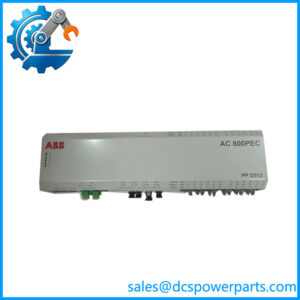
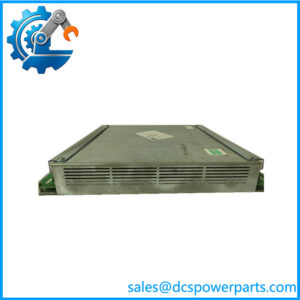
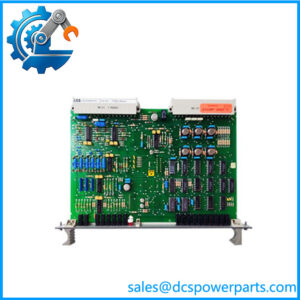
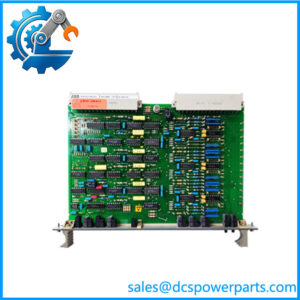
The ABB SD821 is a 24 VDC power supply module used in ABB AC 800M and System 800xA automation installations. It provides regulated DC power for control-system components and is designed for use in industrial control cabinets where stable system power is required.
The ABB SD821 is part of ABB’s S800/AC 800M system infrastructure and is commonly used with controller and I/O configurations requiring dedicated DC power. Its role is straightforward but important: a power supply fault can affect controllers, communication modules, I/O assemblies, or other connected equipment simultaneously.
The ABB SD821 should therefore be evaluated as part of the complete power architecture rather than as an isolated component. During replacement, engineers should verify input power, output voltage, load requirements, terminal connections, redundancy arrangement, and the specific AC 800M hardware configuration.
Technical Specifications
| Parameter | Specification |
|---|---|
| Product Model | SD821 |
| Manufacturer | ABB |
| Product Type | Power Supply Module |
| Output | 24 VDC |
| Application | AC 800M / System 800xA |
| Function | DC power conversion and distribution |
| Installation | Industrial control cabinet |
| Mounting | DIN rail |
| System Role | Controller and automation-system power |
| Redundancy | Supports redundant power-supply configurations |
| Diagnostics | Power/status indication |
| Environment | Industrial automation |
| Typical Use | PLC/DCS controller and I/O systems |
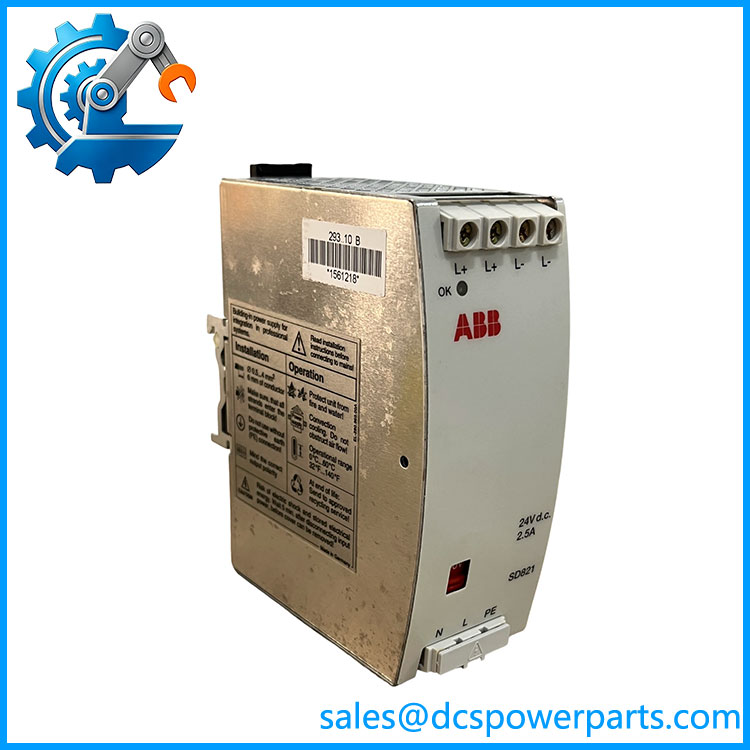
SD821
Product Introduction
ABB SD821 provides 24 VDC power for ABB AC 800M-based control systems and related automation equipment. In a typical installation, the power supply forms part of the control-system infrastructure supporting controllers, communication interfaces, and other system components.
The ABB SD821 is particularly relevant in installations where power availability is treated as part of system reliability. A failure on the DC supply side can produce symptoms that initially look like controller or communication failures, so checking supply voltage and load conditions should be part of the initial troubleshooting process.
The can also be incorporated into redundant power arrangements where maintaining DC power availability is important. The exact redundancy architecture depends on the associated system hardware and installation design, so engineers should not assume that every installation has the same wiring or load configuration.
Application Scenarios & Field Pitfalls
Typical Applications
- AC 800M controller cabinets
- System 800xA installations
- Industrial PLC/DCS control panels
- Remote I/O and communication cabinets
- Process-control power distribution
Engineering Checks Before Replacement
1. Measure the incoming supply.
Confirm that the input voltage is within the module’s specified range before condemning the power supply.
2. Check the 24 VDC load.
An overloaded or shorted downstream circuit can cause repeated power-supply trips and may make a healthy appear defective.
3. Inspect redundancy wiring.
If the is installed in a redundant arrangement, verify the associated power path, distribution terminals, and redundancy configuration.
4. Check downstream modules.
If several AC 800M components lose power at the same time, inspect the common DC supply path before replacing individual controller or communication modules.
5. Verify the exact hardware revision.
For legacy-system replacements, compare the installed unit’s complete ordering information and revision against the proposed replacement.
Related ABB Hardware
- ABB AC 800M Controllers — Modular controllers used in PLC and DCS applications.
- ABB System 800xA — Automation platform incorporating AC 800M controllers, I/O, communication, and engineering functions.
- ABB SD822 — Related power-supply hardware in the same AC 800M system power family.
- ABB SD823 — Higher-capacity power-supply variant used in AC 800M system configurations.
- ABB CI8xx Communication Modules — Communication interfaces commonly installed alongside AC 800M controllers.
Engineering Note: For an replacement, do not treat the module simply as a 24 VDC source. Check the complete load, redundancy arrangement, cabinet wiring, and downstream AC 800M hardware. Power-related faults can propagate across an entire controller cabinet, making proper isolation more important than simply swapping the suspected supply