Description
ABB RXMVB4 RK251401-AP
Product Introduction
The ABB RXMVB4 RK251401-AP is a heavy-duty electromechanical relay used in industrial protection and control circuits where multiple isolated contacts are required from a single relay function. The RK251401-AP designation is consistently associated with the RXMVB4 series and a 125 VDC operating/control voltage with 7 normally open and 7 normally closed contacts. Historical ABB-related procurement records identify the exact part number as “RXMVB4 125V DC – 7NO + 7NC,” providing a useful cross-check for equipment identification.
The RXMVB4 is better understood as a heavy-duty latching or throw-over relay rather than a conventional small signal relay. Its contact arrangement makes it suitable for relay logic where one mechanical switching function must provide several NO and NC circuits simultaneously. In protection panels, generator control equipment, switchgear interfaces, and other industrial control assemblies, this type of relay can be used to transfer, isolate, or distribute control signals without requiring a large number of separate auxiliary relays. Historical trade records also specifically describe RK251401-AP as an “RXMVB4 throw over relay.”
For procurement, the complete designation RK251401-AP should be retained rather than ordering an based only on the family name. Other variants use different RK numbers and contact arrangements. For example, RK251402-AP has been documented with a 125 VDC, 9 NO + 5 NC configuration, so substituting another variant can directly change the relay logic in an existing panel.
Technical Specifications
| Parameter | Specification |
|---|---|
| Product Model | |
| Manufacturer | ABB |
| Complete Part Number | RK251401-AP |
| Product Type | Heavy-duty latching / throw-over relay |
| Control / Coil Voltage | 125 VDC |
| Contact Configuration | 7 NO + 7 NC |
| Contact Type | Electromechanical |
| Relay Function | Latching / throw-over switching |
| Application | Protection and industrial control circuits |
| Mounting | Panel / relay assembly, according to associated mounting hardware |
| Communication Protocol | None |
| PLC/DCS Network Interface | None |
| Signal Type | Hardwired electrical contacts |
| Contact Count | 14 contacts total |
| Operating Temperature | Verify against the original ABB technical documentation for the exact production revision |
| Protection Rating | Verify according to the installed relay/base assembly |
| Contact Rating | Verify against the applicable ABB datasheet and circuit duty |
| Exact Replacement Requirement | Yes — verify and contact arrangement |
Specification note: The 125 VDC and 7 NO + 7 NC configuration are supported by multiple historical procurement records. I would not publish a specific contact-current rating, temperature range, insulation rating, or IP rating without the applicable ABB technical sheet for the exact revision.
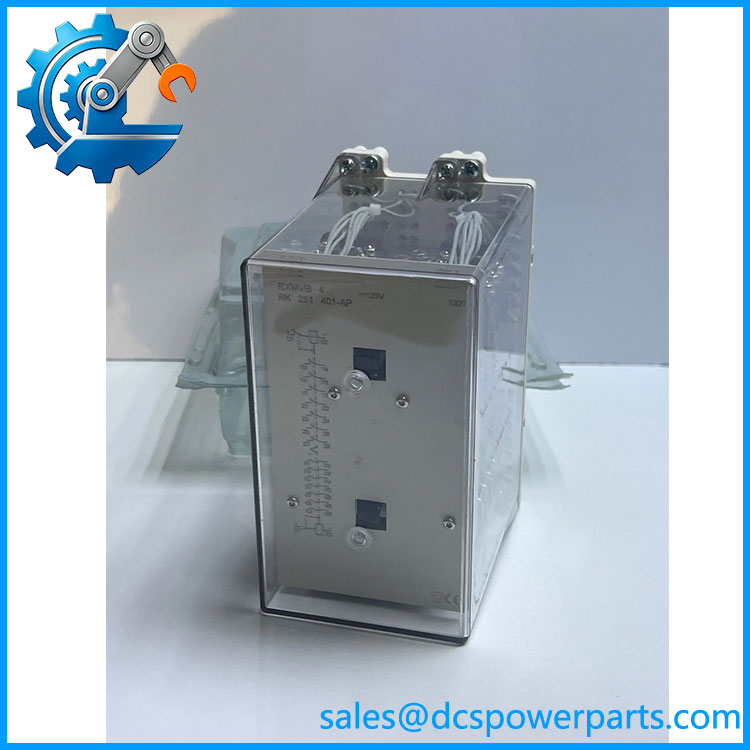
RXMVB4 RK251401-AP
Main Features and Engineering Considerations
1. High contact-count relay architecture
The major practical advantage of the configuration is its 7 NO + 7 NC contact arrangement. This allows one relay mechanism to control multiple hardwired circuits. In older protection and control panels, that can significantly simplify relay logic compared with distributing the same function across numerous smaller auxiliary relays.
2. 125 VDC control system compatibility
is specifically associated with 125 VDC. This matters in substation, switchgear, generator, and protection applications where 110/125 VDC battery systems are commonly used for control and tripping circuits. The 125 VDC designation should be treated as a critical identification parameter, not merely a nominal catalog value.
3. Latching / throw-over operation
The relay’s latching or throw-over function is important when the controlled state must be maintained through the relay’s mechanical switching arrangement rather than treated as a simple continuously energized auxiliary relay. Engineers should verify the actual circuit schematic before assuming how the relay changes state, particularly in trip, transfer, interlock, and annunciation circuits.
4. Exact suffix matters
has several configurations. is not interchangeable simply because another part also carries the designation. Historical ABB records show RK251402-AP with a different 9 NO + 5 NC configuration.
5. No communication interface
This is a hardwired relay, not an intelligent I/O module. There is no Ethernet, Modbus, PROFIBUS, or other digital communication interface. Any PLC, DCS, or protection relay integration occurs through the physical relay contacts and the associated panel wiring.
6. Replacement testing
For a replacement in an operating protection or control panel, verify coil/control voltage, contact arrangement, mechanical latch/throw-over behavior, terminal identification, contact burden, and the actual sequence of operation. A relay that physically fits the panel but has a different contact configuration can create a functional wiring error.
Application Scenarios
- Generator control and protection panels
- Switchgear control circuits
- Substation relay panels
- Electrical protection systems
- Breaker control and interlocking
- Relay logic and signal transfer
- Alarm and annunciator circuits
- Industrial motor and auxiliary control
- Legacy ABB protection/control installations
- Hardwired PLC/DCS interface circuits
Engineer’s Guide: Field Pitfalls
Do not substitute by family number alone. is a family designation. The complete number defines the configuration that matters to the panel.
Check the 125 VDC control voltage. Do not substitute a 110 VAC, 220 VAC, or different DC-voltage version without confirming the circuit design.
Verify all 14 contact paths. The documented configuration is 7 NO + 7 NC. Compare the relay schematic against the panel wiring before energizing.
Do not confuse the relay with an I/O module. provides electromechanical contacts; it does not communicate with a PLC or DCS directly.
Check the mating base and terminal arrangement. The relay’s mechanical and electrical interface must match the existing installation. The relay alone should not be treated as the complete mounting assembly unless the procurement specification says so.
Confirm the latching/throw-over sequence. In protection and transfer circuits, the mechanical operating state can be functionally important. Test the actual state transition rather than assuming it behaves like an ordinary momentary relay.
Check contact duty, not just coil voltage. A 125 VDC control relay can be used in many different circuits, but the actual load switching duty determines whether the contact arrangement is suitable.
Frequently Asked Questions
What is ABB ?
is the ABB part number associated with the heavy-duty latching / throw-over relay, configured for 125 VDC and 7 NO + 7 NC contacts.
What is the contact configuration?
The documented configuration is 7 normally open + 7 normally closed contacts.
What voltage does use?
The part is documented as a 125 VDC relay.
Is a PLC I/O module?
No. It is an electromechanical relay used for hardwired control and protection circuits.
Is interchangeable with another ?
Not automatically. Different part numbers can have different contact configurations. For example, RK251402-AP is documented as 9 NO + 5 NC, which is different from .
Does it support Modbus or Ethernet?
No. The relay has no network communication interface. Integration with automation equipment is through its electrical contacts.
Procurement Note
Specify the complete part as:
ABB — — 125 VDC — 7 NO + 7 NC
For an installed-system replacement, verify the relay nameplate, contact arrangement, coil/control voltage, mating base, terminal assignment, mechanical operating state, contact duty, and the original protection/control schematic. The exact suffix is more important than simply matching “.”