Description
ABB PM856AK01
Product Overview
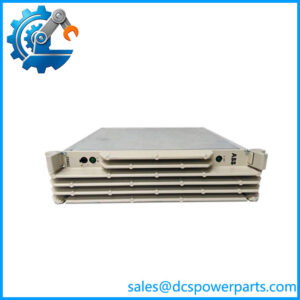
The ABB PM856AK01 is a non-redundant processor unit for the ABB AC 800M controller platform used in industrial automation and System 800xA installations. ABB identifies the unit by article number 3BSE066490R1 and specifies a 24 MHz MPC860 processor, 16 MB memory, flash storage, and application RAM of approximately 10.337 MB. Its published performance is 0.46 ms for 1,000 Boolean operations, with application cycle times down to 1 ms.
From a system-design perspective, the ABB PM856AK01 sits at the controller level rather than the I/O level. It executes the control application and communicates with AC 800M I/O and communication modules through the controller architecture. The base plate provides two RJ45 Ethernet ports for the Control Network and two RJ45 serial ports. COM3 supports RS-232C with modem-control signals, while COM4 is isolated and intended for connection to a configuration tool. The controller also supports CEX-bus communication expansion and AC 800M ModuleBus I/O architecture.
Power requirements are straightforward: the PM856AK01 operates from 24 VDC with a specified range of 19.2–30 VDC, with typical consumption of 180 mA and maximum consumption of 300 mA. The published environmental rating is 0 to +55 °C operating, -40 to +70 °C storage, 5–95% relative humidity non-condensing, and IP20 protection. The hardware is intended for installation in an appropriate control cabinet or enclosure rather than direct exposure to the plant environment.
The ABB PM856AK01 is a particularly important distinction when maintaining older AC 800M systems because ABB’s current hardware-selector data lists it separately from PM851, PM858, PM862, PM866, and other processor families. Do not select a replacement merely from the AC 800M family name. Application memory, controller performance, redundancy requirements, firmware/Control Builder compatibility, CEX-bus configuration, and installed I/O architecture all need to be checked before a controller migration is approved.
Product Introduction
Controller replacement is rarely just a matter of matching the front-panel shape. The ABB PM856AK01 provides a defined 24 MHz processing platform with 16 MB memory and a non-redundant AC 800M architecture.
For a legacy replacement or DCS system upgrade, the engineering check should include the compiled application, AC 800M firmware level, 800xA/Control Builder release, I/O topology, CEX-bus modules, and controller resource utilization—not just the part number.
Key Technical Specifications
| Parameter | Specification |
|---|---|
| Product Model | |
| ABB Article Number | 3BSE066490R1 |
| Manufacturer | ABB |
| Product Family | AC 800M |
| Product Type | Processor Unit / Controller |
| Processor | MPC860 |
| Clock Frequency | 24 MHz |
| Memory | 16 MB |
| RAM Available for Application | 10.337 MB |
| Flash Memory | Yes |
| Boolean Performance | 0.46 ms / 1,000 Boolean operations |
| Minimum Application Cycle | Down to 1 ms |
| Redundancy | No |
| High Integrity | No |
| Power Supply | 24 VDC |
| Supply Range | 19.2–30 VDC |
| Typical Current | 180 mA |
| Maximum Current | 300 mA |
| Typical Power Dissipation | 4.32 W |
| Maximum Power Dissipation | 7.2 W |
| Ethernet Channels | 2 |
| Ethernet Interface | IEEE 802.3, 10 Mbit/s, RJ45 |
| Control Network Protocol | MMS and IAC |
| Serial Interfaces | 2 × RS-232C |
| COM3 | 75–19,200 baud, non-isolated, RTS/CTS |
| COM4 | 9,600 baud, isolated, configuration/service connection |
| CEX-Bus Modules | Up to 12 single CEX-bus modules |
| ModuleBus I/O Capacity | Up to 96 I/O modules |
| Operating Temperature | 0 to +55 °C |
| Storage Temperature | -40 to +70 °C |
| Relative Humidity | 5–95%, non-condensing |
| Protection Rating | IP20 |
| Corrosion Protection | G3, ISA 71.04 |
| Hazardous Location | cULus Class 1, Zone 2 / AEx nA IIC T4 / Ex nA IIC T4 Gc X |
| Marine Certifications | ABS, BV, DNV-GL, LR, CCS |
| Dimensions | 119 × 186 × 135 mm |
| Weight | Approx. 1.1 kg including base |
The specifications above are based primarily on ABB’s current hardware-selector documentation.
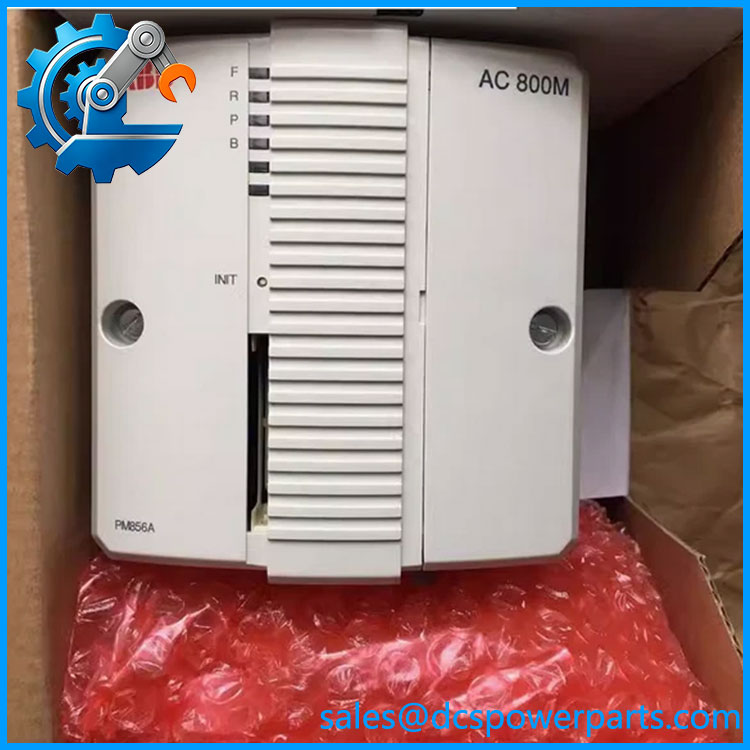
PM856AK01
Major Features and Advantages
24 MHz MPC860 Processing Platform
The uses an MPC860 processor operating at 24 MHz. Its published benchmark is 0.46 ms for 1,000 Boolean operations, giving engineers a concrete reference when assessing controller loading rather than relying on generic descriptions of processing capability.
For an existing application, however, benchmark figures alone do not establish suitability. Task count, cycle times, communication load, application size, and I/O configuration should be reviewed from the actual Control Builder project.
16 MB Controller Memory
The provides 16 MB of memory, with approximately 10.337 MB available for application use according to ABB’s current data. Flash memory is also provided for storage.
This is an important difference from smaller AC 800M processor variants. When replacing an older controller, compare the actual application resource usage rather than assuming that nominal memory capacity alone determines compatibility.
Dual Ethernet Control-Network Interfaces
Two RJ45 Ethernet ports are integrated into the PM856A base plate. ABB specifies IEEE 802.3 Ethernet at 10 Mbit/s, with MMS and IAC used for the Control Network architecture.
The presence of two physical Ethernet ports should not be interpreted as controller redundancy. is explicitly a non-redundant controller.
CEX-Bus and ModuleBus Integration
The controller supports communication expansion through the CEX bus and can support up to 96 I/O modules on the ModuleBus architecture under the documented configuration limits. ABB specifies up to 12 single CEX-bus communication modules and a maximum electrical ModuleBus supply current of 1.0 A at 24 V and 1.5 A at 5 V.
These limits matter during system expansion. Adding communication or I/O hardware is not simply a question of available DIN-rail space; the controller’s bus and power budgets also need to remain within specification.
Integrated Serial Interfaces
Two RS-232C interfaces are provided. COM3 supports 75–19,200 baud, modem-control signals, and full RTS/CTS operation, while COM4 is optically isolated, operates at 9,600 baud, and is intended for a configuration/service-tool connection.
This distinction is easy to overlook when troubleshooting an older installation. The two RJ45 serial connectors do not have identical electrical functions.
Industrial Environmental Qualification
The is specified for 0 to +55 °C operation, 5–95% non-condensing humidity, G3 corrosion protection, and IP20 protection. ABB also lists Class 1, Zone 2 hazardous-location certification and several marine certifications.
IP20 still means the controller requires suitable enclosure protection. Hazardous-area certification of the controller does not automatically make the entire cabinet or surrounding installation compliant.
Related Products
- PM851AK01 — AC 800M processor with 12 MB memory and the same 0.46 ms published Boolean-operation performance; lower memory capacity than .
- PM858K01 — 16 MB AC 800M processor with higher published processing performance than ; non-redundant configuration.
- PM858K02 — Related 16 MB processor with controller redundancy capability.
- PM862K01 — 32 MB AC 800M processor with 0.18 ms published performance; non-redundant.
- PM862K02 — 32 MB version supporting controller redundancy.
- PM866AK01 — 64 MB AC 800M processor with substantially higher published processing performance.
- PM856K01 — Earlier PM856-generation processor-unit package; do not treat the older K01 hardware as automatically identical to the . The later carries article number 3BSE066490R1.
- PM857K01 — 32 MB high-integrity AC 800M controller.
- PM857K02 — 32 MB high-integrity controller with redundancy capability.
ABB’s current controller comparison confirms that memory, processing performance, high-integrity capability, and redundancy vary significantly across the AC 800M processor range.
FAQ
Is a PLC CPU or a DCS controller?
It is an AC 800M processor/controller used in ABB automation and System 800xA architectures. Functionally, it provides the central execution platform for the control application while communicating with distributed I/O and communication modules.
What is the ABB part number for ?
The ABB article number is 3BSE066490R1. ABB’s hardware selector identifies 3BSE066490R1 as the processor unit.
Does support controller redundancy?
No. ABB specifies Redundancy: No for . Do not confuse its two Ethernet ports with CPU redundancy.
Can I hot-swap the ?
Do not assume that the CPU itself can be hot-swapped simply because AC 800M supports hot-swap functions for certain system components. ABB’s current product listing specifically identifies hot-swap capability for certain accessory modules, while is listed as a non-redundant processor unit. Follow the applicable AC 800M maintenance procedure and project-specific shutdown requirements before removing the controller.
Does support firmware v3.1?
The part number alone does not establish the installed firmware revision. Firmware compatibility must be checked against the actual CPU hardware revision and the project’s Control Builder/System 800xA release. Do not treat a firmware version reported for another PM856-generation controller as proof of compatibility.
Can replace an older PM856K01 directly?
Not automatically. There is a documented relationship between the older PM856 generation and the later , but a proper migration check should cover the controller hardware, firmware, application memory, I/O topology, communication modules, baseplate, and engineering software version. ABB’s product catalog identifies as a 24 MHz / 16 MB processor package including the PM856A CPU, TP830 baseplate, TB850 CEX-bus terminator, TB807 ModuleBus terminator, and memory-backup battery.
Does the include a license?
ABB’s product catalog states that the processor-unit package includes the CPU, baseplate, bus terminators, and battery, with no license included.
For procurement, verify whether the replacement requirement is for the processor hardware alone or for a complete processor-unit package. That distinction can affect what is actually included in the shipment.