Description
Product Overview
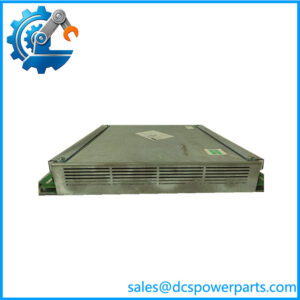
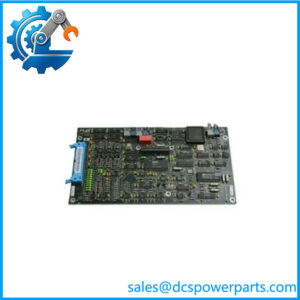
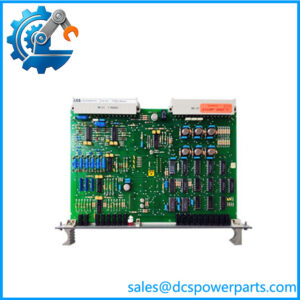
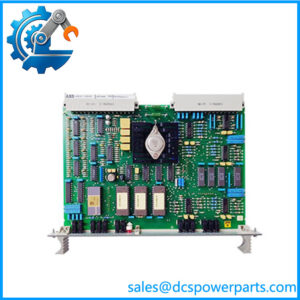
PM645B is the redundancy-capable processor module of ABB’s Advant Controller 160, the compact controller that sits in the Advant OCS line below the AC 410 and AC 450 stations. It is not a general-purpose CPU with a bag of ports; it is the module a station is built around when the process cannot afford to lose one processor. On board it carries a voter for dual and triple redundancy, two RS-422 high-speed serial links that synchronise processor modules with each other, and two RS-422 rotational speed signal inputs — the last being the reason this specific module, rather than its cheaper siblings, turns up on turbine and rotating-machinery duty.
Architecturally it is a two-processor design. The base processor is a Motorola MC68360 running the application from SRAM after copying it from Flash at start-up; the second MC68360 carries an extra 512 kB of system Flash and an extra 2 MB of SRAM for the inter-processor work. There are two RS-232-C ports at 9,600 baud, one for an Advant Station 100 Series engineering station and one for a local operator station speaking MODBUS I. Notably absent is anything Ethernet-shaped: this platform reaches the plant through Communication Interface modules in the subrack, not through a TCP/IP stack on the CPU.
That architecture defines the module’s place in a procurement decision, and it is where most of the confusion around this part number comes from. PM645B is frequently advertised as an AC 800M controller, described with 16 MB of application RAM and a Modbus TCP stack, or sold as a PROFIBUS-DP master. None of that is true. The AC 800M processors are PM851 through PM891; the PROFIBUS-DP master variant in this family is PM644, a different article number entirely; and PM645B’s own network connection to I/O is through CI modules in the basic subrack. A buyer who fits this module expecting it to master PROFIBUS has bought a processor that will never bring the drives online.
The generational question matters just as much. ABB’s product guide states directly that PM645B replaces the Processor Modules PM645A and PM645C, which are no longer available. The suffix is therefore not a revision letter attached to a still-current PM645 — it is the only orderable member of the line, and the older two article numbers should not be quoted against new requirements. Alongside it the guide lists PM640 for non-redundant processing, PM644 for non-redundant processing with an integrated PROFIBUS-DP master, PM646 for redundant processing with the additional hardware and software monitoring that safety application systems demand, and PM665 as the PowerPC-based successor with more RAM and roughly six times the performance. Choosing between them is a functional decision — redundancy, fieldbus, safety, throughput — not a price decision.
Mechanically the module lives in the RF616 ten-position controller subrack, in positions 3 to 8, with at least one Communication Interface in position 2 regardless of whether Advant Fieldbus 100 is used. Up to six processor modules can share one basic unit, which is how the platform handles multiprocessing: several CPUs in one station, each addressed by its slot, synchronised where required over the high-speed links.
Technical Specifications
| Parameter | Value |
|---|---|
| Model | PM645B — Processor Module, type B |
| Ordering number | 3BSE010535R1 |
| Manufacturer | ABB, Sweden |
| Platform | Advant Controller 160 (AC 160), Advant OCS |
| Product type | Processor module (CPU) for redundant and parallel processing |
| Processors | Motorola MC68360, plus a second MC68360 for the redundant/communication functions |
| Memory | 2 MB SRAM; 1 MB Flash PROM for user application; 2 MB Flash PROM for system software; second processor adds 512 kB Flash PROM and 2 MB SRAM; memory not expandable |
| Application capacity | 1 MB available for the application program; up to 31 execution modules per program |
| Serial ports | 2 × RS-232-C at 9,600 baud — engineering station (AS 100 Series) and local operator station via MODBUS I |
| Module interlinks | 2 × RS-422 high-speed serial links for application and system data exchange between processor modules |
| Speed inputs | 2 × RS-422 rotational speed signal input ports |
| Redundancy | On-board voter supporting dual and triple redundancy |
| Supply | 24 V dc through the subrack; SA610 supply module (3BSE000655R1) accepts 110/120/220/240 V ac or 110/220/250 V dc and delivers 24 V dc at 60 W |
| Subrack | RF616 ten-position controller subrack; processor modules in positions 3–8; a Communication Interface required in position 2 |
| Configuration | Control Builder A (AMPL) with target “AC 160 with PM64x 2.1”; AdvaSoft 2.0 for Windows NT; AS 100ES for station functions |
| Enclosure | Sheet-steel subrack housing, IP20 to IEC 529, top and bottom convection openings, wall or cabinet mounting |
| Time synchronisation | External minute-pulse input to the processor module, or DCF77 time signal on the Com B serial line |
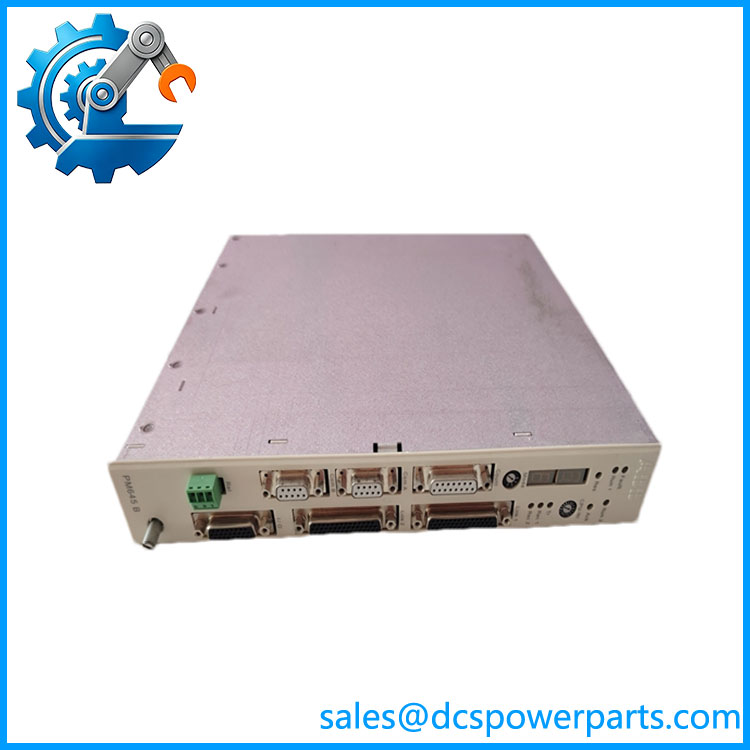
ABB PM645B
Key Features and Advantages
Voter on board, not in software: dual and triple redundancy are handled by dedicated hardware in the module, so a failed processor is outvoted rather than negotiated — the mechanism does not depend on the surviving CPUs agreeing about the failure.
Two high-speed links for state exchange: the RS-422 ports are dedicated to processor-to-processor synchronisation, which is what makes a second PM645B in the same station, or in another station, behave as a partner rather than as a spare sitting idle.
Speed inputs built in: two RS-422 rotational speed channels land directly on the processor module, so a turbine or compressor governor loop does not need a separate tachometer module and its cabling in the subrack.
Speed signal conditioning at the source: because the inputs are on the CPU, the control program reads rotational speed without a fieldbus or I/O round trip, which matters for overspeed logic where a scan delay is a safety margin lost.
Six processors per basic unit: multiprocessing within one station, with each module addressed by its slot position, allows a large application to be split across CPUs instead of being pushed onto a bigger controller.
Engineering access without a network stack: the two RS-232-C ports at 9,600 baud give the engineering station and a local operator station their own serial paths, so commissioning and local operation do not depend on the plant network being up.
Deterministic memory model: the application is copied from Flash into SRAM at start-up and executed there, with the memory explicitly not expandable — an unglamorous design choice that makes program size predictable and rules out the class of fault where an application outgrows a device mid-life.
Field-proven communication architecture: Advant Fieldbus 100 through CI626, CI627, CI630 or CI631, and S800 distributed I/O through CI830 as a PROFIBUS-DP slave, keep this controller compatible with the I/O families already installed across Advant OCS plants.
Applications
Steam and gas turbine control in legacy plants: the two on-board speed inputs plus the redundancy voter make the natural processor for governor and overspeed duty where the station already runs AC 160.
Utility and industrial boiler stations: dual-redundant control of drum level, combustion and feedwater in plants whose Advant OCS installation is still in service and whose spares strategy is board-level replacement.
Pulp and paper machine sections: speed-critical drives and sectional control, where rotational speed feedback and a redundant CPU are both part of the original design.
Metals and cement lines: sequencing and regulatory control in plants built around AC 160 subracks, where the processor is replaced as a module rather than as a system.
Water and wastewater treatment: distributed pumping and dosing stations with modest point counts but continuous duty, where a non-redundant PM640 would be the cost-driven choice and the availability-driven one.
Multiprocessing stations: installations using several processor modules in one basic unit to split a large application, where a single failed CPU must be replaceable without re-engineering the station’s slot plan.
Related Products
PM640 (3BSE010534R1) — the non-redundant processor module this design is built on; the same MC68360 base without the voter, the high-speed links or the speed inputs. PM644 (3BSE014664R1) — non-redundant processor with an integrated PROFIBUS-DP master class 1 interface; the part to order when the station must master PROFIBUS directly, a function does not provide. PM646 (3BSE014700R1) — redundant processor with the additional hardware and software monitoring required for safety application systems. PM665 (3BDS005799R1) — PowerPC-based successor with more RAM and approximately sixfold the performance, for stations that have outgrown the MC68360. PM645A (3BSE010536R1) — the earlier variant, stated by ABB as no longer available and replaced by . PM645C — the other superseded variant, also replaced by ; both older numbers should be treated as legacy references only. CI630 / CI631 — Advant Fieldbus 100 communication interfaces; a redundant pair is recommended with redundant processors to avoid a single point of failure. CI626 / CI627 — the non-redundant communication interfaces for the same bus, usable where redundancy is not required. CI830 — PROFIBUS-DP slave interface that brings S800 I/O and ACS600 standard drives onto an AC 160 station. SA610 (3BSE000655R1) — subrack power supply converting 110–240 V ac or 110–250 V dc to the 24 V dc the modules run on. RF616 — the ten-position controller subrack that provides positions 3–8 for processor modules and position 2 for the mandatory Communication Interface.
Installation and Maintenance
Before installation: establish what the station actually needs. gives redundancy and speed inputs; it does not give a PROFIBUS-DP master (that is PM644) and it does not give the safety monitoring functions of PM646. Confirm the Control Builder A target is set to “AC 160 with PM64x 2.1”, because the database elements for PM640, PM644, PM645 and PM646 are only offered under that target. Verify that position 2 of the basic subrack holds a CI626, CI627, CI630 or CI631 — the guide requires at least one Communication Interface in every configuration, even where no Advant Fieldbus 100 traffic exists. Confirm the application fits within the 1 MB program space and that the slot plan puts the module in positions 3 to 8.
Installation and replacement: for a dual-redundant pair, verify the partner is healthy and synchronised over the high-speed link before disturbing the module under replacement, and confirm afterwards that the pair has re-synchronised rather than merely both being powered. Live insertion is not documented for this platform, so plan a controlled replacement within the station’s maintenance window. Seat the module firmly in its slot: the module address is derived from slot position, so a half-seated module in the wrong position is a configuration error that looks like a hardware fault. Restore the 24 V dc feed from the subrack or the SA610 supply, then download and verify the application.
Maintenance: keep a record of which article number each station position carries, since PM645A, and PM645C are visually similar and only the B version is orderable. When a redundant pair loses synchronisation, check the RS-422 link cabling and the partner module before replacing hardware. Watch the application program size against the 1 MB limit after any change — the memory is not expandable, and a program that no longer fits produces a failure that reads like a module fault. Keep the subrack’s convection openings clear: the enclosure is IP20 and relies on top and bottom airflow, so a cabinet packed with cable ducts will run hotter than the design assumes. Where time synchronisation matters, confirm the minute-pulse input or the DCF77 signal on Com B is still present after any module change.
Warranty and Quality
Every is supplied as the Advant Controller 160 Processor Module defined by ABB’s AC 160 product guide, article number 3BSE010535R1, not as the AC 800M controller or the PROFIBUS master that resale listings describe. Documented for this part: a dual design, with 2 MB SRAM, 1 MB Flash PROM for the user application and 2 MB Flash PROM for system software, the second processor adding 512 kB Flash PROM and 2 MB SRAM; memory not expandable, 1 MB available for the application program and up to 31 execution modules; two RS-232-C ports at 9,600 baud for the AS 100 Series engineering station and a local operator station via MODBUS I; two RS-422 high-speed serial links for processor-to-processor data exchange; two RS-422 rotational speed signal inputs; an on-board voter for dual and triple redundancy; 24 V dc supply through the subrack, with the SA610 (3BSE000655R1) accepting 110/120/220/240 V ac or 110/220/250 V dc and delivering 24 V dc at 60 W; the RF616 ten-position subrack with processor modules in positions 3 to 8 and a Communication Interface required in position 2; IP20 sheet-steel housing; and time synchronisation by minute pulse or DCF77 on Com B. Units are inspected for board condition, connector and edge-finger wear, signs of heat or corrosion, and for the article number against the ABB table. Five corrections are stated plainly: this is an Advant Controller 160 module and not an AC 800M or 800xA CPU; it has no Ethernet, no Modbus TCP/IP and no CAN interface, its serial ports being two RS-232-C channels at 9,600 baud plus the RS-422 links; it is not a PROFIBUS-DP master, that being PM644; its memory is 2 MB SRAM with a 1 MB application space and not 16 MB with a multi-gigabyte Flash; and its ordering number is 3BSE010535R1, not the 3BSE010537R1 quoted by some sellers. One status note is documented rather than inferred: ABB states that PM645A and PM645C are no longer available and that replaces them, so the B suffix is the orderable member of the line. Physical dimensions and weight are not published in the guide text used here and are therefore not quoted rather than estimated. A 12-month repair, replacement or refund commitment applies. Technical support covers distinguishing from , PM646 and PM665 before an order is placed, setting the Control Builder A target and restoring an application within the 1 MB limit, confirming the position-2 Communication Interface requirement, and resynchronising a redundant pair after module replacement.