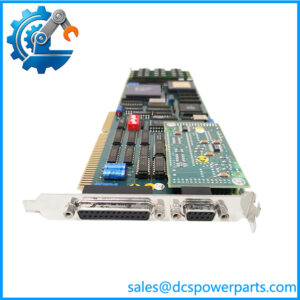
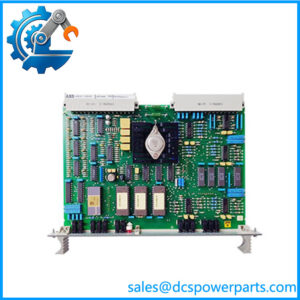
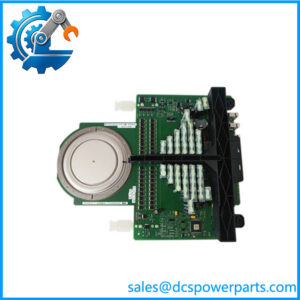
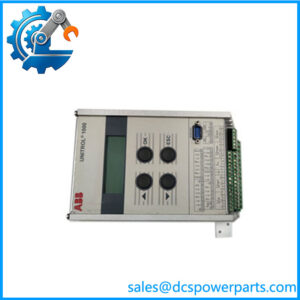
Description
Key Technical Specifications
| Parameter | Specification |
|---|---|
| Manufacturer | ABB |
| Model | DSTS106 |
| Order Number | 3BSE007287R1 |
| Product Type | Trigger pulse generator card |
| Additional Function | Backup regulator, as described in supplier references |
| Supply Rating | 24 VDC, reported in supplier references; verify against the applicable manual |
| Host System | Confirm the specific ABB control or power-conversion assembly |
| Trigger Output Details | Pulse count, timing, and electrical characteristics not independently verified |
| Communication Interface | Not verified; do not assume a standard fieldbus interface |
| Dimensions | Supplier listings report approximately 252 × 153 × 36 mm; confirm before planning installation |
| Weight | Supplier listings report approximately 0.3 kg; verify for the supplied unit |
| Operating Temperature | Not independently verified |
| Installation | According to the compatible host assembly’s hardware documentation |
| Condition | Must be confirmed for the actual unit supplied |
Specification note: The 24 VDC rating and physical measurements are reported by supplier references, not confirmed here from an ABB technical manual. Do not infer trigger timing, output isolation, pulse accuracy, or load limits from those figures.
Application Scenarios & Pain Points
In controlled power-conversion equipment, a trigger-pulse fault can prevent the power stage from responding as expected. Before replacing the DSTS106, distinguish a failed pulse-generator card from a supply fault, damaged trigger wiring, or a problem in the associated power electronics.
- Legacy ABB power-control maintenance: Evaluate the DSTS106 when the installed equipment documentation identifies 3BSE007287R1 as the required trigger-pulse card.
- Controlled rectifier systems: Trigger-pulse generation is relevant to power stages that rely on timed switching devices. Confirm that this particular card is specified for the installed converter.
- Industrial drive service: Consider replacement only after verifying the host drive or control assembly and the exact card designation.
- Critical-spares inventory: Record the complete order number and revision so that a superficially similar pulse card is not substituted during an outage.
Field note: Before removing the failed card, document its label, connector positions, and any diagnostic indications. After replacement, use the approved commissioning procedure to verify pulse operation and the response of the associated power stage. Do not test trigger outputs by improvising connections to energized power electronics.
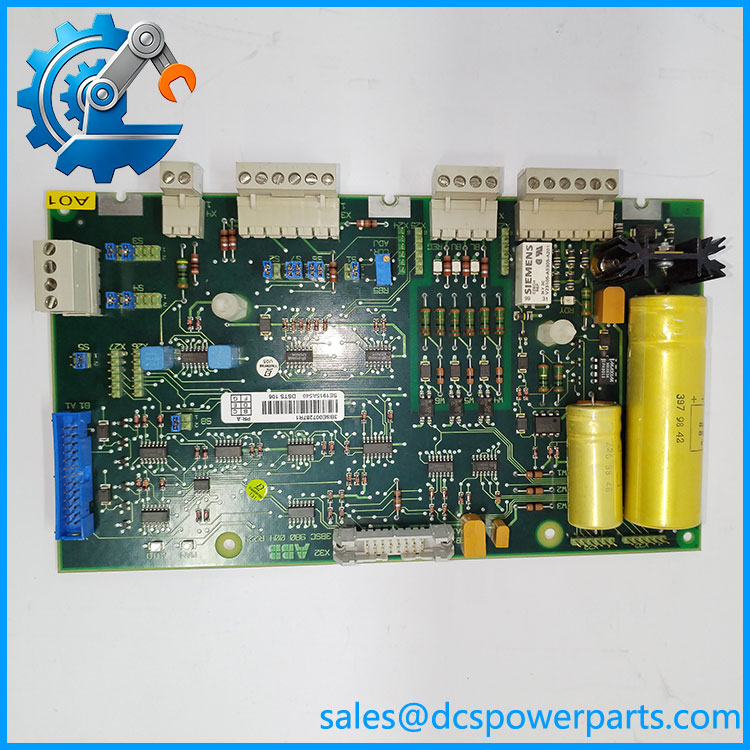
DSTS106
Related Products
The following ABB components may be relevant when maintaining legacy drive and power-control equipment. Their inclusion does not establish direct compatibility with the DSTS106; verify the installed system and parts list before selecting an alternative.
- ABB DSTS106 — 3BSE007287R1: The specified trigger pulse generator card. Use this complete order number when sourcing a like-for-like replacement.
- ABB DSTS104 — 3BSE007285R1: A related DSTS-series designation reported in supplier references for trigger-pulse amplification applications. Verify the actual function and hardware compatibility before considering it as an alternative.
- ABB SDCS-IOB-3 — 3BSE004086R1: An option board associated with ABB drive-control hardware. Its function differs from trigger-pulse generation.
- ABB NAMC-03 — 3BSE006065R1: An ABB control board associated with legacy drive equipment. It serves a different control function and is not a direct DSTS106 substitute.
- ABB CI626A — 3BSE005023R1: A bus-interface module used in applicable ABB Advant control architectures. It addresses system communication rather than trigger-pulse generation.
- ABB PM150 — 3BSE003641R1: A processor module for a compatible ABB control configuration. It performs processing functions rather than directly replacing a trigger-pulse card.
- ABB AO820 — 3BSE008546R1: An analog output module for compatible ABB control systems. It generates analog control signals, not the specialized trigger pulses associated with .
- ABB DSTA131: A terminal-unit designation reported in supplier cross-reference material. Confirm its exact function and system compatibility before considering it for an installation involving .
The Engineer’s Guide: Field Pitfalls to Avoid
Warning 1 — Assuming a related DSTS card is interchangeable
A shared model prefix does not prove that two cards have the same pulse timing, output circuitry, or connector assignments.
How to avoid it:
- Match the complete order number and hardware revision.
- Compare the original board label with the replacement documentation.
- Require documented compatibility before substituting another DSTS-series card.
Warning 2 — Incorrect supply or connector configuration
Supplier references report a 24 VDC supply rating, but the exact supply pins and permissible operating range must be established from the applicable hardware documentation.
How to avoid it:
- Verify the specified supply voltage and polarity.
- Check the connector pinout and cable arrangement.
- Inspect contacts for oxidation, contamination, or bent pins.
- Never energize an unverified replacement to see whether it fits the system.
Warning 3 — Returning the power stage to service without pulse verification
A board can power up without correctly driving its intended control circuit. A successful startup alone does not prove that trigger outputs are operating properly.
How to avoid it:
- Follow the approved commissioning and electrical-safety procedures.
- Check relevant diagnostic indications and trigger signals using the specified test method.
- Confirm the associated power stage responds correctly before restoring normal operation.
- Use ESD-safe handling and antistatic packaging during storage and replacement.
Frequently Asked Questions (FAQ)
1. What is the ABB 3BSE007287R1 used for?
It is identified as an ABB trigger pulse generator card. Supplier references also describe a backup regulator and a 24 VDC supply rating. The exact host equipment and trigger-output characteristics must be confirmed from the applicable hardware documentation.
2. Is the same as DSTS104?
No equivalence should be assumed. DSTS104 is a separate model designation, and available references describe it differently from . Compare the complete order numbers, electrical characteristics, and documented host-system compatibility before considering a substitution.
3. Does the operate on 24 VDC?
Supplier references list 24 VDC. Before connecting the card, confirm the required supply voltage, polarity, permissible range, and connector pinout against the applicable ABB documentation. The nominal voltage alone does not establish the complete power requirements.
4. Can I replace the while the equipment is running?
Do not assume live replacement is supported. Trigger-pulse circuitry may be associated with power electronics capable of hazardous voltages and currents.
Before replacement, follow the equipment-specific shutdown, isolation, and stored-energy discharge procedures. Only use a live-replacement procedure if the manufacturer explicitly permits it for the installed assembly.
5. How can I verify whether a is genuine and functional?
Request photographs of the actual board, its complete identification label, and its connectors. Ask for a written condition declaration and a test report showing the checks performed.
For a refurbished unit, establish whether testing covers the relevant trigger-pulse functions and backup regulation, rather than just visual inspection or power-up.
6. What warranty and lead time should I expect?
Both depend on the supplier, stock condition, and inspection requirements. Before ordering, obtain written confirmation of the exact part number, physical stock status, test status, warranty duration, and expected dispatch date.
For a planned outage, arrange incoming inspection and compatibility checks before the replacement is needed.
7. What information should I provide when requesting a replacement?
Provide the full part number 3BSE007287R1, photographs of the original nameplate, the host equipment model, and the installed hardware revision if available. Include any relevant fault codes or diagnostic observations.
That information helps distinguish a true like-for-like replacement from a related ABB board that may not perform the same trigger-pulse function.