Description
Key Technical Specifications
| Parameter | Specification |
|---|---|
| Product Model | DSQC355A |
| ABB Part Number | 3HNE00554-1 |
| Manufacturer | ABB Robotics |
| Product Type | Analog I/O Board |
| Analog Inputs | 4 |
| Analog Input Type | Voltage |
| Analog Input Range | -10 V to +10 V |
| Analog Input Resolution | 16 bit |
| Analog Outputs | 4 |
| AO 1–3 | -10 V to +10 V |
| AO 4 | 4–20 mA |
| Analog Output Resolution | 12 bit |
| Communication | DeviceNet |
| Supply Voltage | +24 VDC |
| Connectors | X3 power, X5 DeviceNet, X7 analog output, X8 analog input |
| Mounting | Internal control module or external I/O module |
| Compatible Platform | ABB robot controller / IRC5 |
ABB’s RobotWare documentation identifies DSQC355A specifically as an Analog ±10 V I/O unit. The board can normally be mounted inside the robot control module or, as an option, inside an external I/O module. ([turn0search6])
Product Introduction
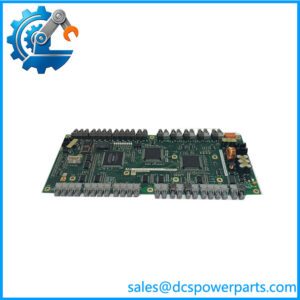
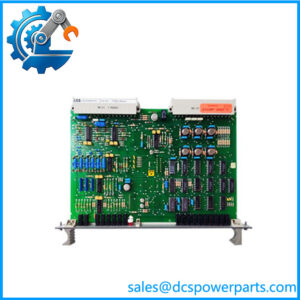
The ABB DSQC355A 3HNE00554-1 is an analog I/O board used to exchange continuous electrical signals between an ABB robot controller and external equipment. It provides four analog inputs and four analog outputs, with the voltage channels using a ±10 V range. The fourth analog output is configured for 4–20 mA operation, making the board useful for interfacing robot control with sensors, drives, process equipment, and external control systems. ([turn0search1])
The board communicates with the robot controller through DeviceNet and receives its supply through the dedicated 24 VDC connector. ABB documentation specifies 16-bit resolution for the four analog inputs and 12-bit resolution for the analog outputs. This distinction matters during troubleshooting because the DSQC355A is not simply a generic analog card; its I/O mapping, DeviceNet configuration, and ABB controller integration are part of the replacement decision. ([turn0search3])
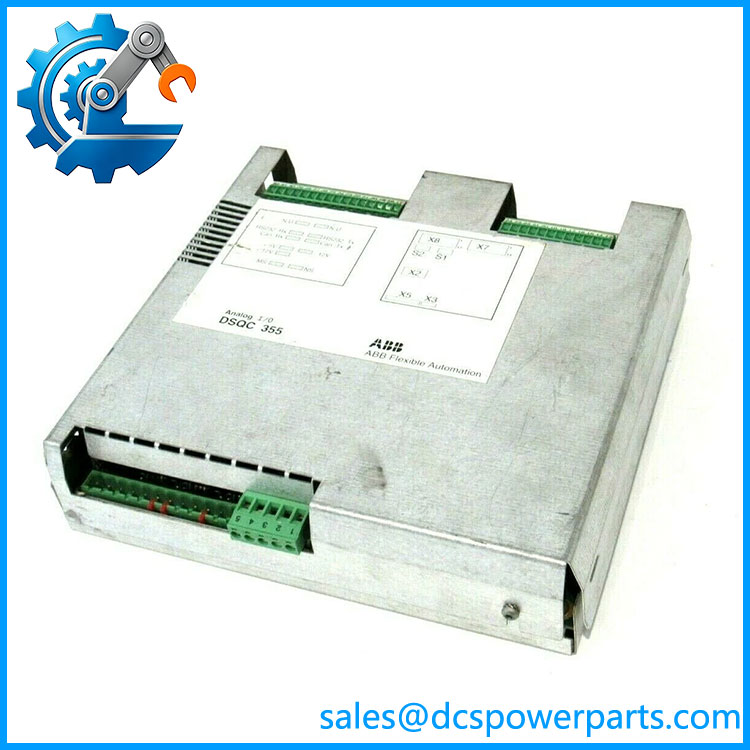
DSQC355A
Application Scenarios & Field Pitfalls
Engineering Pain Point
The main field issue with DSQC355A is signal scaling and controller configuration rather than the physical board itself. A sensor may provide a perfectly valid 0–10 V or ±10 V signal while the robot application expects a different engineering range. The physical signal, DeviceNet I/O mapping, and RobotWare configuration all need to agree.
ABB’s documentation also confirms that the DSQC355A requires a unit ID and setup parameters in the robot system. It supports polled and Change-of-State DeviceNet connections. ([turn0search1])
Typical Applications
- Robot analog sensor feedback — pressure, position, displacement, force, or other continuous measurements.
- External machine coordination — exchanging analog process values between an ABB robot and a PLC or machine controller.
- Drive and actuator interfaces — providing ±10 V command signals to compatible external equipment.
- Motion synchronization — ABB documentation specifically identifies as an example analog input board for analog synchronization applications. ([turn0search21])
Technical Pitfalls to Avoid
- Do not confuse with a digital I/O board. It is an analog unit with four AI and four AO channels. ([turn0search1])
- Check the output type carefully. AO1–AO3 are ±10 V, while AO4 is 4–20 mA. They are not interchangeable outputs. ([turn0search3])
- Respect the current-output load requirement. ABB documentation specifies a 500–1000 Ω load for the AO4 current-mode output. ([turn0search3])
- Verify DeviceNet configuration. The board requires a unit ID and appropriate setup parameters; replacing the hardware without checking the configuration can leave the board physically installed but unavailable to the robot application. ([turn0search1])
- Do not substitute DSQC355 or solely by appearance. Inventory sources associate both with 3HNE00554-1, but the installed board revision and controller documentation should still be checked before procurement. ([turn0search4])
Related Products
- DSQC355 — Earlier ABB analog I/O board in the same family; verify revision and exact part number before substitution.
- DSQC355B — Later revision reported in some inventories; do not assume firmware or pin-level compatibility without ABB documentation.
- DSQC651 — ABB standard digital/analog combination I/O platform used with IRC5 DeviceNet architecture; function differs substantially from .
- DSQC652 — ABB digital I/O unit for IRC5 systems; used for discrete signals rather than continuous analog signals.
- DSQC653 — Digital I/O unit with relay outputs; different electrical function from .
- DSQC350A — DeviceNet/Allen-Bradley remote I/O interface card; provides gateway functionality rather than local analog I/O.
- DSQC352A — PROFIBUS slave interface card; communications role rather than analog signal conditioning.
- DSQC368 — S4C master/slave PROFIBUS interface; relevant to older ABB robot communication architectures.
- 3HNE00554-1 — ABB spare-part identifier associated with and useful as an additional procurement reference. ([turn0search4])
Procurement Check
For , I would specify the replacement as , then verify the installed controller generation, DeviceNet configuration, board revision, and connector condition.
One important correction to watch for in online listings: some recent secondary pages incorrectly describe as a Serial Measurement Board (SMB) for robot encoders. That is not consistent with ABB’s RobotWare documentation, which explicitly identifies as an Analog I/O board with X7 analog outputs and X8 analog inputs. ([turn0search1])