Description
ABB A02020 Uras 26 Module
Product Introduction
The ABB A02020 Uras 26 refers to an ABB Advance Optima continuous gas-analysis configuration incorporating the Uras 26 infrared analyzer module. ABB identifies Uras 26 as one of the analyzer modules used in the AO2000 series, alongside Magnos 206 and other measurement technologies. The AO2020 is the 19-inch rack-mounted housing variant of the Advance Optima platform, while Uras 26 provides the infrared gas-measurement function within the analyzer.
The Uras 26 uses NDIR absorption spectroscopy to selectively measure infrared-active gas components. ABB documentation states that the module can measure concentrations of up to four gas components, depending on the selected configuration. Typical applications include measurement of CO, CO₂, NO, SO₂, and other gases for process monitoring and emissions measurement. The actual measurement range and combination of gases are configuration-specific and should be taken from the analyzer’s nameplate, device passport, or original order documentation rather than inferred from the generic Uras 26 designation.
The ABB A02020 Uras 26 is therefore better understood as a gas-analysis instrument configuration rather than a conventional PLC/DCS module. It can be integrated into larger plant monitoring systems through the AO2000 platform, with communication and analog-output capabilities depending on the installed electronics and ordered configuration. ABB certification documentation also identifies Uras 26 configurations for the AO2020/AO2040 housings and documents the analyzer-module software as part of the certified measurement system.
Technical Specifications
| Specification | Details |
|---|---|
| Manufacturer | ABB |
| System Model | AO2020 / A02020 |
| Analyzer Module | Uras 26 |
| Product Type | Continuous gas analyzer |
| Measurement Principle | NDIR absorption spectroscopy |
| Gas Components | Up to 4, configuration dependent |
| Typical Measured Gases | CO, CO₂, NO, SO₂ and other IR-active gases |
| Housing | 19-inch rack-mounted AO2020 configuration |
| Analyzer Family | Advance Optima AO2000 |
| Calibration | Zero/span calibration |
| Automatic Calibration | Available depending on configuration |
| Analog Outputs | Configuration dependent |
| Digital Communication | Configuration dependent |
| Measurement Range | Configuration dependent |
| Gas Cell | Uras 26 measurement cell |
| Light Source | Infrared source |
| Software | Uras 26 analyzer-module software |
| Installation | AO2020 analyzer housing / system-specific |
| Protection Rating | Depends on complete analyzer housing/configuration |
ABB’s certification material confirms the Uras 26 as an AO2000 analyzer module and identifies the S100 housing configuration as the Uras 26 module, with ST10 representing electronic module plus Uras 26 and S1P0 representing Uras 26 with an O₂ sensor.
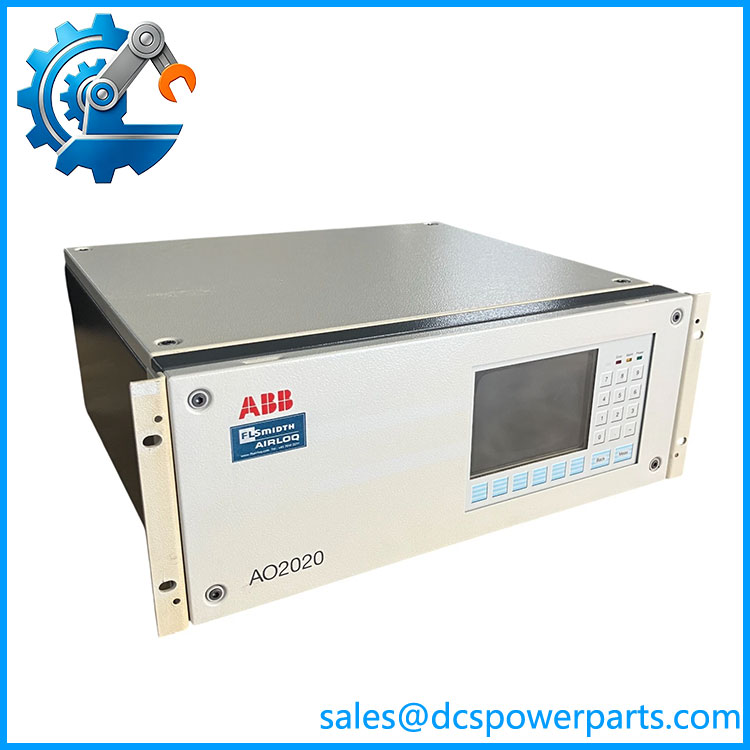
AO2020
Main Features and Engineering Considerations
NDIR gas measurement
The main function of the Uras 26 is selective infrared gas measurement. NDIR is well suited to continuous measurement of gases with appropriate infrared absorption characteristics. The optical measurement path is the core of the analyzer and requires proper zero/span calibration and optical alignment during maintenance.
Multi-component measurement
Uras 26 can be configured for measurement of up to four gas components. The exact combination is not determined solely by the words “Uras 26.” Different analyzers may have different detector configurations, optical filters, measurement ranges, and gas cells.
AO2020 system integration
The Uras 26 can be installed in the ABB Advance Optima platform. ABB documentation identifies the as a 19-inch housing configuration and separately identifies the Uras 26 analyzer module within that architecture.
Calibration and optical alignment
Calibration is a major maintenance consideration. ABB’s operator documentation states that phase alignment is performed after optical alignment when the emitter is replaced. If the emitter has not been replaced, zero and span calibration can be performed for the relevant sample components.
Configuration-specific measurement ranges
Do not publish a single “standard” measuring range for an unidentified Uras 26. Public examples show substantially different ranges depending on the gas and application. One installation, for example, uses Uras 26 for CO, CO₂, CH₄, and H₂ measurement with application-specific ranges.
O₂ integration
The AO2000 certification documentation identifies an S1P0 configuration consisting of a Uras 26 module with an O₂ sensor. This means that an analyzer described simply as “Uras 26” should not automatically be assumed to contain an oxygen measurement channel.
Software and analyzer electronics
The Uras 26 operates as part of the AO2000 analyzer architecture rather than as a standalone passive sensor. ABB certification documents identify analyzer-module software versions and the central Syscon electronics separately. This is important when troubleshooting an analyzer fault because the problem may originate in the optical module, analyzer electronics, calibration system, sample conditioning, or central controller.
Application Scenarios
- Continuous emissions monitoring
- Combustion-gas analysis
- Process gas monitoring
- Industrial furnace monitoring
- Boiler and combustion applications
- Chemical-process gas measurement
- Gasification and fuel-process monitoring
- Laboratory or pilot-process gas analysis
- continuous analyzer systems
- -based plant analyzer systems
Engineer’s Guide: Field Pitfalls
1. Do not treat A02020 as the Uras 26 module part number.
A02020/ identifies the analyzer platform/housing. Uras 26 is the measurement module.
2. Verify the actual gas configuration.
The same Uras 26 family can be configured for different gases and ranges.
3. Check the analyzer nameplate.
For replacement procurement, record the complete analyzer designation, gas components, measuring ranges, serial number, and module identification.
4. Do not replace an optical module based only on physical appearance.
The optical configuration, detector/filter arrangement, gas cell, and calibration characteristics must match the application.
5. Perform calibration after relevant maintenance.
Emitter replacement requires optical alignment followed by phase alignment according to the ABB maintenance procedure.
6. Check sample conditioning before blaming the analyzer.
Condensation, particulate contamination, incorrect sample temperature, leaks, and unsuitable sample flow can produce measurement errors that look like analyzer faults.
7. Verify whether an O₂ channel is actually installed.
Uras 26 can be configured with an additional O₂ sensor, but this is a specific configuration rather than a universal feature.
Frequently Asked Questions
What is ABB Uras 26?
It refers to an ABB Advance Optima continuous gas analyzer configuration incorporating the Uras 26 infrared analyzer module.
What measurement principle does Uras 26 use?
Uras 26 uses non-dispersive infrared absorption spectroscopy (NDIR).
How many gas components can Uras 26 measure?
The Uras 26 platform can measure up to four gas components, depending on configuration.
Which gases can it measure?
Depending on configuration, applications include CO, CO₂, NO, SO₂ and other suitable infrared-active gases.
Is Uras 26 a PLC or DCS I/O module?
No. It is an analytical measurement module used in ABB continuous gas analyzers.
Does every Uras 26 measure oxygen?
No. ABB identifies separate configurations in which Uras 26 is combined with an O₂ sensor.
Does identify the exact Uras 26 replacement part?
Not safely. identifies the analyzer platform/configuration. The exact Uras 26 replacement should be matched using the analyzer’s full type designation, gas configuration, serial number, and module identification.
Procurement Note
For procurement, I recommend specifying ABB / with Uras 26 together with the measured gases, measuring ranges, O₂ configuration if applicable, and complete nameplate information. Do not purchase solely against ” Uras 26 Module” if an exact module replacement is required. ABB’s documentation confirms multiple Uras 26 configurations, so the gas channel and optical configuration can materially affect interchangeability.