Description
ABB PVD164A2059 3BHE014340R2059 | AC 800PEC Excitation Processor Module | High-Speed Power Control
Key Technical Specifications
| Parameter | Specification |
|---|---|
| Manufacturer | ABB |
| Type Designation | PVD164A2059 |
| Article Number | 3BHE014340R2059 |
| Product Family | AC 800PEC |
| Product Type | High-performance processor / controller module |
| Primary Application | High-speed power-electronics control |
| Common Application | Generator excitation and power-converter control |
| Control Architecture | AC 800PEC multi-level control architecture |
| Fast Control Cycle | Down to approximately 100 μs at system level |
| Ultra-Fast Processing | FPGA-based tasks can operate at substantially shorter intervals |
| Fast I/O | Optical-fiber-based fast I/O architecture |
| Engineering Environment | IEC 61131-3-oriented control engineering; MATLAB/Simulink-supported development |
| Communication | Configuration-dependent; AC 800PEC supports optical and industrial communication interfaces |
| Mounting | AC 800PEC control-system hardware |
| Exact Power Requirement | Configuration dependent; verify system documentation |
| Operating Temperature | System/configuration dependent; do not infer from generic AC 800PEC listings |
ABB describes the AC 800PEC architecture as a high-performance controller intended for applications where conventional PLC scan times are insufficient. Its architecture separates ultra-fast FPGA tasks, fast controller tasks around the 100 μs range, and slower millisecond-level processing.
The exact electrical ratings, connector assignment, installed firmware, and application-specific I/O configuration for should be checked against the cabinet documentation and the installed hardware revision rather than copied from generic AC 800PEC system specifications.
Product Introduction
The ABB 3BHE014340R2059 is a high-performance processing module associated with the ABB AC 800PEC control platform. AC 800PEC was developed for power-electronics applications requiring deterministic processing, fast I/O, and control algorithms operating considerably faster than conventional process-control systems. Typical applications include high-power rectifiers, power converters, drives, and generator excitation systems.
The is particularly relevant in excitation-control environments where the controller must coordinate fast regulation with slower supervisory and plant-level functions. The AC 800PEC architecture supports optical-fiber communication for fast I/O and controller-to-controller links, while standard industrial communication options can be incorporated according to the particular system configuration.
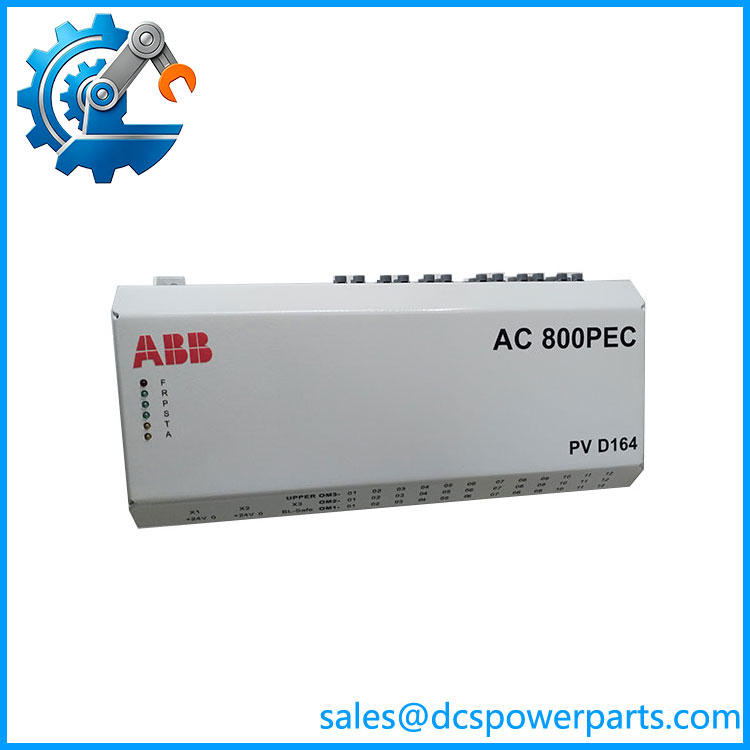
PVD164A2059
Application Scenarios & Field Pitfalls — The Engineer’s Perspective
Engineering Pain Point
Replacing an AC 800PEC processor is not equivalent to replacing a conventional PLC CPU. In an excitation or converter-control cabinet, the processor is part of a tightly coordinated hardware and software environment. Firmware, application code, FPGA configuration, fast-I/O topology, communication interfaces, and controller redundancy all have to agree.
Typical Applications
- Generator excitation systems: Fast voltage, excitation-current, and field-control algorithms for synchronous generators.
- High-power rectifiers: Deterministic control of rectifier firing and DC output regulation.
- Power converters: High-speed closed-loop control where conventional PLC scan times are inadequate.
- Rolling mills and industrial drives: AC 800PEC can support demanding control applications such as high-speed thickness and drive control. ABB documentation specifically describes AC 800PEC applications in industrial process control and rolling-mill thickness control.
Technical Pitfalls to Avoid
1. Do not confuse the processor with the complete excitation controller.
The belongs to the AC 800PEC control architecture. A UNITROL or converter system contains additional processor, I/O, communication, power-electronics, and interface hardware. Replacing one board does not automatically reproduce the complete system configuration.
2. Verify the application firmware and hardware revision.
A physically identical processor can still be unsuitable if its firmware generation or application configuration does not correspond with the installed AC 800PEC system. Back up application parameters and record the existing processor identification before replacement.
3. Check fast-I/O and optical connections.
AC 800PEC uses fast optical communication in its high-speed I/O architecture. The fiber topology is part of the control design, so connector mapping and communication configuration should be documented before removing the original processor.
4. Do not use generic AC 800PEC electrical ratings as the module’s ratings.
Some secondary listings attribute system-level values such as 100–240 VAC input or 0–20 A output directly to . Those are not adequately established as specifications of the processor board itself and should not be used for procurement or engineering calculations.
5. Confirm whether the application is excitation, rectifier, or another AC 800PEC configuration.
The same controller platform can be deployed across different high-speed power-control applications. Software configuration and connected I/O can therefore be application-specific.
Related Products
- ABB PPD539A102 — AC 800PEC-related control hardware used in high-performance power-control architectures.
- ABB PPD115A02 — Another AC 800PEC-family controller used in excitation-system applications; functional configuration must be checked before substitution.
- — The exact processor identification covered here; retain the complete hardware designation when procuring a spare.
- ABB AC 800PEC — High-performance programmable electronic controller platform for power electronics and fast industrial control.
- ABB UNITROL 6000 — Excitation-system platform commonly associated with AC 800PEC control technology.
- ABB UNS4684A-P,V.1 HIEE305114R0001 — UNITROL 6000 overvoltage-protection board; complementary excitation-system hardware, not a processor substitute.
- ABB PFEA tension-control systems — ABB high-performance control applications that use specialized controller architectures; not a direct replacement for AC 800PEC.
- ABB DCS800 — ABB drive/converter platform that can interface with AC 800PEC-based high-speed control architectures in appropriate applications.
Procurement Note
For , the complete identification should be recorded exactly as marked on the hardware. Before installation, compare the designation, 3BHE014340R2059 article number, hardware revision, firmware/application version, optical I/O topology, and cabinet configuration with the existing unit.
For an excitation or high-power converter system, this is a controlled replacement rather than a generic plug-in PLC swap. The safest practice is to preserve the original configuration and verify controller communication and fast-I/O operation before returning the equipment to service.