Description
Technical Specifications
| Parameter | Specification |
|---|---|
| Model family | µR1800 (UR1800) |
| Manufacturer | Yokogawa |
| Product category | Industrial chart recorder |
| Recording format | Pen or dot-printing type, depending on model |
| Input types | DC voltage, thermocouple, RTD, and contact input, depending on configuration |
| Channel count | Model-dependent |
| Communication option | RS-422-A available on models fitted with /C3 |
| Mathematical functions | Available with the /M1 option |
| IC memory card | Available with the /E1 option |
| Panel front protection | IP54 door on the µR series design |
| Dimensions | Approx. 288 × 288 × 220 mm for the µR1800 form factor |
| Power consumption | Approximately 55 VA, depending on model |
| Product status | Discontinued January 1, 2006 |
Specifications vary by recorder model and installed options. Confirm the full model number and nameplate before selecting a replacement or spare part.
Product Overview
The Yokogawa µR1800 is designed to record industrial process measurements on chart paper for operational review, troubleshooting, and quality documentation. Depending on the exact model, it uses pen recording or dot printing and supports multiple measurement channels. Its input flexibility allows compatible configurations to accept signals from instruments such as thermocouples, resistance temperature detectors, and DC voltage sources.
For plant operators, a chart recorder provides a time-based record that can be reviewed after a process deviation, equipment trip, or production run. The recorded trace can help identify changes in temperature, pressure-related signals, or other measured variables when the recorder is configured for the relevant input. Actual supported measurements depend on the installed model and its configured inputs.
The µR1800 was offered in several model variants, including models with different recording channel counts and optional communication or mathematical functions. The /C3 option provides RS-422-A communication, while /M1 adds mathematical functions and /E1 identifies the IC memory-card option. These options should be confirmed from the original nameplate rather than inferred from the µR1800 family designation.
Because the series is discontinued, replacement planning should account for the exact recorder format, channel count, input configuration, chart dimensions, terminal arrangement, and optional interfaces. A newer recorder may share mounting dimensions but still require changes to communication commands, configuration, or integration software.
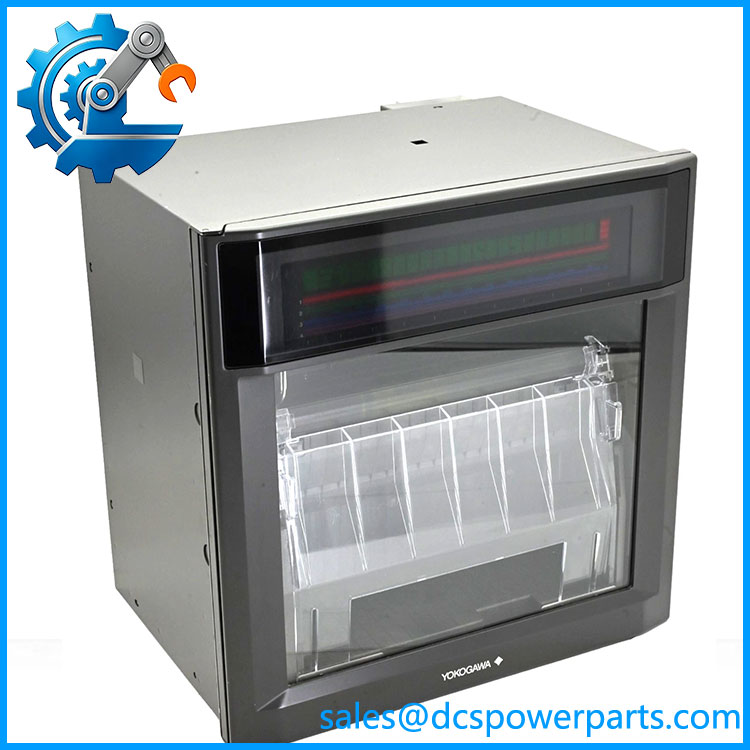
UR1800
Major Features and Advantages
1. Permanent process records
The µR1800 produces a physical chart record that can be reviewed without a computer. This is useful for maintenance investigations, process review, and applications that require a paper-based operating history.
2. Multiple recording configurations
The family includes pen and dot-printing models. The correct recording mechanism and channel count must be identified from the complete model code, as these determine the recorder’s physical operation and consumable requirements.
3. Flexible measurement inputs
Supported configurations can accept DC voltage, thermocouple, RTD, and contact inputs. Input type and range must be configured according to the specific instrument and process signal; do not assume every input type is available on every model without configuration checks.
4. Optional communication and calculation functions
Selected versions support RS-422-A communications or mathematical functions. These options can be useful for data acquisition and calculated process values, but they must be verified against the recorder’s installed option codes and the host system’s interface requirements.
5. Legacy equipment support
The µ remains relevant to facilities maintaining older panels and established measurement systems. Correctly identifying the recorder can help avoid unnecessary changes to panel cutouts and field wiring during maintenance. However, discontinued status means that the availability of complete recorders and model-specific replacement parts should be confirmed before a shutdown.
Applications
The Yokogawa µ is used in industrial monitoring applications where measured values must be displayed and recorded over time. Depending on the installed input configuration, it can record temperature, electrical process signals, and other instrument measurements in industries such as power generation, water and wastewater treatment, chemical processing, and general manufacturing.
In process monitoring, recorded charts can help engineers compare the behavior of several measured variables over a production cycle. They can also provide a historical trace for investigating intermittent disturbances that may not be apparent during a later inspection. The usefulness of these records depends on correct input scaling, chart speed, channel configuration, and maintenance of the recording mechanism.
For existing installations, the recorder may be retained where the panel, wiring, operating procedures, and paper-record requirements remain suitable. Before replacement, verify the number of channels, input types, recording method, alarm or contact requirements, and any serial communication functions.
Where a digital replacement is considered, review data retention, export requirements, communication protocols, and the need for paper records. Yokogawa notes that µR10000 and µR20000 models succeeded the discontinued µR1000 and µ families, but communication commands may differ between generations.
Related Products
| Model or product | Relationship |
|---|---|
| µR10000 | Successor family for the smaller-format µR1000 recorder range |
| µR20000 | Successor family for the µ’s larger-format recorder range |
| µRS1800 | Related recorder family with its own model and configuration requirements |
| DAQLOGGER | PC-based data logging software referenced in Yokogawa recorder resources |
| Chart paper | Consumable matched to the recorder and chart format |
| Recording pens | Consumables for pen-type configurations |
| Ribbon cassette | Consumable for applicable dot-printing configurations |
Check exact model compatibility and consumable part numbers before ordering.
Installation and Maintenance
Before installing or replacing a µ, verify the full model number and option codes on the nameplate. Confirm the panel dimensions, terminal layout, input configuration, recording method, channel count, supply requirements, and any communication option. Isolate power and follow the facility’s electrical safety procedures before opening the panel or working on terminals.
Inspect the chart drive, recording mechanism, display, keys, terminals, and housing for damage or wear. Check that the correct chart paper, pens, or ribbon cassette is fitted for the particular recording type. Confirm the input configuration and scaling with a known signal before relying on the chart for process decisions.
If the recorder uses RS-422-A communication, test the interface against the actual host-system configuration. When upgrading to a newer recorder, do not assume the older communication commands will remain compatible. Preserve existing configuration records and verify data acquisition and channel assignments during commissioning.
Document the installed model, option codes, consumables, calibration checks, and maintenance history. Since the µ is discontinued, plan for spare availability and evaluate replacement requirements before a recorder failure affects required process documentation.
Product Assurance
For procurement of the Yokogawa µ, confirm the exact model variant, recording method, channel count, option codes, and supplied condition. Request photographs of the nameplate, front panel, terminals, and recording mechanism. For used or refurbished stock, ask what inspection and functional testing have been completed.
A useful acceptance check should include power-up behavior, input response, chart movement, recording quality, and communication operation where applicable. Confirm that the supplied unit matches the required input configuration and that the correct consumables can be obtained.
Before purchase, establish warranty terms, return conditions, lead time, and whether accessories or consumables are included. Because the product has been discontinued since 2006, availability and serviceability should be confirmed for the specific model rather than assumed from the series name alone.