Description
Product Overview
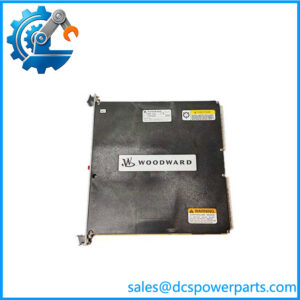
5466-1035 is the processor at the centre of a MicroNet Plus chassis: the card that executes the application, holds the tuning constants, owns the time base, and talks to the I/O modules, the operator station and — in redundant arrangements — to its partner CPU. Woodward’s own documentation identifies it precisely: MicroNet CPU, PowerPC-5200 at 400 MHz, 64 MB of flash, 128 MB of RAM, dual CAN. It sits in slot 8 or slot 14 of the chassis and is built for the machine types that made MicroNet a standard in prime-mover control: gas turbines, steam turbines, compressor trains and generator sets, including the Vertex-Pro compressor control package.
The part’s real significance today is not its clock speed. It is the fact that 5466-1035 is the original, non-hardened CPU of the platform. Woodward’s cybersecurity manual 26479 states plainly that this CPU does not meet the requirement for secure passwords, and its application note 51459 describes the original MicroNet Plus as a control where protocol sniffing is possible, passwords are static and in clear text, and many ports stand open. The cyber-secure successors — 5466-1145, 5466-1245 and the P1020-based 5466-1511 / 5466-1521 — exist precisely because of that gap, and 5466-1035 is the unit they replace.
That framing decides how the part should be bought and used. As a drop-in replacement in an existing, physically protected, network-isolated MicroNet Plus installation, it does exactly what the cabinet’s drawings expect: same slot, same connectors, same application, same coder. As an addition to a new build, or to a control reachable from a plant network, it is the wrong answer — not because it fails, but because it was designed before the requirement existed.
Technical Specifications
表格
| Parameter | Value |
|---|---|
| Model | 5466-1035 |
| Manufacturer | Woodward, Fort Collins, Colorado, USA |
| Product type | CPU / controller module, MicroNet Plus platform |
| Processor | PowerPC MPC5200, 400 MHz |
| Program memory | 64 MB Flash |
| Working memory | 128 MB RAM |
| Chassis position | Slot 8 or slot 14 of a MicroNet Plus / Simplex chassis |
| Redundancy | Simplex or redundant CPU pair |
| CAN interfaces | 2 CAN ports (dual CAN), chassis and Vertex-Pro communications |
| Ethernet | 2 × 10/100 Base-T ports, configurable, one usable as Real-Time Network (RTN) port |
| Serial | 1 isolated, configurable RS-232 / 422 / 485 port, 300 to 57.6 kbaud |
| Service port | Front-panel service / debug port for AppManager access |
| Operating system | VxWorks 6.8 real-time OS |
| Timekeeping | Battery-backed real-time clock, roughly 3 months retention after full charge |
| Conformal coating | Silicone through revision G; sulfur-resistant polyacrylate from revision H |
| Security posture | No secure passwords, no SSH, no embedded firewall — superseded by 5466-1145 / -1245 / -1511 / -1521 |
| Certification | CSA Class I Division 2 (per Woodward system documentation) |
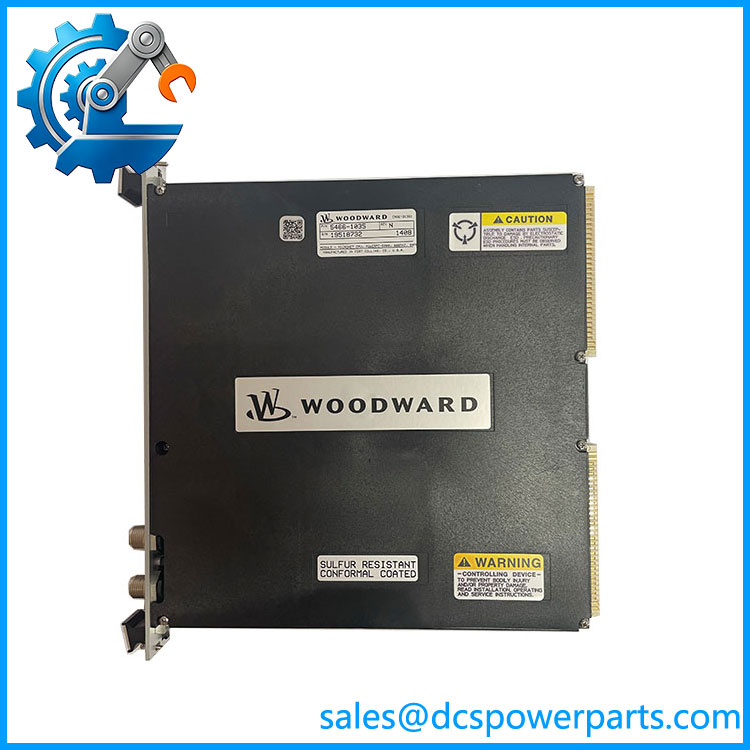
WOODWARD-5466-1035
Key Features and Advantages
Deterministic control where the machine cannot wait
The MPC5200 at 400 MHz with VxWorks is not a fast processor by modern standards, and that is the point: the application was engineered around a fixed scan and a known execution budget, so valve positioning, speed ramping and trip logic behave the same way on every unit that carries the same coder version. A 5466-1035 swapped into a running cabinet therefore reproduces the timing the plant was commissioned against, which is exactly what a turbine or compressor train needs after a failure.
Redundancy that is a chassis decision, not a card feature
The module supports simplex and redundant configurations, and in a redundant pair the transfer logic runs at the platform level: the standby CPU tracks the active one and takes over on fault. 5466-1035 is the unit that makes that arrangement possible, and the practical benefit is that a processor fault becomes a bumpless transfer rather than a trip — provided the pair is genuinely matched in revision and application.
Front panel built for field diagnosis
Two CAN ports with their own status LEDs, two Ethernet ports, an isolated serial port configurable from 300 baud to 57.6 kbaud and a dedicated service port give a technician more than a single fault lamp. On a 5466-1035, a communications problem can be separated from an application problem at the chassis, before anyone connects a laptop or assumes the card is dead.
Revision letter is a specification, not a footnote
Woodward’s own application note records that this CPU moved from silicone to polyacrylate conformal coating at revision H — a unit produced at revision G cannot be re-coated later, and a plant that needs sulfur-resistant protection must buy revision H or newer. On a 5466-1035, that single letter distinguishes a spare that will survive a corrosive plant atmosphere from one that will not, and it is invisible in most marketplace listings.
Applications
Gas turbine packages use 5466-1035 as the main processor for start-up sequencing, fuel valve control, speed and exhaust temperature limiting, and the protection logic that decides when to trip; the module’s determinism is what keeps those functions predictable across a fleet of identical units.
Steam turbine controls apply it in the same chassis family for governor and overspeed protection duties, where the processor’s isolation from the plant network is often deliberate and physically enforced rather than accidental.
Centrifugal and reciprocating compressor trains — including packages built around the Vertex-Pro control — rely on the CPU for anti-surge control, load sharing and recycle valve positioning, functions in which a processor that stumbles for a scan can cost a machine a surge event.
Generator-set and marine power installations use the module where Lloyd’s-type environmental qualification and Class I Division 2 area classification are part of the specification, and where the control cabinet is a closed, locally maintained system.
Legacy installations now facing a cyber-hardening or NERC/CIP-driven review treat 5466-1035 as the component to be replaced rather than defended: it is the documented starting point of Woodward’s upgrade path, and identifying how many of them remain in service is usually the first step of that project.
Related Products
5466-1037 — CPU5200L, the reduced-memory sibling of the same processor design. 5466-1045 — cyber-ready CPU5200 that supports coder 6.0 but ships without the security licence. 5466-1145 — cyber-secure CPU5200 with the licence included; the direct hardened replacement for 5466-1035. 5466-1245 — enhanced-performance-footprint cyber-secure CPU5200, the same upgrade family with additional capability. 5466-1511 / 5466-1521 — P1020-based MicroNet Plus CPUs, the current preferred processors where secure passwords, Achilles certification and SSH are required. 5466-1047 — MicroNet TMR CPU5200, the triplicated-architecture counterpart for TMR chassis. 5466-1036 — Real-Time Network transceiver used to link remote expansion racks to the CPU. 5466-1000 / 5466-1001 / 5466-1002 — two-slot MicroNet Plus power supplies (24 VDC, 110 VAC/125 VDC, 220/250 VAC input) that feed the chassis the CPU sits in. 5466-1115 — high-density speed/analog combo I/O module, the current preferred front end for the same chassis. 5466-411 — MicroNet Ethernet (RJ45) module, for installations where the CPU’s own ports are insufficient.
Installation and Maintenance
Before installation: confirm the target slot — 8 or 14 — and confirm whether the chassis is simplex or redundant, because the second CPU’s presence changes both the application and the transfer logic. Read the existing module’s revision letter and coating type before ordering a spare; a revision H or later 5466-1035 carries the sulfur-resistant polyacrylate coating while earlier units do not. Back up the running application and the tuning constants through AppManager, record the coder version, and verify the replacement matches the chassis bill of material rather than merely the item number.
Maintenance practice: the CPU is not a hot-swap card in the sense a power module is, so plan the replacement inside a controlled shutdown or a genuine redundant transfer, and re-verify the application download and the I/O scan after power-up rather than assuming the copy took. Check the battery-backed clock at each outage — the module holds time for roughly three months without power, and a control that logs with the wrong timestamp makes every later event reconstruction unreliable. Keep cabinet air filtered and dry: the coating protects the board, not the connectors, and corrosive-gas attack at the front-panel terminations is the failure mode the coating was introduced to reduce.
Plan the security question deliberately. If the unit sits on an isolated control network inside a locked cabinet, 5466-1035 remains serviceable; if the same chassis is being connected to a plant historian, an OPC client or a remote support path, the correct action is the documented upgrade to a cyber-secure CPU in the same slot rather than a network workaround around an insecure processor.
Warranty and Quality
5466-1035 is supplied as a genuine Woodward MicroNet CPU5200, identified against Woodward’s own item description rather than a reseller’s guess, with the revision letter and conformal coating type confirmed before dispatch so the unit matches the plant’s environmental and compatibility requirements. Every module is verified for application download, redundant transfer behaviour, CAN and Ethernet communications, serial port configuration and real-time clock retention before shipment. Units carry a 12-month repair, replacement or refund commitment, with exchange support for the rarer early revisions. Technical support covers slot and chassis matching, coder and application compatibility, the cyber-secure upgrade path across 5466-1045 / -1145 / -1245 / -1511 / -1521, and the practical question most plants actually ask: whether to keep a legacy CPU in service or replace it as part of a hardening programme.
免费
今天 11:42